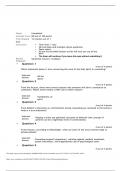
HSCO 506 Exam 3 Liberty University Complete Solution..Attempt Score: 100 Out of 100
• Question 1 4 out of 4 points Which statement below is true concerning the work of the Holy Spirit in counseling? Selected Answer: • Question 2 All the above 4 out of 4 points From the lecture, there were several reasons why someone will have a resistance to confession. Which answer below is NOT one of those reasons? Selected Answer: • Question 3 Humbleness of spirit 4 out of 4 points From McMinn’s discussion on confrontation during counseling (as reviewed in the lecture) what is a true statement? Selected Answer: Helping a client see potential outcomes to behavior (the concept of acherit) can be a legitimate form of confrontation. • Question 4 4 out of 4 points In the lecture, according to Ohlschlager, what are some of the most common legal or ethical pitfalls? Selected Answer: Counseling beyond competency, advising against medical treatment, sexual misconduct, and inappropriate use of psychological tests. • Question 5 4 out of 4 points Which statement is NOT true regarding ethical standards for counseling practice? Selected Answer: • Question 6 Ethical guidelines provide the counselor with a step-by-step method of counseling. 4 out of 4 points Which answer below is NOT one of the ethical concerns given regarding confrontation? Selected Answer: • Question 7 Internal pain 4 out of 4 points The lectures reviewed Nouwen’s concept of “hospitality” in counseling. What is true from that discussion? Selected Answer: • Question 8 Simply welcoming a counselee in need can have positive therapeutic effects. 4 out of 4 points As we consider “sin” as a factor in human problems and behavior, the perspective from psychology is that psychopathology, rather than a sin nature, is the cause of emotional problems. Selected Answer: • Question 9 Tru e 4 out of 4 points McMinn emphasizes that the counselor’s motivation needs to be examined as the counselor confronts the client. What is a true statement based on that discussion? Selected Answer: All of these are true. • Question 10 4 out of 4 points Based on McMinn’s counseling “map,” the lecture posed a series of questions to help a client identify where the client was in terms of self/need/relationship. What is a true statement from that discussion? Selected Answer: If clients hope that the counselor is the ultimate solution to their problems, this reveals what they believe about “need.” • Question 11 4 out of 4 points The lectures talked about attributional styles. What is true from that discussion? Selected Answer: We actually experience the most freedom when we take responsibility for our choices and behavior. • Question 12 4 out of 4 points The lectures talked about some important points with regard to confidentiality. What is a true statement from that discussion? Selected Answer: All of these points were discussed in the lecture. • Question 13 4 out of 4 points From the perspective of secular psychology, the concept of “sin” can best be described as Selected Answer: None of the above. • Question 14 4 out of 4 points When putting together your informed consent document for a client, what item should you include as part of that document? Selected Answer: All the above • Question 15 4 out of 4 points It is important that counselors help clients overcome resistance to legitimate confession. Which of the following statements does NOT fit with the lecture emphasis in that discussion? Selected Answer: A hesitancy to confess is rarely rooted in a wrong concept of God. • Question 16 4 out of 4 points The lectures distinguished the effects of “original sin” and “personal sins.” What is true from that discussion? Selected Answer: The concept of original sin would suggest that we are all prone to distort the wholesome elements of God’s creation. • Question 17 4 out of 4 points The lecture explained how psychology would explain the “concept of sin.” What is a true statement from that discussion? Selected Answer: In psychology, the real problem is how one interprets or feels about a behavior, not the behavior itself. • Question 18 4 out of 4 points McMinn (as reviewed in the lectures) describes several ways to confront sin in the life of a counselee. What factors should a counselor take into account before choosing one of the confrontation techniques? Selected Answer: Whether a trust relationship has been established between the counselor and client • Question 19 4 out of 4 points From the lecture, in questioning yourself regarding ethical decision-making, which answer is NOT used? Selected Answer: When do we discuss fees? • Question 20 4 out of 4 points When a Christian counselor looks at the role of sin in client problems, what is a true statement? Selected Answer: All of these. • Question 21 4 out of 4 points Which answer below describes what should be on the professional disclosure statement to the client? Selected Answer: All the above • Question 22 4 out of 4 points The lectures talked about counseling ethics guiding how we directly confront clients about their behavior. From that lecture, what is a true statement? Selected Answer: Counseling ethics would direct that a counselor “do no harm” even when confronting wrong behavior, that the counselor is aware of his/her attitudes, and that the counselor is aware of the power dynamics at play with redemption being the goal of confrontation. • Question 23 2 out of 2 points It is rarely helpful in counseling to confront a client about the client’s attribution style. Selected Answer: Fals e • Question 24 2 out of 2 points Christian counseling would conclude that change can happen without confronting sin. Selected Answer: Fals e • Question 25 2 out of 2 points A client with an internal attribution style would want to just feel better about themselves as a result of counseling. Selected Answer: Fals e • Question 26 2 out of 2 points Whether a client has a sense of conscience will be a clue to the client’s attributional style. Selected Answer: Tru e • Question 27 2 out of 2 points As we consider "sin" as a factor in human problems and behavior, the concept of external attribution would place the blame for human choices on the individual person. Selected Answer: Fals e With regard to the concept of “sin” in Christian counseling, it is appropriate to focus on helping a client to primarily reduce their guilt and inner turmoil about their bad behavior? Selected Answer: Fals e
Información del documento
- Subido en
- 19 de julio de 2023
- Número de páginas
- 9
- Escrito en
- 2022/2023
- Tipo
- Examen
- Contiene
- Preguntas y respuestas