
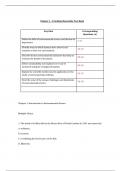
Chapter 1 – Friedland Essentials Test Bank
Key Idea Corresponding
Questions (#)
Define the field of environmental science and discuss its
1–11
importance.
Identify ways in which humans have altered and
12–33
continue to alter our environment.
Describe the key environmental indicators that help us
34–44
evaluate the health of the planet.
Define sustainability and explain how it can be
45–52
measured using the ecological footprint.
Explain the scientific method and its application to the
53–73
study of environmental problems.
Describe some of the unique challenges and limitations
74–78
of environmental science.
Chapter 1: Introduction to Environmental Science
Multiple Choice
1. The death of a billion fish in the Neuse River of North Carolina in 1991 was caused by
A. sediment.
B. bacteria.
C. overfishing the food source of the fish.
D. Pfiesteria.
,E. acid rain.
ANS: D
DIF: E
MSC: Fact based
Key Idea: Define the field of environmental science and discuss its importance.
2. Pfiesteria is a
A. microscopic free living organism.
B. macroscopic algae.
C. fungus.
D. fish.
E. nutrient.
ANS: A
DIF: E
MSC: Definitional
Key Idea: Define the field of environmental science and discuss its importance.
3. Pfiesteria has many life stages, including a
I. carnivorous stage.
II. free-floating amoeba stage.
III. stage that allows development of a protective casing.
A. I only
B. II only
C. III only
D. I and III
E. I, II, and III
,ANS: E
DIF: E
MSC: Fact based
Key Idea: Define the field of environmental science and discuss its importance.
4. The factor that enabled Pfiesteria to enter the life stage that caused fish kills in the Neuse
River of North Carolina is that
A. all Pfiesteria are dangerous to aquatic life forms.
B. the development of a protective coat prevented the work of pesticides.
C. overfishing caused a decrease in predators.
D. nutrients were added to the water.
E. drought made conditions appropriate.
ANS: D
DIF: M
MSC: Fact based
Key Idea: Define the field of environmental science and discuss its importance.
5. The effect of a Pfiesteria outbreak on humans is a(n)
A. decrease in tourism.
B. economic loss from decreased seafood sales.
C. decrease in recreational fishing.
D. increase of skin sores and nausea.
E. All of the above
ANS: E
DIF: M
MSC: Fact based
Key Idea: Define the field of environmental science and discuss its importance.
, 6. When we discuss “our environment,” we are referring to
A. all conditions in the world.
B. only interactions that affect human life.
C. only conditions that cause negative effects on our health.
D. primarily interactions that harm the atmosphere.
E. the sum of all the conditions surrounding us that influence life.
ANS: E
DIF: M
MSC: Concept based
Key Idea: Define the field of environmental science and discuss its importance.
7. The study of environmental science is concerned with
A. the interactions among human systems and those found in nature.
B. biotic and abiotic interactions with human systems.
C. only abiotic factors.
D. only biotic factors.
E. Both A and B
ANS: E
DIF: M
MSC: Concept based
Key Idea: Define the field of environmental science and discuss its importance.
8. The Neuse River is considered a system because it involves
A. components that influence each other irreversibly.
B. specifically interacting biotic components that influence each other.
Key Idea Corresponding
Questions (#)
Define the field of environmental science and discuss its
1–11
importance.
Identify ways in which humans have altered and
12–33
continue to alter our environment.
Describe the key environmental indicators that help us
34–44
evaluate the health of the planet.
Define sustainability and explain how it can be
45–52
measured using the ecological footprint.
Explain the scientific method and its application to the
53–73
study of environmental problems.
Describe some of the unique challenges and limitations
74–78
of environmental science.
Chapter 1: Introduction to Environmental Science
Multiple Choice
1. The death of a billion fish in the Neuse River of North Carolina in 1991 was caused by
A. sediment.
B. bacteria.
C. overfishing the food source of the fish.
D. Pfiesteria.
,E. acid rain.
ANS: D
DIF: E
MSC: Fact based
Key Idea: Define the field of environmental science and discuss its importance.
2. Pfiesteria is a
A. microscopic free living organism.
B. macroscopic algae.
C. fungus.
D. fish.
E. nutrient.
ANS: A
DIF: E
MSC: Definitional
Key Idea: Define the field of environmental science and discuss its importance.
3. Pfiesteria has many life stages, including a
I. carnivorous stage.
II. free-floating amoeba stage.
III. stage that allows development of a protective casing.
A. I only
B. II only
C. III only
D. I and III
E. I, II, and III
,ANS: E
DIF: E
MSC: Fact based
Key Idea: Define the field of environmental science and discuss its importance.
4. The factor that enabled Pfiesteria to enter the life stage that caused fish kills in the Neuse
River of North Carolina is that
A. all Pfiesteria are dangerous to aquatic life forms.
B. the development of a protective coat prevented the work of pesticides.
C. overfishing caused a decrease in predators.
D. nutrients were added to the water.
E. drought made conditions appropriate.
ANS: D
DIF: M
MSC: Fact based
Key Idea: Define the field of environmental science and discuss its importance.
5. The effect of a Pfiesteria outbreak on humans is a(n)
A. decrease in tourism.
B. economic loss from decreased seafood sales.
C. decrease in recreational fishing.
D. increase of skin sores and nausea.
E. All of the above
ANS: E
DIF: M
MSC: Fact based
Key Idea: Define the field of environmental science and discuss its importance.
, 6. When we discuss “our environment,” we are referring to
A. all conditions in the world.
B. only interactions that affect human life.
C. only conditions that cause negative effects on our health.
D. primarily interactions that harm the atmosphere.
E. the sum of all the conditions surrounding us that influence life.
ANS: E
DIF: M
MSC: Concept based
Key Idea: Define the field of environmental science and discuss its importance.
7. The study of environmental science is concerned with
A. the interactions among human systems and those found in nature.
B. biotic and abiotic interactions with human systems.
C. only abiotic factors.
D. only biotic factors.
E. Both A and B
ANS: E
DIF: M
MSC: Concept based
Key Idea: Define the field of environmental science and discuss its importance.
8. The Neuse River is considered a system because it involves
A. components that influence each other irreversibly.
B. specifically interacting biotic components that influence each other.

