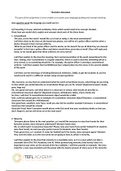
9.8.3 Assignment 03
This assignment is compulsory and will contribute 40% towards your year mark.
NO EXTENSION will be granted! DO NOT copy the textbook! You MUST write in
your own words. Submit your assignment online.
ASSIGNMENT 03
QUESTION 1
The way we interpret the world around us is determined partly by our beliefs, values and
norms, but mostly by contextual influences. The educator’s interpretation and
implementation of a curriculum is also influenced by the context. Choices regarding
planning and designing a learning programme, the inclusion of particular instructional
strategies and the practical application are embedded in knowledge and the
understanding of the educational situation. Influences ranging from the political, social
and economic culture to the norms and knowledge structures of educators affect teaching
and learning.
Taking the above into consideration, critically discuss the following:
1.1 A socio-constructivist’s view (Vygotsky) of the impact of context on curriculum
implementation (7 marks). Do you agree with his view (1 mark)? Justify your answer (2
marks). (Page 26) (10)
Lev Vygotsky argued for a constructionist perspective in education, through formal and
informal education, adults convey to children the way their culture interprets and respond
to the world. Example a child grasps the concepts, its African culture that you need to pay
lobola before you get married, the child adopts that culture from parents and will apply it
when they grow old.
Social interaction plays a fundamental role in the process of cognitive development. He
explains that mental process begins as a social activity. A lifelong process of development
is dependent on social interactions and the social learning actually leads to cognitive
development. Teachers and learners need to play a non-traditional role as they
collaborate with each other since they are both influenced by the contexts in which they
live, teach and learn. The teacher should collaborate with his or her learners to facilitate
the meaning of construction in learners. Learning therefore becomes a reciprocal
, experience for the learner and the teacher. Social interactions that learners engage in
help them to discover and create meaning from things that they discover.
Example a child tries to observe the behavior of the tutor, follow the instruction from the
tutor. The child will the emulate what they have observe, try to understand what they have
observed and instruction they have received by copying and internalizing while learning
to apply them to their own lives. This is called collaborative or cooperative dialogue.
A classroom becomes a community of learning, the instrumental design of material to be
learned should be structured to promote and encourage collaboration and interaction.
Physical classroom should provide clustered desk, tabled and space for peer interaction.
The assumption is that play allow to stretch themselves cognitively. The educator needs
to provide children with, especially young children, many opportunities of play. Through
play a child’s conceptual abilities are stretched. He argued that play leads to
development, while a child imitate in cultural patterned activities, children generate
opportunities for intellectual development.
The next assumption is that challenging task promotes maximum growth; Vygotsky
asserts that cognitive change occurs within the zone of proximal development, instruction
should be designed to reach a developmental level that is just above the student’s current
developmental level. The zone of proximal development is the range of abilities that an
individual can only perform with assistance, but cannot perform independently. These
skills are called proximal because the individual is close to mastering them, but need
more guidance and practice in order to perform these actions independently.
Example of zone proximal development is teaching a learner something that they cannot
do independently, but would be able to do with assistance of someone else, e.g. a learner
may be able to speak their home language, but cannot speak English languages. With
assistance from the educator who begins teaching the learner English words, how to
construct sentences and repeating the words the learner will begin to speak English
independently without the help form the teacher.
This assignment is compulsory and will contribute 40% towards your year mark.
NO EXTENSION will be granted! DO NOT copy the textbook! You MUST write in
your own words. Submit your assignment online.
ASSIGNMENT 03
QUESTION 1
The way we interpret the world around us is determined partly by our beliefs, values and
norms, but mostly by contextual influences. The educator’s interpretation and
implementation of a curriculum is also influenced by the context. Choices regarding
planning and designing a learning programme, the inclusion of particular instructional
strategies and the practical application are embedded in knowledge and the
understanding of the educational situation. Influences ranging from the political, social
and economic culture to the norms and knowledge structures of educators affect teaching
and learning.
Taking the above into consideration, critically discuss the following:
1.1 A socio-constructivist’s view (Vygotsky) of the impact of context on curriculum
implementation (7 marks). Do you agree with his view (1 mark)? Justify your answer (2
marks). (Page 26) (10)
Lev Vygotsky argued for a constructionist perspective in education, through formal and
informal education, adults convey to children the way their culture interprets and respond
to the world. Example a child grasps the concepts, its African culture that you need to pay
lobola before you get married, the child adopts that culture from parents and will apply it
when they grow old.
Social interaction plays a fundamental role in the process of cognitive development. He
explains that mental process begins as a social activity. A lifelong process of development
is dependent on social interactions and the social learning actually leads to cognitive
development. Teachers and learners need to play a non-traditional role as they
collaborate with each other since they are both influenced by the contexts in which they
live, teach and learn. The teacher should collaborate with his or her learners to facilitate
the meaning of construction in learners. Learning therefore becomes a reciprocal
, experience for the learner and the teacher. Social interactions that learners engage in
help them to discover and create meaning from things that they discover.
Example a child tries to observe the behavior of the tutor, follow the instruction from the
tutor. The child will the emulate what they have observe, try to understand what they have
observed and instruction they have received by copying and internalizing while learning
to apply them to their own lives. This is called collaborative or cooperative dialogue.
A classroom becomes a community of learning, the instrumental design of material to be
learned should be structured to promote and encourage collaboration and interaction.
Physical classroom should provide clustered desk, tabled and space for peer interaction.
The assumption is that play allow to stretch themselves cognitively. The educator needs
to provide children with, especially young children, many opportunities of play. Through
play a child’s conceptual abilities are stretched. He argued that play leads to
development, while a child imitate in cultural patterned activities, children generate
opportunities for intellectual development.
The next assumption is that challenging task promotes maximum growth; Vygotsky
asserts that cognitive change occurs within the zone of proximal development, instruction
should be designed to reach a developmental level that is just above the student’s current
developmental level. The zone of proximal development is the range of abilities that an
individual can only perform with assistance, but cannot perform independently. These
skills are called proximal because the individual is close to mastering them, but need
more guidance and practice in order to perform these actions independently.
Example of zone proximal development is teaching a learner something that they cannot
do independently, but would be able to do with assistance of someone else, e.g. a learner
may be able to speak their home language, but cannot speak English languages. With
assistance from the educator who begins teaching the learner English words, how to
construct sentences and repeating the words the learner will begin to speak English
independently without the help form the teacher.