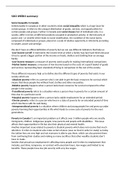
EDT1602 summary
, CHAPTER 1
UNDERSTANDING THE NATIONAL CURRICULUM STATEMENT
Background and overview
The South African national curriculum was changed in 1997.
The reforms changed the education system from one that was Content-based to one that
was Outcomes based
From the start of democracy the curriculum is built on the values that inspired the SA
Constitution
The National Curriculum Statement for grades R to 12 incorporates the principles of the
Constitution.
There are 3 possible approaches to structuring a curriculum framework:
A content based approach
Curriculum design starts with identifying the content that students have to learn about
The approach tends to emphasize the importance of individual subjects
An experience –based approach
Curriculum design starts with identifying the learning experiences in which students will
participate
An outcomes-based approach
Curriculum design starts with the question “what do we want learners to be able to do by
the end of their learning
This approach places strong emphasis on the total result of the educational process,
rather than just on what learners might achieve in each subject.
South Africa‘s National Statement grades R-12 Curriculum
In 1994 a democratic approach to education was initiated
In 1997 the Statement of the national curriculum for grades R - 9 was approved for
Foundation phase, Intermediate phase and Senior Phase.
This initiative became known as Curriculum 2005
Curriculum 2005 was a form of outcomes-based education
Curriculum 2005 was reviewed in 2000 and a new curriculum framework was released.
The new one was called the Draft Revised National Curriculum Statement grades R-9, and
was released in July 2001, and approved in 2002.
The South African curriculum was revised again in 2009 and resulted in the National
Curriculum Statement grades R-12 being developed for implementation from 2012.
This statement comprises:
a policy document called the National Policy Pertaining to the program and promotion
requirements of the National Curriculum Statement grades R-12. This describes which
subjects to be offered in each grade and the promotion requirements.
Curriculum and Assessment Policy Statements (CAPS) for each approved subject listed
in the policy document
A policy document called the National Protocol for Assessment grades R-12, which
describes the recording and reporting process to be used in grades R-12.
,The four essential principles of outcomes – based education
Clarity of focus
Designing down from long-term outcomes
High expectations for all learners
Expanded learning opportunities
Teachers are expected to use the principles of outcomes-based education to guide their planning and
teaching activities.
, CHAPTER 2
Constructivism:
Constructivist approaches to teaching and learning
The basic premise of constructivism is that knowledge is obtained and understanding is
explained through active construction and reconstruction of mental frameworks.
Learning is not a passive process of simply receiving information, rather it involves
deliberate, progressive construction and deepening of meaning.
Understanding involves the development of valid connections between new and existing
knowledge and experiences
Constructivism is an approach to learning in which learners are provided the opportunity
to construct their own sense of what is being learned by building internal connections
among the ideas and facts being taught
Cognitive constructivism focuses on the cognitive processes that learners actively
construct knowledge for themselves by forming their own representations of the material
to be learned.
Social constructivism approach treats learning as a social process whereby students
acquire knowledge through interaction with their environment.
In order for teachers to help learners build their understanding, they must do the
following:
Scaffolding
Providing learners with enough help to complete a task and then gradually decreasing the
help as the learner becomes able to work independently
Using realistic learning contexts
Using multiple perspectives
In a constructivist classroom the primary goal of teachers is to foster critical thinking skills.
Teachers seek and value their students’ point of view.
EFFECTIVE LEARNERS
Characteristics of effective learners
Learners should be ready and matured in the following aspects:
Cognitive Development
Language and Literacy development
Physical development
Emotional Stability
Self-efficacy and self confidence
Motivation
Prior knowledge
Attitudes towards school and learning
, CHAPTER 1
UNDERSTANDING THE NATIONAL CURRICULUM STATEMENT
Background and overview
The South African national curriculum was changed in 1997.
The reforms changed the education system from one that was Content-based to one that
was Outcomes based
From the start of democracy the curriculum is built on the values that inspired the SA
Constitution
The National Curriculum Statement for grades R to 12 incorporates the principles of the
Constitution.
There are 3 possible approaches to structuring a curriculum framework:
A content based approach
Curriculum design starts with identifying the content that students have to learn about
The approach tends to emphasize the importance of individual subjects
An experience –based approach
Curriculum design starts with identifying the learning experiences in which students will
participate
An outcomes-based approach
Curriculum design starts with the question “what do we want learners to be able to do by
the end of their learning
This approach places strong emphasis on the total result of the educational process,
rather than just on what learners might achieve in each subject.
South Africa‘s National Statement grades R-12 Curriculum
In 1994 a democratic approach to education was initiated
In 1997 the Statement of the national curriculum for grades R - 9 was approved for
Foundation phase, Intermediate phase and Senior Phase.
This initiative became known as Curriculum 2005
Curriculum 2005 was a form of outcomes-based education
Curriculum 2005 was reviewed in 2000 and a new curriculum framework was released.
The new one was called the Draft Revised National Curriculum Statement grades R-9, and
was released in July 2001, and approved in 2002.
The South African curriculum was revised again in 2009 and resulted in the National
Curriculum Statement grades R-12 being developed for implementation from 2012.
This statement comprises:
a policy document called the National Policy Pertaining to the program and promotion
requirements of the National Curriculum Statement grades R-12. This describes which
subjects to be offered in each grade and the promotion requirements.
Curriculum and Assessment Policy Statements (CAPS) for each approved subject listed
in the policy document
A policy document called the National Protocol for Assessment grades R-12, which
describes the recording and reporting process to be used in grades R-12.
,The four essential principles of outcomes – based education
Clarity of focus
Designing down from long-term outcomes
High expectations for all learners
Expanded learning opportunities
Teachers are expected to use the principles of outcomes-based education to guide their planning and
teaching activities.
, CHAPTER 2
Constructivism:
Constructivist approaches to teaching and learning
The basic premise of constructivism is that knowledge is obtained and understanding is
explained through active construction and reconstruction of mental frameworks.
Learning is not a passive process of simply receiving information, rather it involves
deliberate, progressive construction and deepening of meaning.
Understanding involves the development of valid connections between new and existing
knowledge and experiences
Constructivism is an approach to learning in which learners are provided the opportunity
to construct their own sense of what is being learned by building internal connections
among the ideas and facts being taught
Cognitive constructivism focuses on the cognitive processes that learners actively
construct knowledge for themselves by forming their own representations of the material
to be learned.
Social constructivism approach treats learning as a social process whereby students
acquire knowledge through interaction with their environment.
In order for teachers to help learners build their understanding, they must do the
following:
Scaffolding
Providing learners with enough help to complete a task and then gradually decreasing the
help as the learner becomes able to work independently
Using realistic learning contexts
Using multiple perspectives
In a constructivist classroom the primary goal of teachers is to foster critical thinking skills.
Teachers seek and value their students’ point of view.
EFFECTIVE LEARNERS
Characteristics of effective learners
Learners should be ready and matured in the following aspects:
Cognitive Development
Language and Literacy development
Physical development
Emotional Stability
Self-efficacy and self confidence
Motivation
Prior knowledge
Attitudes towards school and learning