Cellular Respiration:
Cellular respiration is a catabolic pathway that breaks down energy-rich compounds to
produce ATP.
● Aerobic respiration refers to catabolic pathways that require oxygen.
● The overall summary reaction for aerobic respiration is: C6H12O6 + 6O2 →
6CO2 + 6H2O + energy.
Stages of Cellular Respiration:
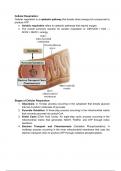
1. Glycolysis: A 10-step process occurring in the cytoplasm that breaks glucose
into two 3-carbon molecules of pyruvate.
2. Pyruvate Oxidation: A three-step process occurring in the mitochondrial matrix
that converts pyruvate into acetyl-CoA.
3. Krebs Cycle (Citric Acid Cycle): An eight-step cyclic process occurring in the
mitochondrial matrix that generates NADH, FADH2, and ATP through redox
reactions.
4. Electron Transport and Chemiosmosis (Oxidative Phosphorylation): A
multistep process occurring in the inner mitochondrial membrane that uses the
electron transport chain to produce ATP through oxidative phosphorylation.
Cellular respiration is a catabolic pathway that breaks down energy-rich compounds to
produce ATP.
● Aerobic respiration refers to catabolic pathways that require oxygen.
● The overall summary reaction for aerobic respiration is: C6H12O6 + 6O2 →
6CO2 + 6H2O + energy.
Stages of Cellular Respiration:
1. Glycolysis: A 10-step process occurring in the cytoplasm that breaks glucose
into two 3-carbon molecules of pyruvate.
2. Pyruvate Oxidation: A three-step process occurring in the mitochondrial matrix
that converts pyruvate into acetyl-CoA.
3. Krebs Cycle (Citric Acid Cycle): An eight-step cyclic process occurring in the
mitochondrial matrix that generates NADH, FADH2, and ATP through redox
reactions.
4. Electron Transport and Chemiosmosis (Oxidative Phosphorylation): A
multistep process occurring in the inner mitochondrial membrane that uses the
electron transport chain to produce ATP through oxidative phosphorylation.