
Robin de Bree
Gastheer-pathogeen interacties
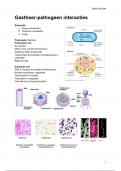
Eukaryote:
1. Worms (helminths)
2. Protozoa (unicellular)
3. Fungi
Prokaryote: Bacteria
Prokaryotic cell
No nucleus
DNA is one circular chromosome
Additional DNA as plasmids
Transcription & translation simultaneously in
cytoplasm
Rigid cell wall
Eukaryote cell
DNA in nucleus as multiple chromosomes
Nuclear membrane, organelles
Transcription in nucleus
Translation in cytoplasm
Cell wall only in fungi and plants
1
,Gram staining
Major method used to characterize bacteria
Gram-positive bacteria → retain the crystal violet dye (the primary stain in Gram staining),
resulting in a purple color after staining. This is because they have a thick layer of
peptidoglycan in their cell wall, which traps the crystal violet dye. When the counterstain
(usually safranin) is applied, Gram-positive bacteria retain the purple color and appear as
purple under the microscope.
Gram-negative bacteria → do not retain the crystal violet dye due to their thinner
peptidoglycan layer and the presence of an outer membrane. After the decolorization step in
the Gram staining process, Gram-negative bacteria lose the purple color and take up the
counterstain, which is usually red or pink.
Infection: Colonization and growth of a microorganism within a host.
Disease: Damage to the host, which interferes with normal functions of the host (-cell)
Pathogenicity: The potential of a microorganism to inflict damage on its host (qualitative)
- often referring to genetic components of the pathogen
- host-independent
Virulence: The extent of damage that a pathogen can inflict on its host (quantitative)
- host-pathogen interactions
- host-dependent
2
,Koch’s postulates
1. The same pathogen must be present in every case of the disease, but not in healthy
individuals.
2. The pathogen must be isolated from the sick host and grown in a pure culture.
3. The pure pathogen must cause the same disease when given to uninfected hosts.
4. The pathogen must be re-isolated from the newly infected hosts, and shown to be the
same organisms as isolated initially.
1. Start with a sick mouse.
2. Examine the spleen of the sick mouse.
3. Obtain and grow a pure culture of the pathogen from the spleen on a culture plate.
4. Inject the obtained pure culture into a healthy mouse.
5. The healthy mouse becomes similarly ill.
6. Isolate the same pathogen from the second sick mouse.
The postulates do not apply to:
1. No animal model available
Example: chlamydia (Chlamydia trachomatis)
2. Bacteria do not grow in the lab
Example: leprosy (Mycobacterium leprae)
3. Viruses: need host cells to grow them in the lab
4. Presence of pathogens in healthy individuals = opportunistic pathogens
Opportunistic pathogens: Causes disease in weakened individuals or when in an unusual
location; often belong to the commensal microflora
Primary pathogens: Causes disease in healthy individuals
Virulence factors: Molecules of pathogenic microorganisms that contribute to their ability to
cause disease. Are specific to pathogenic microorganisms, frequently interact with host cells,
and are often on the surface or secreted.
3
, Extracellular vs. intracellular pathogens
Intracellular:
- Viruses need host cells for replication → All protein components of new virus
particles are made by the host cell
- Intracellular bacterial pathogens (in phagocytes) → Important defence mechanism
by clearing pathogens (inside lysosomes)
Example: M. tuberculosis. Survives and grows inside macrophages
1. Blocks phagosome-lysosome fusion
2. Escapes from the phagosome
- Intracellular bacterial pathogens (Invasion of nonphagocytic cells (e.g., epithelial
cells). Through manipulation of the cytoskeleton
Advantages of intracellular lifestyle
1. Hiding from the immune system
2. Invasion: penetrating deeper tissue
Extracellular pathogens have to confront the immune system
- Self-protection: e.g. capsule, cell wall components
- Weapons: e.g. enzymes and toxins
- Antigenic variation: change surface structures in time.
Differences in disease progression
1. Acute infection: multiply as fast as possible and spread rapidly → a lot of damage
2. Chronic or persistent infection: staying in the host for a long time → causing little damage
4

