Memory AO1
Factors Affecting Eyewitness
Testimony
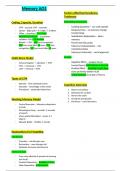
Coding, Capacity, Duration Misleading Information
- STM – acoustic LTM – semantic - Leading Questions – car crash speeds
- Jacobs – digit span = 9.3 digits, 7.3 letters - Response bias – no memory change
- Miller – chunking = 7+/-2 units (conforming)
- Peterson & Peterson – (consonant - Substitution Explanation – alters
syllables) STM = 18 seconds memory
- Bahrick – LTM – 90% face recognition, - Post-Event Discussion
60% free recall after 15 years, 70% face - Memory Contamination – mix
recognition, 305 free recall after 48 years (mis)information
- Memory Conformity – social approval
Multi-Store Model Anxiety
- Sensory Register -> attention -> STM - Negative Effect – weapon focus,
- STM -> rehearsal -> LTM tunnel theory (knife/blood vs pen/oil)
- LTM -> retrieval -> STM - Positive Effect – shooting in gun shop,
close proximity better recall
- Yerkes-Dobson Inverted U-Theory
Types of LTM
- Episodic – time stamped events
Cognitive Interview
- Semantic – knowledge of the world
- Procedural – automatic behaviours 1. Report everything
2. Reinstate the context
3. Revere the order
Working Memory Model 4. Chang the perspective
5. Enhanced – social dynamics
- Central Executive – allocates subsystems
to tasks
- Phonological Loop – acoustic, 2 seconds
of speech
- Visuo-spatial Sketchpad – visual, 3-4
objects
- Episodic Buffer – flexible, 4 chunks
Explanations for Forgetting
Interference
- Proactive – old disrupts new
- Retroactive – new disrupts old
- Similarity increases interference
Retrieval Failure
- Cues most effective if present at learning
and recall
- Context-Dependent – Baddeley’s divers
- State-Dependent –antihistamine
Factors Affecting Eyewitness
Testimony
Coding, Capacity, Duration Misleading Information
- STM – acoustic LTM – semantic - Leading Questions – car crash speeds
- Jacobs – digit span = 9.3 digits, 7.3 letters - Response bias – no memory change
- Miller – chunking = 7+/-2 units (conforming)
- Peterson & Peterson – (consonant - Substitution Explanation – alters
syllables) STM = 18 seconds memory
- Bahrick – LTM – 90% face recognition, - Post-Event Discussion
60% free recall after 15 years, 70% face - Memory Contamination – mix
recognition, 305 free recall after 48 years (mis)information
- Memory Conformity – social approval
Multi-Store Model Anxiety
- Sensory Register -> attention -> STM - Negative Effect – weapon focus,
- STM -> rehearsal -> LTM tunnel theory (knife/blood vs pen/oil)
- LTM -> retrieval -> STM - Positive Effect – shooting in gun shop,
close proximity better recall
- Yerkes-Dobson Inverted U-Theory
Types of LTM
- Episodic – time stamped events
Cognitive Interview
- Semantic – knowledge of the world
- Procedural – automatic behaviours 1. Report everything
2. Reinstate the context
3. Revere the order
Working Memory Model 4. Chang the perspective
5. Enhanced – social dynamics
- Central Executive – allocates subsystems
to tasks
- Phonological Loop – acoustic, 2 seconds
of speech
- Visuo-spatial Sketchpad – visual, 3-4
objects
- Episodic Buffer – flexible, 4 chunks
Explanations for Forgetting
Interference
- Proactive – old disrupts new
- Retroactive – new disrupts old
- Similarity increases interference
Retrieval Failure
- Cues most effective if present at learning
and recall
- Context-Dependent – Baddeley’s divers
- State-Dependent –antihistamine