
INDU 6331 Assignment 4 Advanced Quality Control
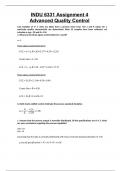
6.25 Samples of n= 5 units are taken from a process every hour. The x and R values for a particular quality characteristic are determined. After 25 samples have been collected, we calculate x avg.= 20 and R= 4.56 a. What are the three sigma control limits for x and R? n= 5 Three sigma control limits for X UCL=´x+ A2 R´ =20+0.577∗4.56=22.63 Centerline=x´ =20 LCL=´x−A2R´ =20−0.577∗4.56=17.37 Three sigma control limits for R UCL=D4R´ =2.114∗4.56=9.64 Centerline=R´ =4.56 LCL=D3R´ =0∗4.56=0 b. Both charts exhibit control. Estimate the process standard deviation σ^ R= R´ d2 = 4.56 2.326 =1.96 c. Assume that the process output is normally distributed. Of the specifications are 19 ± 5, what are your conclusions regarding the process capability? USL= 24 LSL= 14 Assuming that the data is normally distributed with mean of 20 and standard deviation of 1.96 p (out of specification)=P{ x14 }+P{ x24 } INDU 6331 Assignment 4 Advanced Quality Control p (out of specification)=Φ( 14−20 1.96 ) +1−Φ( 24−20 1.96 ) p (out of specification)=Φ (−3.06 )+1−Φ(2.04 )=1−0.99889+1−0.97932=0.0218 The probability of a data point to be out of specification limits is near to 2,18% C^ p= USL−LSL 6 σ^ = 24−14 6(1.96) =0.85 Assuming that the process is centered in the specification limits, having a value of Cp= 0.85 (1) means that the process has bad performance and that it will expected to have a high level of nonconformances. ^P=( 1 C^ p ) ∗100 =( 1 0.85 )∗100 =117.65 This value verifies the previous comment. We can appreciate that the process is using 117.65% of the specification band. d. If the process mean shifts to 24, what is the probability of not detecting this shift on the first subsequent sample? n= 5 L= 3 (control limits calculated at 3σ) μ1= μ0 + kσ k= μ1−μ0 σ = 24−20 1.96 =2.04 β=Φ( L−k √n)−Φ(−L−k √n)=Φ(3−2.04√5)−Φ(−3−2.04√5) β=Φ(−1.56)−Φ (−7.56 )=0.0594 The probability of not detecting this shift on the first subsequent sample is 5.94% 6.30 Control charts for x and R are to be established to control the tensile strength of a metal part. Assume that the tensile strength is normally distributed. Thirty samples of size n= 6 parts are collected over a period of time with the following results: ´xi=6000∧¿∑ i=1 30 Ri=150 ∑ i=1 30 ¿ a. Calculate control limits for x and R
Información del documento
- Subido en
- 25 de junio de 2023
- Número de páginas
- 19
- Escrito en
- 2022/2023
- Tipo
- Examen
- Contiene
- Preguntas y respuestas

