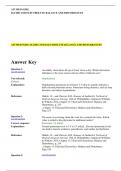
ATI Med Surg Test Questions Fluid and Electrolytes Balance and Disturbance
ATI Med Surg Test Questions Fluid and Electrolytes Balance and Disturbance Answer Key Question 1: (see full question) An elderly client takes 40 mg of Lasix twice a day. Which electrolyte imbalance is the most serious adverse effect of diuretic use? You selected: Hypokalemia Correct Explanation: Hypokalemia (potassium level below 3.5 mEq/L) usually indicates a defict in total potassium stores. Potassium-losing diuretics, such as loop diuretics, can induce hypokalemia. Reference: Hinkle, J.L., and Cheever, K.H. Brunner & Suddarth's Textbook of Medical-Surgical Nursing, 13th ed. Philadelphia: Lippincott Williams & Wilkins, 2014, Chapter 13: Fluid and Electrolytes: Balance and Disturbance, p. 255. Chapter 13: Fluid and Electrolytes: Balance and Disturbance - Page 255 Question 2: (see full question) The nurse is reviewing client lab work for a critical lab value. Which value is called to the physician for additional orders? Correct response: Potassium: 5.8 mEq/L Explanation: Normal potassium level is 3.5 to 5.5 mEq/L. Elevated potassium levels can lead to muscle weakness, paresthesias, and cardiac dysrhythmias. Reference: Hinkle, J.L., and Cheever, K.H. Brunner & Suddarth's Textbook of Medical-Surgical Nursing, 13th ed. Philadelphia: Lippincott Williams & Wilkins, 2014, Chapter 13: Fluid and Electrolytes: Balance and Disturbance, p. 254. Chapter 13: Fluid and Electrolytes: Balance and Disturbance - Page 254 Question 3: (see full question) A client with pancreatic cancer has the following blood chemistry profile: Glucose, fasting: 204 mg/dl; blood urea nitrogen (BUN): 12 mg/dl; Creatinine: 0.9 mg/dl; Sodium: 136 mEq/L; Potassium: 2.2 mEq/L; Chloride: 99 mEq/L; CO2: 33 mEq/L. Which result should the nurse identify as critical and report immediately? You selected: Potassium Correct Explanation: The nurse should identify potassium: 2.2 mEq/L as critical because a normal potassium level is 3.8 to 5.5 mEq/L. Severe hypokalemia can cause cardiac and respiratory arrest, possibly leading to death. Hypokalemia also depresses the release of insulin and results in glucose intolerance. The glucose level is above normal (normal is 75 to 110 mg/dl) and the chloride level is a bit low (normal is 100 to 110 mEq/L). Although these levels should be reported, neither is life-threatening. The BUN (normal is 8 to 26 mg/dl) and creatinine (normal is 0.8 to 1.4 mg/dl) are within normal range. (less) Reference: Hinkle, J.L., and Cheever, K.H. Brunner & Suddarth's Textbook of Medical-Surgical Nursing, 13th ed. Philadelphia: Lippincott Williams & Wilkins, 2014, Chapter 13: Fluid and Electrolytes: Balance and Disturbance, p. 255. Chapter 13: Fluid and Electrolytes: Balance and Disturbance - Page 255 Question 4: (see full question) Which nerve is implicated in the Chvostek’s sign? You selected: Facial Correct Explanation: Chvostek’s sign consists of twitching of muscles supplied by the facial nerve when the nerve is tapped about 2 cm anterior to the earlobe, just below the zygomatic arch. Reference: Hinkle, J.L., and Cheever, K.H. Brunner & Suddarth's Textbook of Medical-Surgical Nursing, 13th ed. Philadelphia: Lippincott Williams & Wilkins, 2014, Chapter 13: Fluid and Electrolytes: Balance and Disturbance, p. 259. Chapter 13: Fluid and Electrolytes: Balance and Disturbance - Page 259 Question 5: (see full question) A client has the following arterial blood gas (ABG) values: pH, 7.12; partial pressure of arterial carbon dioxide (PaCO2), 40 mm Hg; and bicarbonate (HCO –), 15 mEq/L. These ABG values suggest which disorder? You selected: Metabolic acidosis Correct Explanation: This client's pH value is below normal, indicating acidosis. The HCO – value also is below normal, reflecting an overwhelming accumulation of acids or excessive loss of base, which suggests metabolic acidosis. The PaCO2 value is normal, indicating absence of respiratory compensation. These ABG
Información del documento
- Subido en
- 21 de junio de 2023
- Número de páginas
- 83
- Escrito en
- 2022/2023
- Tipo
- Examen
- Contiene
- Preguntas y respuestas