CPSC 3600 Final Exam 2023 with correct answers
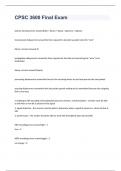
latency formula dtotal = dtrans + dprop + dprocess + dqueue transmission delay the time required to transmit a packet onto the "wire" dtrans = L/R propagation delay the time required for the data to travel along the "wire" to its destination dprop = D/Sprop processing delay the time for the receiving device to read and process the next packet queuing delay the time the packet spends waiting to be transmitted because the outgoing link is very busy 3 challenges with encoding (and explanations) 1. synchronization - receiver must be able to tell when a new bit is present in the signal 2. signal detection - the receiver must be able to determine when a signal IS present vs. when the line is idle 3. performance - the sender should be able to send with the highest data rate possible NRZ encoding high = 1 low = 0 NRZI encoding toggle = 1 no change = 0 Manchester encoding adds clock between every data bit toggle when 1 or clock 4B/5B encoding use 4 bit "nybbles" and convert to 5 bit sequences collision when 2 or more hosts attempt to send at the same time on the same medium why is a collision problematic? the receiver can't easily distinguish between the 2 transmissions exponential backoff algorithm each consecutive collision forces the sender to choose from an exponentially increasing range of time switch connects 2 physical Ethernets hubs connect buses how do switches self learn? - for each packet that is received along a specific link, the switch associates the source address with the link - remembers that a packet from that address came from there, so it knows packets going to that address should be sent along that link - switches only learn adjacent links TCP vs. UDP TCP is connection oriented, uses socket to send to/receive from one host, and guarantees delivery and order of packets. UDP is connectionless, allows sending to/receiving from multiple hosts, and doesn't guarantee that the message was delivered, which means that there is no waiting for the recipient to acknowledge What is the relationship between link utilization and queuing delay? If the outgoing link is busy, there will be a queuing delay Stop and Wait - Sender sends one packet, then waits for receiver response - if there's a dropped packet or ACK, retransmit after timer expires Go-Back-N - sender can send N packets without receiving an ACK - ACKs are cumulative
Información del documento
- Subido en
- 20 de junio de 2023
- Número de páginas
- 5
- Escrito en
- 2022/2023
- Tipo
- Examen
- Contiene
- Preguntas y respuestas