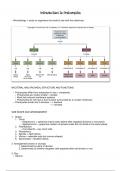
Introduction to Prokaryotes
• Microbiology = study or organisms too small to see with the naked eye
BACTERIAL AND ARCHAEAL STRUCTURE AND FUNCTIONS
• Prokaryotes di er from eukaryotes in size + complexity
• Prokaryotes are mostly smaller + simpler
• Most lack internal membrane systems
• Prokaryotes do not have a true nucleus surrounded by a nuclear membrane
• Prokaryotes divide into 2 domains —> bacteria
—> archaea
SIZE SHAPE AND ARRANGEMENT
1. Shape
1. Cocci
• Streptococci = spherical chains (cells adhere after repeated divisions in one plane)
• Staphylococci = grape like clusters of spheres (cells did not divide in the same plane)
2. Rod/Bacillus
• Coccobacilli = very short rods
3. Filamentous
4. Spirillia = rigid helices
5. Vibrios = resemble rods but comma shaped
6. Spirochetes = exibile helices
2. Arrangement (chains or clumps)
1. Determined by plane of division
2. Determined by whether daughter cells separate after cell division or not
3. Size
• Various
fffl
, CELL ORGANISATION OF ARCHAEA AND BACTERIA
FUNCTIONS OF PROKARYOTIC STRUCTURES
CELL ENVELOPE Plasma membrane plus all the layers outside of it
(ie. Membrane, cell wall + layers outside of cell wall
CYTOPLASM No organelles
No ER
No Golgi apparatus
EXTERNAL FEATURES Fimbriae and pili = attachment to surfaces, bacterial
conjugation and transformation, twitching and
gliding motility
Flagella = swimming motility
Some have a capsule or layer of slime
NUCLEOID Localisation of genetic material (single chromosome
of linear or circular DNA)
PERIPLASMIC SPACE In gram -‘ve bacteria, contains hydrolytic enzymes
+ binding proteins for nutrient processing and
uptake
In gram +’ve bacteria + archaeal cells, may be
smaller or absent
INCLUSION BODIES Storage of carbon, phosphate and other
substances
1. Bacterial Plasma Membrane
FUNCTION
• Encompass cytoplasm
• Selectively permeable membrane —> major determinant of what enters and exits the
cytoplasm
• Interacts with external environment
• Receptors for detection of an response to
chemicals
• Transport, excretion + secretion systems
• Essential metabolic processes
• Electron transport
• Synthesis of lipids and cell wall components
• Oxidative phosphorylation occurs in the
membrane!
STRUCTURE
• FLUID MOSIAC MODEL —> membranes (5-10nm thick)
are lipid bilayers in which proteins
• Lipids = amphipathic
• Eg. Glycerophospholipids
• Polar heads = hydrophilic and interact with water
• Non polar tails = hydrophobic + insoluble in water
• Lipid composition of membrane phospholipids
changes with environmental temperature in order to
maintain uidity of the membrane
• Lower temp —> more fatty acids + more unsaturated carbon atoms
fl
, • Membrane proteins
• Integral
• 70-80% of total membrane proteins
• Amphipathic + embedded in the membrane
• Eg. Transport proteins (carrier and channel proteins)
• Peripheral
• 20-30% of total membrane proteins
• Can associate with integral proteins or a lea et of the plasma membrane
• Associate via hydrogen bonds or ionic interactions therefore can be dislodged
easily via temperature or pH changes
• Lack sterols but do contains sterol like molecules called hopanoids
• Allow for membrane stabilisation
• Hopanoids have similar structure in that they have the same fused ring structure but with
an additional 6 membered ring
• Hopanoids are synthesised from the same molecular precursors as steroids
fl
• Microbiology = study or organisms too small to see with the naked eye
BACTERIAL AND ARCHAEAL STRUCTURE AND FUNCTIONS
• Prokaryotes di er from eukaryotes in size + complexity
• Prokaryotes are mostly smaller + simpler
• Most lack internal membrane systems
• Prokaryotes do not have a true nucleus surrounded by a nuclear membrane
• Prokaryotes divide into 2 domains —> bacteria
—> archaea
SIZE SHAPE AND ARRANGEMENT
1. Shape
1. Cocci
• Streptococci = spherical chains (cells adhere after repeated divisions in one plane)
• Staphylococci = grape like clusters of spheres (cells did not divide in the same plane)
2. Rod/Bacillus
• Coccobacilli = very short rods
3. Filamentous
4. Spirillia = rigid helices
5. Vibrios = resemble rods but comma shaped
6. Spirochetes = exibile helices
2. Arrangement (chains or clumps)
1. Determined by plane of division
2. Determined by whether daughter cells separate after cell division or not
3. Size
• Various
fffl
, CELL ORGANISATION OF ARCHAEA AND BACTERIA
FUNCTIONS OF PROKARYOTIC STRUCTURES
CELL ENVELOPE Plasma membrane plus all the layers outside of it
(ie. Membrane, cell wall + layers outside of cell wall
CYTOPLASM No organelles
No ER
No Golgi apparatus
EXTERNAL FEATURES Fimbriae and pili = attachment to surfaces, bacterial
conjugation and transformation, twitching and
gliding motility
Flagella = swimming motility
Some have a capsule or layer of slime
NUCLEOID Localisation of genetic material (single chromosome
of linear or circular DNA)
PERIPLASMIC SPACE In gram -‘ve bacteria, contains hydrolytic enzymes
+ binding proteins for nutrient processing and
uptake
In gram +’ve bacteria + archaeal cells, may be
smaller or absent
INCLUSION BODIES Storage of carbon, phosphate and other
substances
1. Bacterial Plasma Membrane
FUNCTION
• Encompass cytoplasm
• Selectively permeable membrane —> major determinant of what enters and exits the
cytoplasm
• Interacts with external environment
• Receptors for detection of an response to
chemicals
• Transport, excretion + secretion systems
• Essential metabolic processes
• Electron transport
• Synthesis of lipids and cell wall components
• Oxidative phosphorylation occurs in the
membrane!
STRUCTURE
• FLUID MOSIAC MODEL —> membranes (5-10nm thick)
are lipid bilayers in which proteins
• Lipids = amphipathic
• Eg. Glycerophospholipids
• Polar heads = hydrophilic and interact with water
• Non polar tails = hydrophobic + insoluble in water
• Lipid composition of membrane phospholipids
changes with environmental temperature in order to
maintain uidity of the membrane
• Lower temp —> more fatty acids + more unsaturated carbon atoms
fl
, • Membrane proteins
• Integral
• 70-80% of total membrane proteins
• Amphipathic + embedded in the membrane
• Eg. Transport proteins (carrier and channel proteins)
• Peripheral
• 20-30% of total membrane proteins
• Can associate with integral proteins or a lea et of the plasma membrane
• Associate via hydrogen bonds or ionic interactions therefore can be dislodged
easily via temperature or pH changes
• Lack sterols but do contains sterol like molecules called hopanoids
• Allow for membrane stabilisation
• Hopanoids have similar structure in that they have the same fused ring structure but with
an additional 6 membered ring
• Hopanoids are synthesised from the same molecular precursors as steroids
fl