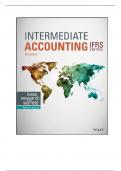
,Intermediate Accounting: IFRS
Edition
Fourth Edition
DONALD E. KIESO PhD, CPA
Northern Illinois University DeKalb, Illinois
JERRY J. WEYGANDT PhD, CPA
University of Wisconsin—Madison Madison, Wisconsin
TERRY D. WARFIELD, PhD
University of Wisconsin—Madison Madison, Wisconsin
, DEDICATED TO
Our wives, Donna, Enid, and Mary, for their love, support, and
encouragement
DIRECTOR AND VICE PRESIDENT Michael McDonald
EXECUTIVE EDITOR Emily Marcoux
CONTENT DEVELOPMENT EDITOR Lindsey Myers
EDITORIAL SUPERVISORS Terry Ann Tatro/Nicola Smith
SENIOR DEVELOPMENT AND PRODUCTION MANAGER Ed Brislin
SENIOR PRODUCTION EDITORS Elena Saccaro/Rachel Conrad
DIRECTOR OF MARKETING Karolina Honsa Zarychta
MARKETING MANAGER Jenny Geiler
SENIOR DESIGNER Wendy Lai
ASSISTANT EDITOR Kirsten Loose
EDITORIAL ASSISTANT Natalie Munoz
COVER IMAGE © Elymas / Shutterstock
(BACKCOVER) © Hero Images/Getty Images
Copyright © 2020 John Wiley & Sons, Inc. All rights reserved. No part of this publication may
be reproduced, stored in a retrieval system or transmitted in any form or by any means,
electronic, mechanical, photocopying, recording, scanning or otherwise, except as permitted
under Sections 107 or 108 of the 1976 United States Copyright Act, without either the prior
written permission of the Publisher, or authorization through payment of the appropriate per-
copy fee to the Copyright Clearance Center, Inc. 222 Rosewood Drive, Danvers, MA 01923,
website www.copyright.com. Requests to the Publisher for permission should be addressed to
the Permissions Department, John Wiley & Sons, Inc., 111 River Street, Hoboken, NJ 07030-
5774, (201)748-6011, fax (201)748-6008, website http://www.wiley.com/go/permissions.
To order books or for customer service, please call 1-800-CALL WILEY (225-5945).
ISBN-13 978-1-119503682
, Table of Contents
Cover
Title Page
DEDICATED TO
Copyright
From the Authors
About the Authors
New to This Edition
Proven Pedagogical Framework
Acknowledgments
CHAPTER 1: Financial Reporting and Accounting Standards
Global Markets
Objective of Financial Reporting
Standard-Setting Organizations
Financial Reporting Challenges
Review and Practice
Global Accounting Insights
CHAPTER 2: Conceptual Framework for Financial Reporting
Conceptual Framework
Fundamental Concepts
Assumptions
Measurement, Recognition, and Disclosure Concepts
Review and Practice
Global Accounting Insights
CHAPTER 3: The Accounting Information System
Accounting Information System