Purpose Trusts
Tuesday, 15 March 2022 16:33
TI 1
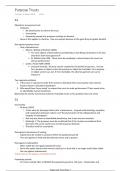
Objections to purpose trusts
- Problems:
○ No beneficiaries to enforce the trust
○ Uncertainty
○ Perpetuity (people die, purposes could go on forever)
- None of this applies to charities - they are exempt because of the good they do (public benefit)
Rule against purpose trusts
- Lack of beneficiaries
○ Morice v Bishop of Durham (1804)
▪ 'For such objects of benevolence and liberality as the Bishop of Durham in his own
discretion shall most approve of'
▪ Sir William Grant MR - 'there must be somebody in whose favour the court can
decree performance'
○ Leahy v AG for NSW [1959]
▪ Viscount Simonds: '[A] trust may be created for the benefit of persons… but not
for a purpose or object unless the purpose or object be charitable. For a purpose
or object cannot sue, but, if it be charitable, the attorney-general can sue to
enforce it'
Two separate problems
1. If the court is required to order the trustees to distribute the trust property, they need to
know to whom it should be distributed
2. Who would have 'locus standi' to request the court to order performance? There needs to be
an identifiable human beneficiary
[Note that the charity commission enforces charitable trusts so this problem does not arise]
TI 2
Uncertainty
- Re Astor [1952]
○ Trusts were for (amongst others) the 'maintenance… of good understanding, sympathy
and cooperation between nations' and 'the preservation of the independence and
integrity of newspapers'
○ Not only was there no identifiable beneficiary, but it was also too uncertain
○ Roxburgh J: 'The purposes must be so defined that if the trustees surrendered their
discretion the courts could carry out the purposes declared.'
○ Therefore void for uncertainty
Rule against remoteness of vesting
- Capital must be vested in someone within the perpetuity period
- This rule applies to fixed and discretionary trusts and to powers
Rule against inalienability
- Often called the rule against perpetual trusts
- Not in the public interest that money is tied up in a trust that is no longer useful (also called
the rule against endowments
These rules do not apply to charitable trusts!!
Perpetuity periods
- For trusts created after 5/10/2010 the perpetuity period is 125 years - Perpetuities and
Accumulation Act 2009, S5
Equity and Trusts Page 1
Tuesday, 15 March 2022 16:33
TI 1
Objections to purpose trusts
- Problems:
○ No beneficiaries to enforce the trust
○ Uncertainty
○ Perpetuity (people die, purposes could go on forever)
- None of this applies to charities - they are exempt because of the good they do (public benefit)
Rule against purpose trusts
- Lack of beneficiaries
○ Morice v Bishop of Durham (1804)
▪ 'For such objects of benevolence and liberality as the Bishop of Durham in his own
discretion shall most approve of'
▪ Sir William Grant MR - 'there must be somebody in whose favour the court can
decree performance'
○ Leahy v AG for NSW [1959]
▪ Viscount Simonds: '[A] trust may be created for the benefit of persons… but not
for a purpose or object unless the purpose or object be charitable. For a purpose
or object cannot sue, but, if it be charitable, the attorney-general can sue to
enforce it'
Two separate problems
1. If the court is required to order the trustees to distribute the trust property, they need to
know to whom it should be distributed
2. Who would have 'locus standi' to request the court to order performance? There needs to be
an identifiable human beneficiary
[Note that the charity commission enforces charitable trusts so this problem does not arise]
TI 2
Uncertainty
- Re Astor [1952]
○ Trusts were for (amongst others) the 'maintenance… of good understanding, sympathy
and cooperation between nations' and 'the preservation of the independence and
integrity of newspapers'
○ Not only was there no identifiable beneficiary, but it was also too uncertain
○ Roxburgh J: 'The purposes must be so defined that if the trustees surrendered their
discretion the courts could carry out the purposes declared.'
○ Therefore void for uncertainty
Rule against remoteness of vesting
- Capital must be vested in someone within the perpetuity period
- This rule applies to fixed and discretionary trusts and to powers
Rule against inalienability
- Often called the rule against perpetual trusts
- Not in the public interest that money is tied up in a trust that is no longer useful (also called
the rule against endowments
These rules do not apply to charitable trusts!!
Perpetuity periods
- For trusts created after 5/10/2010 the perpetuity period is 125 years - Perpetuities and
Accumulation Act 2009, S5
Equity and Trusts Page 1