Business Research Methods chapter 10 Observation
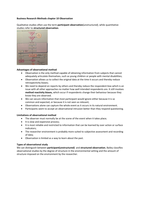
Qualitative studies often use the term participant observation(unstructured), while quantitative
studies refer to structured observation.
Advantages of observational method
Observation is the only method capable of obtaining information from subjects that cannot
adequately articulate themselves, such as young children or people with mental disabilities;
Observation allows us to collect the original data at the time it occurs and thereby reduce
retrospectivity biases;
We need to depend on reports by others and thereby reduce the respondent bias which is an
issue with all other approaches no matter how well intended respondents are. It still involves
method reactivity biases, which occur if respondents change their behaviour because they
know they are observed.
We can secure information that most participant would ignore either because it is so
common and expected, or because it is not seen as relevant;
Observations alone can capture the whole event as it occurs in its natural environment.
Participants seem to accept an observational intrusion better than they respond questioning.
Limitations of observational method
The observer must normally be at the scene of the event when it takes place;
It is slow and expensive process;
It is most reliable and restricted to information that can be learned by over action or surface
indicators;
The researcher environment is probably more suited to subjective assessment and recording
of data;
Observation is limited as a way to learn about the past.
Types of observational study
We can distinguish between participant(unstructured) and structured observation. Bailey classifies
observational studies by the degree of structure in the environmental setting and the amount of
structure imposed on the environment by the researcher.
Qualitative studies often use the term participant observation(unstructured), while quantitative
studies refer to structured observation.
Advantages of observational method
Observation is the only method capable of obtaining information from subjects that cannot
adequately articulate themselves, such as young children or people with mental disabilities;
Observation allows us to collect the original data at the time it occurs and thereby reduce
retrospectivity biases;
We need to depend on reports by others and thereby reduce the respondent bias which is an
issue with all other approaches no matter how well intended respondents are. It still involves
method reactivity biases, which occur if respondents change their behaviour because they
know they are observed.
We can secure information that most participant would ignore either because it is so
common and expected, or because it is not seen as relevant;
Observations alone can capture the whole event as it occurs in its natural environment.
Participants seem to accept an observational intrusion better than they respond questioning.
Limitations of observational method
The observer must normally be at the scene of the event when it takes place;
It is slow and expensive process;
It is most reliable and restricted to information that can be learned by over action or surface
indicators;
The researcher environment is probably more suited to subjective assessment and recording
of data;
Observation is limited as a way to learn about the past.
Types of observational study
We can distinguish between participant(unstructured) and structured observation. Bailey classifies
observational studies by the degree of structure in the environmental setting and the amount of
structure imposed on the environment by the researcher.