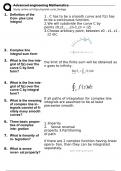
1. Definition of the Com- plex Line integral 2. Complex line integral sum form 3. What is the line inte- gral of f(z) over the curve C by limit form? 4. What is the line inte- gral of f(z) over the curve C by integral form? 5. What is the meaning of complex line in- tegrals consist of fi- nitely many smooth curves? 6. Three basic proper- ties of complex inte- gration 7. What is linearity of in- tegration? 8. What is sense rever- sal property? 1 . C has to be a smooth curve and f(z) has to be a continuous function. 2. We will subdivide the curve C by points z0,z1,....,zn-1,zn = (Z) 3. Choose arbitrary point, between z0 - z1, z1 - z2 etc. the limit of the finite sum will be obtained as n goes to infinity. If all paths of integration for complex line integrals are assumed to be at least piecewise smooth. 1. linearity 2. Sense reversal property 3.Partitioning of path if there are 2 complex function having linear opera- tion, then they can be integrated separately. changing their limit by adding minus sign 9. What is partitioning of path ? 10. What is existence of the complex line inte- gral ? 11. Proof of existence of the complex line inte- gral 12. What is first method of solving complex line integral ? 13. Theorem of indefinite integration of analytic functions 14. What is the second method of solving complex line integral ? 15. Theorem of integra- tion by the use of a parametric represen- tation of the path 16. Proof of integration by the use of a para- metric representation of the path integrate function by 2 path which is one path actually If f(z) is continuous and the curve C is at least piece- wise smooth, the complex line integral of f(z) exists Indefinite integration and substituition of limits, but it is restricted to analytic functions. If f(z) is analytic in a simply connected domain D, In the domain there exists an indefinite integral of f(z), F'(z) = f(z) and for all paths in D joining two points z0 and z1 Use of a oarametric representation of the path, ap- plies to any continuous complex function. If C be at least piecewise smooth, and represented by z = z(t), where a= t =b. f(z) be continuous on the C 1. Represent the path C in the form of z(t) (a = t =b) 2. Calculate the derivative z'(t) = dz / dt 3.Substitute z(t) into f[z(t)] 4. Integrate f[z(t)]z'(t) over t from a to b 17. If we integrate a non- analytic function f(z) from point z0 to a point z1 along differ- ent paths, what value will be evaluated ? 18. what is convergent sequence? 19. what is theorem of Convergence of Com- plex Sequences ? 20. what is nth partial sum of the series ? 21. what is second the- orem of convergence of complex series ? 22. what is absolute con- vergence ? 23. Ratio Test (Conver- gence) In general all have different values. if sequence has a limit c, then it is convergent se- quence. For any small number A sequence (zn = xn + iyn) convergences to c = a + ib if and only the real parts {xn} converges to a and the sequence of the imaginary parts {yn} converges to b partial sum sn = z1 + z2 +. zn And if lim sn = z1 + z2 + .... = s where n is infinity a series with zm = xm + iym, has the sum s = u + iv if and only if sum of x1 + x2 + ... = u , y1 + y2 + .... = v zn|| where n’ converges Let a series z_1 + z_2 + ..... with z_n != 0 have lim |z_n+1 / z_n | = L a) if L 1, the series converges 24. Root test(conver- gence) 25. what is power series ? b) if L 1, the series diverges c) if L = 1, the test fails. Let a series z_1 + z_2 + ..... have a property lim n/2(^(| z_n |)) = L a) if L 1, the series converges b) if L 1, the series diverges c) if L = 1, the test fails. complex complex constants a_n is called the power series in powers of z - z_0 26. circle of converges every power series has the circle of converges of radius R. R = means that a series converges for all z and R = 0 means that a series converges only at the center z = z_0 27. Taylor series of a function f(z) 28. The maclaurin series The Maclaurin series is a special case of the Taylor series with center z_0 = 0. That is, 29. a_n coffeicent of tay- lor and maclauren se- ries 30. what is singular in complex analysis ? A function f (z) is called singular at a point z_0 if it is not analytic (or not defined) at z_0 and z_0 is called a 31. what is an isolated singular point ? singular point and pole of f(z) and the point at which f(z) = 0 is called a zero if z_0 has a neighborhood without further singulari- ties, we call z_0 an isolated singular point of f(z) 32. what is order of pole ? m is the order of pole and the poles of the first order are called simple order 33. what is laurent series ? consisting of negative integer powers of z - z_0 as well as positive integer powers of z - z_0, because if we want to expand a function f(z) in powers of z - z_0 when f(z) is singular at z_0, we can't use the Taylor series anymore. 34. Laurent's theorem Let f (z) be analytic in a domain containing two con- centric circles C_1 and C_2 with center at z = z_0 and the annulus between them. Then f(z) can be represented by the laurent series such that consisting of nonnegative and negative powers of z - z_0 and the coefficients 35. laurent series coeffi- cent formulas 36. what is principal part of f(z) at z_0 ? the series of the negative powers is called the princi- pal part of f(z) at z_0 37. What is residue in residue integration method ? Integrating both sides for any simple closed path C including the singular point z_0 in counter-clockwise direction. The coefficient b_1 is called the residue of f(z) at z = z_0 and is denoted by b_1 = Res f(z) 38. formula for residue Simple pole at z_0 . A formula for the residue at a simple pole is 39. residue theorem Let f (z) be analytic inside a simple closed path C, except for finitely many singular points z_1, z_2, z_3 z_k inside C. Then, the integral of f (z) taken counter-clockwise around C is 40. How to divide com- plex numbers 41. How to visualize com- plex numbers in the coordinate plane ? 42. How does addition and subtraction visu- alized ? 43. how can we employ the polar coordinates ? real part is x-axis, imaginary part is y-axis we can add two complex number similar to vector addition and subtraction x = rcos(thuthu), y = rcos(thuthu) 44. polar form of complex number 45. thuthu is called the argument of z given by 46. the value of thuthu is multiple-valued, 47. for any complex num- bers we have the im- portant triangle in- equality z = x + iy = r(cos(thuthu) + isin(thuthu) ) = re^(ithuthu) r = |z| = (x *2 + y^2)^(1/2) thuthu = arg z = tan^(-1) y / x repeated at integer multiples of 2pi. The value of thuthu that lies in the interval -pi thuthu = pi is called the principal argument of z and is denoted by Arg z 48. the polar form of com- 1. Multiplication plex number is very useful in multiplica- tion z_1*z_2 = r_1e^(ithuthu_1)r_2e^(ithuthu_2) = r_1r_2e^i(thuthu_1 + thuthu_2) = r_1r_2[cos(thuthu_1 + thuthu_2) + isin(thuthu_1 + thuthu_2) ] In general , |z_1z_2| = |z_1||z_2|, arg(z_1z_2) = arg(z_1) + arg(z_2) 49. the polar form of com- z_1 / z_2 = r_1e^(ithuthu_1) / r_2e^(ithuthu_2) = r_1 plex number is very useful in division e ^i(thuthu_1 - thuthu_2) / r_2 = r_1[cos(thuthu_1 - thuthu_2) + isin(thuthu_1 - thuthu_2)] in general, argz_1 / arg_2 = arg(z_1) - arg(z_2) 50. De Moivre's Theorem If z= [r(cos theta + i sin theta)], then z^n=(r^n)* (cos n*theta + isin n*theta). 51. complex roots for z = w ^ n , there are n distinct values of w satisfying the equality. Each of these values is called nth root of z, and we write 52. what is analytic func- tion ? 53. what is neighborhood of a ? 54. what are the upper half - plane and the lower half - plane ? a function f(z) is said to be analytic in a domain D if it is defined and differentiable at all points of D. A function f(z) is said to be analytic at a point z = z_0 if it has a derivative at every point in some neighborhood of z_0 an open circular disk |z - a| p with an arbitrarily small p is Upper half-plane: z = x + iy such that y 0 Lower half-plane : z = x + iy such that y 0 55. 1 concept on sets in the complex plane 56. 2 concept on sets in the complex plane 57. 3 concept on sets in the complex plane 58. 4 concept on sets in the complex plane A set S is called open if every point of S has a neighborhood that belongs to S. An open set S is called connected if any two of its points can be joined by line segments whose points belong to S. An open connected set is called a domain; for exam- ple, open disk or open annulus. An open square with a diagonal removed is not a domain. A region is a set consisting of a domain plus some or all of its boundary points. 59. complex function w = f(z) = u(x,y) + iv(x,y) z = x + iy 60. what is limit in com- plex function ? 61. what is continuous function ? A function f (z) is said to have the limit l as z approaches a point z_0 , if |f(z) - l | e when | z - z_0 | d for arbitrarily small e and d , written lim f(z) = l where z - z_0 . Z can approach z_0 from any direction in the complex plane A function f(z) is said to be continuous at z = z_0 if f(z_0) is defined, and we can write lim f(z) = f(z_0) where z - z_0 62. the derivative of f(z) at Differentiability at z_0 means that, along whatever a point z_0 path z approaches z_0 , its value should be the same. 63. e^z = e^(x + iy) = e^(cosy + isiny) complex exponential function 64. complex exponential function derivative (e^z)' = u_x + iv_x = e^x cosy + ie^x siny = e^z - analytic for all z 65. e^z_1 e^z_2 z_1 = x_1 + iy_1, z_2 = x_2 + iy_2 e^(z_1 + z_2) = e^(x_1 + x_2 + i(y_1 + y_2)) 66. |e^z| = e^x arg e^z = y + 2npi arg e^z = y - 2npi 67. cos(z) ( e^iz + e^-iz ) / 2 68. sin(z) (e^iz - e^-iz) / 2 69. cosh(z) (e^z + e^-z) / 2 70. sinh(z) (e^z - e^-z) / 2 71. cosh (iz) cosz 72. sinh (iz) isinz 73. cos(iz) cosh z 74. sin(iz) isinhz 75. the natural logarithm of z = x + iy w = ln z and defined by the inverse of the exponential function, that is w = lnz - e^w = z ln z = ln(re^ithuthu) = lnr + ithuthu (r = |z|, thuthu = arg z) 76. The value of ln z corresponding to the principal argu- ment Argz is denoted by Lnz and called the principal value of lnz Lnz = ln r + iArgz lnz = Lnz + 2n(pi)i lnz = Lnz - 2n(pi)i 77. n= 0, 1 , 2, .... is multiple - valued arg(e^z) = y + 2n(pi)i arg(e^z) = y - 2n(pi)i 78. z^c e^clnz lnz is infinitely many - valued 79. z^c = e^cLnz is called the principal value of z^c 80. a^z e^zlna
Vista previa del contenido
Advanced engineering Mathematics
Study online at https://quizlet.com/_9v4qgx
1. Definition of the
1 . C has to be a smooth curve and f(z) has
Com- plex Line
to be a continuous function.
integral
2.We will subdivide the curve C by
points z0,z1,....,zn-1,zn = (Z)
3.Choose arbitrary point, between z0 - z1, z1 -
z2 etc.
2. Complex line
integral sum form
3. What is the line inte- the limit of the finite sum will be obtained as
gral of f(z) over the n goes to infinity.
curve C by limit
form?
4. What is the line inte-
gral of f(z) over the
curve C by integral
form?
If all paths of integration for complex line
5. What is the meaning integrals are assumed to be at least
of complex line in- piecewise smooth.
tegrals consist of fi-
nitely many smooth
curves?
6. Three basic proper-
1. linearity
ties of complex
2. Sense reversal
inte- gration
property 3.Partitioning
7. What is linearity of of path
in- tegration?
if there are 2 complex function having linear
opera- tion, then they can be integrated
8. What is sense separately.
rever- sal property?
1/
,Advanced engineering Mathematics
Study online at https://quizlet.com/_9v4qgx
changing their limit by adding minus sign
2/
, Advanced engineering Mathematics
Study online at https://quizlet.com/_9v4qgx
9. What is partitioning integrate function by 2 path which is one path
of path ? actually
10.What is existence of
the complex line If f(z) is continuous and the curve C is at least
inte- gral ? piece- wise smooth, the complex line integral
of f(z) exists
11.Proof of existence of
the complex line
inte- gral
12.What is first
method of solving
complex line Indefinite integration and substituition of
integral ? limits, but it is restricted to analytic
functions.
13.Theorem of indefinite
integration of
analytic functions If f(z) is analytic in a simply connected
domain D, In the domain there exists an
indefinite integral of f(z), F'(z) = f(z) and for
all paths in D joining two points z0 and z1
14.What is the second
method of solving
complex line
integral Use of a oarametric representation of the
? path, ap- plies to any continuous complex
function.
15.Theorem of integra-
tion by the use of a
parametric represen-
tation of the path If C be at least piecewise smooth, and
represented by z = z(t), where a<= t <=b.
16.Proof of integration f(z) be continuous on the C
by the use of a para-
metric representation
of the path
3/