
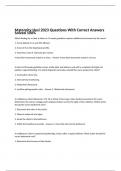
Maternity Hesi 2023 Questions With Correct Answers Solved 100%
Which finding for a client in labor at 41-weeks gestation requires additional assessment by the nurse? 1. Cervix dilated 2 cm and 50% effaced. 2. Score of 8 on the biophysical profile. 3. Fetal heart rate of 116 beats per minute. 4.One fetal movement noted in an hour. - Answer 4.One fetal movement noted in an hour. A client at 28-weeks gestation arrives at the labor and delivery unit with a complaint of bright red, painless vaginal bleeding. For which diagnostic procedure should the nurse prepare the client? 1. Contraction stress test. 2. Internal fetal monitoring. 3. Abdominal ultrasound. 4. Lecithin-sphingomyelin ratio. - Answer 3. Abdominal ultrasound A multiparous client delivered a 7 lb 10 oz infant 5 hours ago. Upon fundal assessment, the nurse determines the uterus is boggy and is displaced above and to the right of the umbilicus. Which action should the nurse implement next? 1. Document the color of the lochia. 2. Observe maternal vital signs. 3. Assist the client to the bathroom. 4. Notify the healthcare provider - Answer 3. Assist the client to the bathroom. A multiparous client is experiencing bleeding 2 hours after a vaginal delivery. What action should the nurse implement next? 1. Determine the firmness of the fundus 2. Give oxytocin (Pitocin) intravenously 3. Inform the healthcare provider of the bleeding. 4. Assess the vital signs for indicators of shock. - Answer 1. Determine the firmness of the fundus The nurse notes a pattern of the fetal heart rate decreasing after each contraction. What action should the nurse implement? 1. Give 10 liters of oxygen via face mask. 2. Prepare for an emergency cesarean section. 3. Continue to monitor the fetal heart rate pattern. 4. Obtain an oral maternal temperature - Answer 1. Give 10 liters of oxygen via face mask. A client at 28-weeks gestation experiences blunt abdominal trauma. Which parameter should the nurse assess first for signs of internal hemorrhage? 1. Vaginal bleeding. 2. Complaints of abdominal pain. 3. Changes in fetal heart rate patterns. 4. Alteration in maternal blood pressure. - Answer 3. Changes in fetal heart rate patterns. Which client should the nurse report to the healthcare provider as needing a prescription for Rh Immune Globulin (RhoGAM)? 1. Woman whose blood group is AB Rh-positive. 2. Newborn with rising serum bilirubin level. 3. Newborn whose Coombs test is negative. 4. Primigravida mother who is Rh-negative. - Answer 4. Primigravida mother who is Rh-negative. The nurse is caring for a client whose labor is being augmented with oxytocin (Pitocin). Which finding indicates that the nurse should discontinue the oxytocin infusion? 1. The client needs to void. 2. Amniotic membranes rupture 3. Uterine contractions occur every 8 to 10 minutes. 4. The fetal heart rate is 180 bpm without variability - Answer 4. The fetal heart rate is 180 bpm without variability At 14-weeks gestation, a client arrives at the Emergency Center complaining of a dull pain in the right lower quadrant of her abdomen. The LPN/LVN obtains a blood sample and initiates an IV. Thirty minutes after admission, the client reports feeling a sharp abdominal pain and a shoulder pain. Assessment findings include diaphoresis, a heart rate of 120 beats/minute, and a blood pressure of 86/48. Which action should the nurse implement next? A. Check the hematocrit results. B. Administer pain medication. C. Increase the rate of IV fluids. D. Monitor client for contractions. - Answer C. Increase the rate of IV fluids. During a prenatal visit, the LPN/LVN discusses with a client the effects of smoking on the fetus. When compared with nonsmokers, mothers who smoke during pregnancy tend to produce infants who have A. lower Apgar scores. B. lower birth weights. C. respiratory distress. D. a higher rate of congenital anomalies. - Answer D. a higher rate of congenital anomalies. Which action should the LPN/LVN implement when preparing to measure the fundal height of a pregnant client? A. Have the client empty her bladder. B. Request the client lie on her left side. C. Perform Leopold's maneuvers first. D. Give the client some cold juice to drink. - Answer A. Have the client empty her bladder. The LPN/LVN identifies crepitus when examining the chest of a newborn who was delivered vaginally. Which further assessment should the nurse perform? A. Elicit a positive scarf sign on the affected side. B. Observe for an asymmetrical Moro (startle) reflex. C. Watch for swelling of fingers on the affected side. D. Note paralysis of affected extremity and muscles. - Answer B. Observe for an asymmetrical Moro (startle) reflex. One hour after giving birth to an 8-pound infant, a client's lochia rubra has increased from small to large and her fundus is boggy despite massage. The client's pulse is 84 beats/minute and blood pressure is 156/96. The healthcare provider prescribes Methergine 0.2 mg IM Å~ 1. What action should the LPN/LVN take immediately? A. Give the medication as prescribed and monitor for efficacy. B. Encourage the client to breastfeed rather than bottle feed. C. Have the client empty her bladder and massage the fundus. D. Call the healthcare provider to question the prescription. - Answer D. Call the healthcare provider to question the prescription. Methergine is contraindicated for clients with elevated blood pressure, so the nurse should contact the healthcare provider and question the prescription (D). The LPN/LVN is preparing to give an enema to a laboring client. Which client requires the most caution when carrying out this procedure? A. A gravida 6, para 5 who is 38 years of age and in early labor. B. A 37-week primigravida who presents at 100% effacement, 3 cm cervical dilatation, and a -1 station. C. A gravida 2, para 1 who is at 1 cm cervical dilatation and a 0 station admitted for induction of labor due to post dates. D. A 40-week primigravida who is at 6 cm cervical dilatation and the presenting part is not engaged. - Answer D. A 40-week primigravida who is at 6 cm cervical dilatation and the presenting part is not engaged. When the presenting part is ballottable (D), it is floating out of the pelvis. In such a situation, the cord can descend before the fetus causing a prolapsed cord, which is an emergency situation. A client at 32-weeks gestation comes to the prenatal clinic with complaints of pedal edema, dyspnea, fatigue, and a moist cough. Which question is most important for the LPN/LVN to ask this client? A. Which symptom did you experience first? B. Are you eating large amounts of salty foods? C. Have you visited a foreign country recently? D. Do you have a history of rheumatic fever? - Answer D. Do you have a history of rheumatic fever? Clients with a history of rheumatic fever (D) may develop mitral valve prolapse, which increases the risk for cardiac decompensation due to the increased blood volume that occurs during pregnancy, so obtaining information about this client's health history is a priority. The LPN/LVN is assessing a client who is having a non-stress test (NST) at 41- weeks gestation. The nurse determines that the client is not having contractions, the fetal heart rate (FHR) baseline is 144 bpm, and no FHR accelerations are occurring. What action should the nurse take? A. Check the client for urinary bladder distention. B. Notify the healthcare provider of the nonreactive results. C. Have the mother stimulate the fetus to move. D. Ask the client if she has felt any fetal movement. - Answer D. Ask the client if she has felt any fetal movement.
Información del documento
- Subido en
- 8 de mayo de 2023
- Número de páginas
- 14
- Escrito en
- 2022/2023
- Tipo
- Examen
- Contiene
- Preguntas y respuestas

