Acrp Practice Test|Already Graded A||100% Pass
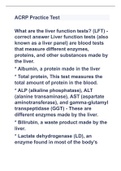
What are the liver function tests? (LFT) Liver function tests (also known as a liver panel) are blood tests that measure different enzymes, proteins, and other substances made by the liver. * Albumin, a protein made in the liver * Total protein, This test measures the total amount of protein in the blood. * ALP (alkaline phosphatase), ALT (alanine transaminase), AST (aspartate aminotransferase), and gamma-glutamyl transpeptidase (GGT) - These are different enzymes made by the liver. * Bilirubin, a waste product made by the liver. * Lactate dehydrogenase (LD), an enzyme found in most of the body's cells. LD is released into the blood when cells have been damaged by disease or injury. * Prothrombin time (PT), a protein involved in blood clotting. What are the thyroid function tests? (TFT) A thyroid panel is a group of tests that may be ordered together to help evaluate thyroid gland function and to help diagnose thyroid disorders. * TSH (thyroid-stimulating hormone) - to test for hypothyroidism, hyperthyroidism and to monitor treatment for a thyroid disorder * Free T4 (thyroxine) - to test for hypothyroidism and hyperthyroidism; may also be used to monitor treatment * Free T3 or total T3 (triiodothyronine) - to test for hyperthyroidism; may also be used to monitor treatment 00:01 01:11 What order should a CRC inform the appropriate people when an SAE has occurred? 1. Study PI should be notified first as he/she is responsible for the subject well-being while on the clinical trial and should assure that adequate medical care is provided. 2. Sponsor, per ICH guidelines, all SAEs should be reported immediately (within 24 hrs) to the study sponsor. 3. IRB/IEC, following applicable regulatory requirements for reporting SAEs When does the initiation visit occur? Once the site has received the IRB/IEC approval letter - any additional action needed regarding the initiation visit would occur after status of approval letter is received - The sponsor does not receive approval letters directly from the IRB/IEC Unexpected AE/SAE any event thought to be related to the investigational product that is not listed in the Investigator's Brochure What are Kidney Function Tests? kidneys filter and clean your blood, taking out waste products and making urine. Kidney tests check to see how well your kidneys are working. They include blood, urine, and imaging tests * Glomerular filtration rate (GFR) - one of the most common blood tests to check for chronic kidney disease. It tells how well your kidneys are filtering. * Creatinine blood and urine tests - check the levels of creatinine, a waste product that your kidneys remove from your blood * Albumin urine test - checks for albumin, a protein that can pass into the urine if the kidneys are damaged * Imaging tests, such as an ultrasound - provide pictures of the kidneys. The pictures help the health care provider see the size and shape of the kidneys, and check for anything unusual. * Kidney biopsy - a procedure that involves taking a small piece of kidney tissue for examination with a microscope. It checks for the cause of kidney disease and how damaged your kidneys are. What must occur prior to a subject signing the ICF? Subject must be given ample time to review the document and have all questions answered. Subject must sign the document prior to any study specific procedures and/or test. According to ICH guidelines, what information should the source document contain regarding the consent? Evidence that the consent form was signed prior to trial related procedures. A clinical trial being conducted to confirm the safety and tolerability of a new anti-emetic IP would be considered what phase of clinical study? Phase I Trial Phase I trials usually have non-therapeutic objectives Are intended to determine the tolerability of dose ranges for future trials Determine the nature of adverse events that may be expected To ensure subjects understand safety issues, the IRB/IEC would be most concerned that the subjects are informed of what? Any additional risks posed by study requirements (additional imaging, blood draws, ect.) All associated risk/side effects of the investigational product, combination of IP with current standard treatment, and current stand treatment associated with the trial During a close out visit the following regulatory documents will be filed and/or sent to the sponsor 1. Treatment Decoding Documentation - Sponsor retains this document 2. Drug Accountability Log - Kept at both the site and with the sponsor 3. Subject Identification Code List - Kept at the site in a confidential manner 4. Documentation of IP destruction - retained by the sponsor and kept at the site if IP was destroyed at the site 5. Final report to the IRB/IEC First in Human trials would most likely include Phase I trials are primarily involved with PK sampling Dose escalation are primarily done in Phase I studies 00:00 01:11 pharmacokinetic/pharmacodynamic modeling (PK/PD) a technique that combines the two classical pharmacologic disciplines of pharmacokinetics and pharmacodynamics. It integrates a PK and a PD model component into one set of mathematical expressions that allows the description of the time course of effect intensity in response to administration of a drug dose. PK/PD modeling is related to the field of pharmacometrics. There are a variety of PK/PD modeling approaches to describe exposure-response relationships Direct vs Indirect link PK/PD models Direct vs Indirect response PK/PD models[7] Time variant vs time invariant Cell lifespan models Complex response models Pharmacokinetics What the body does to the drug (absorption, distribution, metabolism, excretion) A branch of pharmacology dedicated to determine the fate of substances administered to a living organism. Pharmacodynamics What the drug does to the body; mechanism of action The study of the biochemical and physiologic effects of drugs (especially pharmaceutical drugs). The effects can include those manifested within animals (including humans), microorganisms, or combinations of organisms (for example, infection). Sponsor/Investigator (investigator-initiated research) Must Monitor compliance with GCP. The references speak with a sponsor (in this case an investigator) assuring the trial is conducted in compliance with the approved protocol. Keep investigators informed of new findings, promptly notifying all concerned investigators of findings that could affect safety or impact the trial. Sponsor/Investigator is not required to update investigators on current requirement in the trial. The Sponsor/Investigator may but is not required to report non-serious adverse events to participating sites. When can a subject sign consent with an X? The subject is competent bur cant write their name, the CRC must document why the subject signed with an X. Sponsor provided equipment/tool malfunction If Sponsor provided equipment/tool malfunctions the first course of action is to notify the sponsor. The sponsor will confirm if other subjects must be notified of the malfunction and/or provided with a replacement. The sponsor is responsible for maintaining quality assurance and control.
Información del documento
- Subido en
- 3 de mayo de 2023
- Número de páginas
- 19
- Escrito en
- 2022/2023
- Tipo
- Examen
- Contiene
- Preguntas y respuestas