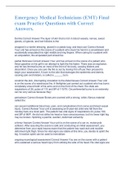
Emergency Medical Technicians (EMT) Final exam Practice Questions with Correct Answers.
Dermis Correct Answer The layer of skin that is rich in blood vessels, nerves, sweat glands, oil glands, and hair follicles is the: wrapped in a sterile dressing, placed in a plastic bag, and kept cool Correct Answer Your unit has arrived on the scene of a patient who stuck his hand in a snowblower and accidentally amputated his right middle and ring fingers. When caring for a patient with an amputation, the amputated part should be: partial thickness Correct Answer Your unit has arrived on the scene of a patient who threw gasoline on his grill in an attempt to light the fire faster. There was an explosion, and he has thermal burns on most of the front of his body, causing blisters and discomfort. Once you are sure the fire is out by hosing him off you then proceed to begin your assessment. A burn to the skin that damages the epidermis and dermis, causing pain and blisters, is called a ______ burn. constrict the skin, interrupting circulation to the distal tissues Correct Answer Your unit is on the scene of a warehouse fire. A firefighter just carried out a patient who has burns completely around both of his arms and on the front of his chest. His vitals are respirations of 26, pulse of 110 and BP of 110/70. Circumferential burns to an extremity can be very serious because they: periosteum Correct Answer Bones are covered with a strong, white, fibrous material called the: can prevent additional blood loss, pain, and complications from nerve and blood vessel injury. Correct Answer Your unit is assessing an 8-year-old child who fell from the monkey bars at a local park. The patient has vital signs of respirations 24, pulse 100, and BP of 96/P. He did not strike his head or lose consciousness, but his lower right leg may be broken. Splinting a painful, swollen, deformed extremity: a femur fracture Correct Answer Your unit is on the scene of a car vs. motorcycle collision. After assuring the scene is safe and conducting an initial assessment, you determine from your rapid trauma exam that the patient has road rash and swollen deformed right thigh. Since his vital signs are stable at this time, you decide to splint the leg. A traction splint can be used to immobilize: ongoing neurological assessment Correct Answer You are on the scene with a patient who sustained a serious head injury from striking the side of his head. His vital signs are
Información del documento
- Subido en
- 24 de abril de 2023
- Número de páginas
- 12
- Escrito en
- 2022/2023
- Tipo
- Examen
- Contiene
- Preguntas y respuestas