VA-BC Study Guide Latest Updates
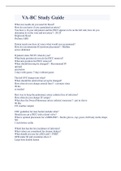
VA-BC Study Guide What size needle do you need for blood? How do you know if you cannulated an artery? You have a 16 year old patient and the PICC appears to be on the left side, how do you determine its in the vein and not artery? - 20-24 Bright red blood Preform ABG Patient needs one dose of vanco what would you recommend? How do you determine IO position placement? - Midline across abdomen If patient states NO IV what do you? What body position do you do for PICC removal? What arm position for PICC removal? When should dressing be changed? - Recommend IV upward arm below 2 days with gauze, 7 days without gauze The left SVC dumps into what? When should the arterial line set up be changed? How often do you change arterial lines? - coronary sinus 96 hrs as needed Best way to keep the pulmonary artery catheter free of infection? How often do you change IV setups? What does the Swan (Pulmonary artery catheter) measures? - put in sleeve 96 Hrs CO (cardiac output) CDC guideline for max barrier include what? Should you cut a PICC with a distal valve? What is optimal placement for a MIDLINE? - Sterile gloves, cap, gown, full body sterile drape. NO 1 inch below axilla Which line has the less incidence of infection? What values are considered for chronic kidney? What should you use for a HD cath? - PORT GFR under 60 and creatinine above 2 Large bore double lumen How long should you flush for? How long can the umbilical cord be used? Why is vein selection harder in babies? - 2 times the length of catheter 14 days less options Which part of the vessel has the most smooth muscle? Abian family wants everything done even though patients outcome is death what do you do? - media respect there cultural beliefs on death. What should you consider for Device Selection in adults? What are the pediatric considerations? - Patient assessment like: preference, lifestyle, willingness to preform maintenance, history, complications, review of variables to determine correct VAD, high risk factors, advantages and disadvantages. limited selection, fewer veins, VAD's preserve vessels, caregiver education, avoid scalp vad's in infants rolling, avoid lower extremity Vad's for crawling patients. What are the Indications for short peripheral catheters? - infusion for 6 days or less. non-irritating and non-vesicant medications and solutions. What are the contraindications for short peripheral catheters? - Placement into arm with fracture,trauma, infection, or compromised circulation. Veins in the arm on the side of a mastectomy, breast surgery, lymph node dissection, av fistula or graft. What are the preferred vessels for Short peripheral catheters? - metacarpal, cephalic, basilic, accessory veins in arm. What are the insertion procedures for short peripheral catheters? - follow guidelines, aseptic technique, 2 attempts per provider, limit of 2 providers, smallest gauge possible to deliver therapy. What are pediatric considerations for short peripheral catheters? - Metacarpal, cephalic, basic, scalp and saphenous veins may be used. Use imaging devices to minimize iv attempts and secure with approved devices. What are the indications for MIDLINE catheters? - infusion for 6 days to 4 weeks. Non-irritating and Non-vesicant medications or solutions. What are the contraindications for a MIDLINE? - Placement in arm with fracture, trauma, infection, AV fistula, or compromised circulation. Chronic kidney disease patients. What is the vessel selection for Midline? - Basilic or cephalic vein in antecubital fossa What is the insertion procedures for MIDLINE? - Follow guidelines, sterile technique, max sterile barrier precautions, 2 attempts per provider, PICC for midline risks liability as its against midline DFU. What are the supplies and the optimal tip location for MIDLINE? - Midline device, sterile insertion tray, ultrasound, normal saline flush, dressing supplies. One inch below the axillary area. What are the Pediatric considerations for MIDLINE? - alternative vein selection like the scalp, popliteal, and saphenous veins. What are the indications and Contraindications for Non-Tunneled Catheters? - Short term and emergency central vein access. neck and chest sites excluded for trach patients, neck dissection, cervical fracture, or unstable airway. unable to position, insert, or stabilize catheter. Avoid same side as PICC. What is the vessel selection for Non-tunneled catheters? - Jugular, Subclavian, or femoral veins What are the insertion procedures for non-tunneled catheters? - Antimicrobial catheters for high risk patients, Follow guidelines, maximum sterile barrier precautions, put in slight trendelenburg to avoid air emboli, avoid blind stick, use ECG for tip location, check for blood return prior to infusion. What are the supplies for a non-tunneled catheters? - Non-tunneled percutaneous venous catheter, sterile procedural insertion tray, max sterile barrier precautions, Ultrasound, normal saline flush, Heparin flush, dressing What is the Optimal tip location for non-tunneled catheters? - Cavoatrial juncture, inferior vena cava at diaphragm if inserted in femoral vein. What are the indications for a PICC? - Patients who require a central venous access when duration is unknown. irritating and vesicant agents. What are the Contraindications for a PICC? - Placement in arm with fracture, trauma, infection, amputation, paralyzed (thrombosis risk), compromised circulation. Chronic kidney disease patients. What is the vessel selection for a PICC? - Basilic, brachial, cephalic vein. What are the insertion procedures for a PICC? - Antimicrobial catheters for high risk patients, follow guidelines, Max sterile barrier precautions, Avoid blind stick, avoid catheter tip in upper SVC or midclavicular, Confirm with ECG or radiograph, check for blood return prior to infusion What are the supplies for a PICC and what is the Optimal tip location? - PICC device, Sterile insertion tray, Ultrasound, ECG system, normal saline flush, heparin flush. Caval atrial juncture What are the Pediatric considerations for a PICC? - Alternative vein selection like scalp and popliteal vein. Heparin may decrease catheter occlusion. What are the indications for a Tunneled Catheters? - Infusions for months or years, Apheresis, What are the contraindications for a Tunneled Catheters? - Current infection, severe coagulopathy, Cellulitis on insertion site. What are the vessel selection for a tunneled catheter? - Subclavian, Jugular, and Femoral vein. What is the insertion procedure for tunneled catheter? - Follow guidelines, sedation, stabilizing dacron cuff attached to the catheter will be positioned in the tissue track to secure the catheter, exit site will heal within 2-3 weeks, once cuff has developed tissue attachment and exit site is healed, it may be maintained without a dressing upon physician approval, confirm with ECG or Xray, obtain free flowing blood. What are the supplies for a tunneled catheter? - tunneeled central venous catheter, sterile insertion tray, ultrasound, surgical equipment, dressing supplies, normal saline, heparin flushes, What is optimal tip location and pediatric considerations for tunneled catheter? - Cavoatrial junction or Inferior vena cava. Catheter tip location (assess as the child grows to maintain in SVC. What are the Indications and contraindications for a Implanted venous port? - infusions for months to years. Severe coagulopathy, uncontrolled sepsis, burns, cellulitis on site, cachectic, below body weight or lacking tissue for port implantation. What are the site selections for implanted venous port? - Peripheral: Basilic or cephalic vein Central: Subclavian, Jugular, femoral vein. What are the considerations for implanted venous port access? - comfort for location of port, depth must be shallow enough to palpate and insert a non-coring access needle safely to maintain access into the port septum. What are the insertion procedures for implanted venous port access? - Follow guidelines, scheduled operative/radiology procedure, sedation, site may be upper chest or lower abdominal side area depending upon thevein accessed, port is sutured into a subcutaneous pocket under the skin, different designs shapes and types, confirm with fluoroscopy or radiography, follow policies, obtain free flowing blood. What is the optimal tip location for implanted venous port? - Cavoatrial junction, inferior vena cava above level of diaphragm if inserted into femoral vein.
Información del documento
- Subido en
- 22 de abril de 2023
- Número de páginas
- 24
- Escrito en
- 2022/2023
- Tipo
- Examen
- Contiene
- Preguntas y respuestas