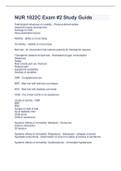
NUR 1022C Exam #2 Study Guide with complete solution
NUR 1022C Exam #2 Study Guide Pathological influences on mobility - Postural Abnormalities Impaired muscle development Damage to CNS Musculoskeletal trauma Mobility - ability to move freely Immobility - inability to move freely Bed rest - an intervention that restricts patients for therapeutic reasons Therapeutic reasons for bed rest - Decreased oxygen consumption Weakness Safety Rest a body part (ex: fracture) Reduce pain Equipment availability Severity of condition CBR - Complete bed rest BRP - Bed rest with bathroom privileges BSC - Bed rest with bedside commode OOB - Out of bed (ad lib or w/ assistance Levels of activity - CBR BRP BSC Dangle on side of bed Up to bedside chair OOB ad lib OOB w/ assistance Systemic effects of immobility: Metabolic - Endocrine Calcium absorption GI function Systemic effects of immobility: Respiratory - Atelectasis - collapse of alveoli hypostatic pneumonia - inflammation of lung from stasis or pooling of secretions Systemic effects of immobility: Cardiovascular - Orthostatic hypotension thrombus formation Systemic effects of immobility: Musculoskeletal - loss of endurance and muscle mass decreased stability and balance Systemic effects of immobility: Muscle - Muscle atrophy Systemic effects of immobility: Skeletal - impaired calcium absorption joint abnormalities Systemic effects of immobility: Urinary elimination - Urinary stasis Renal calculi Systemic effects of immobility: Integumentary - Pressure ulcer ischemia You notice a respiratory change in your immobilized patient. What type of change is this alteration consistent with? - Atelectasis Nursing diagnosis (problems) associated with immobility: respiratory - Ineffective airway clearance Ineffective breathing pattern Impaired gas exchange Nursing interventions for respiratory problems caused by immobility - change position every 2 hours suction oropharyngeal airway prn encourage deep breathing/coughing q1-2hr Assess lung sounds for diminished/absent/adventitious(abnormal) sound Assess for decreased ability to cough, accumulation of secretions, colored sputum, fever, SOB, changes in skin color, changes in pulse oximetry. incentive spirometer - used to open patients alveoli Metabolic changes: immobility - immobility -- muscle atrophy -- negative nitrogen balance -- further loss of mass -- increased weakness -- immobility Cardiovascular changes: immobility - orthostatic hypotension increased cardiac workload thrombus formation Cardiovascular problems: DVT (immobility) - immobility causes blood to pool (edema) makes pts more prone to pressure injury blood will clot faster (at risk for thrombus formation and embolism) thromboembolism - clot (thrombus) breaks off and travels to another part of the body Orthostatic hypotension - Hypotension when position is changed (typically from sitting to standing position) heart rate increases symptoms = dizziness, lightheadedness, syncope, pallor common in elderly, immobilized, and those with depleted blood volume Treatment/management of orthostatic hypotension - use of compression stockings raise/lower HOB Fowler's position (90 degrees) before getting out of bed have client dangle legs over bed Cardiovascular implementations: immobility - progress from bed to chair to ambulation SCD (specific carb diet), TED hose (compression socks), and leg exercises Musculoskeletal changes: immobility - loss of lean body mass muscle weakness/atrophy skeletal effects disuse osteoporosis joint contracture contracture - permanent shortening of muscles, followed by shortening of joints and ligaments Musculoskeletal interventions: immobility - passive/active ROM CPM use of mobility aids COAL - cane opposite of affected leg WWAL - walker with affected leg Crutches - hand grip at wrist-level weight should be on hands, not axilla Passive ROM - slow and smooth, aided movements helps point resistance support distal and proximal to joint head to toe; large to small Active ROM - Patient is actively able to move and exercise areas of the body on their own Nursing action that will assist in preventing contracture - changing position of bed passive range of motion to joints turning clients in bed using a draw sheet to move a client in bed Immobility affects on urinary system - stagnant urine renal calculi UTI (infection) difficulty voiding Urinary interventions: immobility - move you pt hydrate pt assess pt clean foley properly monitor diet GI changes: immobility - slows peristalsis constipation (pharmacological intervention = laxatives) Fecal impaction Fecal obstruction Paralytic ileus - inability of the intestine to contract normally GI interventions: immobility - move pt hydrate pt give medications (laxatives) assessment: auscultate, palpate, observe auscultate - Listening with a stethoscope Integumentary changes: immobility - tissue ischemia inflammation older adults greater risk Pressure ulcer may develop Acute care immobility implementation: Metabolic - high-protein high-calorie diet vitamins B and C Acute care immobility implementation: Respiratory - cough and deep breathe q1-2hr chest physiotherapy Acute care immobility implementation: integumentary - reposition q1-2 hrs skin care elimination system adequate hydration diet rich in fluids, fruits, vegetables and fiber How does the nurse evaluate the patient's understanding of the use of elastic stockings? - Pt says, "I can remove them for 30 minutes every 8 hours." Hoyer lift - moves pt from bed to seated position (such as wheelchair) supine - lying on back prone - lying on stomach fowler's position - Patient position for difficulty of breathing semi-fowler's position - 30-45 degrees; good for patients who have cardiac, respiratory or neurological problems or if pt has nasogastric tube side-lying position - lateral position sims' position - lying on left side left arm behind the body right arm flexed for support (Rectal exams) IADL - instrumental activities of daily living how should the nurse position a patient with severe back pain? - Pathogenesis of pressure ulcers - pressure intensity pressure duration tissue tolerance Tissue ichemia - lack of blood flow to a tissue Blanching - ability of skin to turn white when pressure is applied (when skin is white, blood is temporarily absent from that area) Risk factors for pressure ulcers - impaired sensory perception alteration in LOC impaired mobility nutrition shear force/friction moisture fecal/urinary incontinence LOC - level of consciousness When transferring a patient from bed to stretcher and the patient's skin is pulled across the bed, this is? - shear force/friction Stage 1 pressure (decubitus) ulcer - non-blanchable redness of intact skin Stage 2 pressure (decubitus) ulcer - partial-thickness skin loss or blister
Escuela, estudio y materia
- Institución
- NUR 1022C
- Grado
- NUR 1022C
Información del documento
- Subido en
- 13 de abril de 2023
- Número de páginas
- 20
- Escrito en
- 2022/2023
- Tipo
- Examen
- Contiene
- Preguntas y respuestas
Temas
-
nur 1022c exam 2 study guide with complete solution

Documento también disponible en un lote