
• ¿Documento equivocado? Cámbialo gratis
  • Escrito por estudiantes que aprobaron
  • Inmediatamente disponible después del pago
  • Leer en línea o como PDF
Vender
¿Dónde estudias?
Tu idioma
Document preview thumbnail
Vista previa 2 fuera de 9 páginas
Examen

Chapter 10 Aggression

Document preview thumbnail
Vista previa 2 fuera de 9 páginas

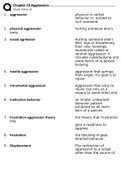
aggression physical or verbal behavior in- tended to hurt someone. physical aggression hurting someone else's body. social agression Hurting someone else's feel- ings or threatening their rela- tionships. Sometimes called re- lational aggression, it includes cyberbullying and some forms of in-person bullying. hostile aggression aggression that springs from anger; it's goal is to injure. intrumental aggression Aggression that aims to injure, but only as a means to some other end. instinctive behavior an innate, unlearned behavior pattern exhibited by all mem- bers of a species. frustration-aggression theory the theory that frustration trig- gers a readiness to aggress. frustration the blocking of goal-directed behavior. Displacement The redirection of aggression to a target other than the source of the frustration. Gen- erally, the new target is a safer target. relative deprivation the perception that one is worse off relative to those with whom one compares oneself. social learning theory the theory that we learn social behavior by observing and imi- tating and by being rewarded or punished. prosocial behavior positive, constructive, helpful behavior. The opposite of anti- social behavior. social scripts culturally provided mental in- structions for how to act in var- ious situations. Catharsis emotional release; the cathar- sis hypothesis maintains that "releasing" aggressive energy (through action or fantasy) re- lieves aggressive urges Chapter 10 Pre-Lecture Quiz In contrast to Freud's view of aggression, Lorenz argued that aggression is: adaptive rather than self-de- structive. Most murders are aggression. hostile The redirection of aggression to a safer or more socially acceptable target other than the source of the frustration is referred to as: In the context of aggression, which of the following refers to emotional release? Displacement. catharsis. According to Gentile and Anderson (2003), is basically over. "The scientific debate of whether tele- vision or movie violence has an effect ." aversive stimulation In view of research on the pain-attack re- sponse, Berkowitz (1983, 1989, 1998) pro- posed that is the basic trigger of hostile aggression. Frustration is noted to arise from: the gap between expectations and attainments. In an experiment, men watched a neu- Those who saw the ag- tral, an erotic, or an aggressive-erotic film. gressive-erotic film delivered These men were then asked to teach a confederate a list of nonsense syllables by choosing how much shock to administer for incorrect answers. Who delivered the most shock? may explain why happiness tends to be lower and crime rates higher in countries with income inequality. In the context of aggression, the most-studied environmental irritant is: In a famous experiment by Albert Ban- dura and his colleagues (1961), children watched an adult attack a Bobo doll with a mallet. They were then shown some toys that they were forbidden to play with. When they were taken to another room, they: Sigmund Freud speculated that human ag- gression springs from: In the context of culture change and world violence, the United States practices the death penalty for . Bandura (1979) contended that whether we act aggressively depends on: stronger shocks than others. Relative deprivation Heat. attacked a Bobo doll. a self-destructive impulse. homicide. the anticipated consequences. In an experiment conducted by Griffitt (1970), students who answered question- naires while they were reported feeling more tired and aggressive and ex- pressed more hostility toward a stranger than did participants in a control group. Increased aggressive behaviors are pre- dicted by all of the following EXCEPT: Which of the following is NOT one of the effects of playing violent video games? All the following factors are likely to in- crease aggression EXCEPT: Americans' ideas for protecting them- selves include all of the following EX- CEPT: In the context of the influences on aggres- sion, research confirms that groups: Which hormone is closely correlated with human aggression? According to Pedersen et al. (2008), are especially vulnerable to dis- placed aggression. In the context of the influences on aggres- sion, which of the following has NOT been linked with aggressive behavior? MacDonald et al. (2000) found that in- toxicated people administered stronger shocks and felt angrier than did sober people during lab experiments when asked to think back on: in an uncomfortably hot room silent sulking. increased interest in drugs and alcohol. Too much sleep. not killing people who kill. can amplify aggressive reac- tions. testosterone. outgroup targets an unexpected request. relationship conflicts. The perception that one is less well-off than others with whom one compares one- self is referred to as: Relative deprivation.

Vista previa del contenido

Chapter 10 Aggression
Study online at
https://quizlet.com/_6eqo3u
1. aggression physical or verbal
behavior in- tended to
hurt someone.

2. physical aggression hurting someone else's
body.

3. social agression Hurting someone else's
feel- ings or threatening
their rela- tionships.
Sometimes called re-
lational aggression, it
includes cyberbullying and
some forms of in-person
bullying.

4. hostile aggression aggression that springs
from anger; it's goal is to
injure.

5. intrumental aggression Aggression that aims to
injure, but only as a
means to some other end.

6. instinctive behavior an innate, unlearned
behavior pattern
exhibited by all mem-
bers of a species.

7. frustration-aggression theory the theory that frustration
trig-
gers a readiness to
aggress.

8. frustration the blocking of goal-
directed behavior.

9. Displacement The redirection of
aggression to a target
other than the source of
1

, Chapter 10 Aggression
Study online at
https://quizlet.com/_6eqo3u the frustration. Gen-
erally, the new target is a
safer target.

10. relative deprivation the perception that one is
worse off relative to those
with whom one compares
oneself.

11.social learning theory


1

Información del documento

Estudio
Subido en
11 de abril de 2023
Número de páginas
9
Escrito en
2022/2023
Tipo
Examen
Contiene
Preguntas y respuestas
$8.49

¿Documento equivocado? Cámbialo gratis Dentro de los 14 días posteriores a la compra y antes de descargarlo, puedes elegir otro documento. Puedes gastar el importe de nuevo.
Escrito por estudiantes que aprobaron
Inmediatamente disponible después del pago
Leer en línea o como PDF

Seller avatar
Los indicadores de reputación están sujetos a la cantidad de artículos vendidos por una tarifa y las reseñas que ha recibido por esos documentos. Hay tres niveles: Bronce, Plata y Oro. Cuanto mayor reputación, más podrás confiar en la calidad del trabajo del vendedor.
Vendido
101
Seguidores
44
Artículos
5717
Última venta
1 mes hace


Por qué los estudiantes eligen Stuvia

Creado por compañeros estudiantes, verificado por reseñas

Calidad en la que puedes confiar: escrito por estudiantes que aprobaron y evaluado por otros que han usado estos resúmenes.

¿No estás satisfecho? Elige otro documento

¡No te preocupes! Puedes elegir directamente otro documento que se ajuste mejor a lo que buscas.

Paga como quieras, empieza a estudiar al instante

Sin suscripción, sin compromisos. Paga como estés acostumbrado con tarjeta de crédito y descarga tu documento PDF inmediatamente.

Student with book image

“Comprado, descargado y aprobado. Así de fácil puede ser.”

Alisha Student

Preguntas frecuentes
