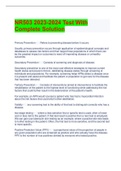
NR Test With Complete Solution
NR Test With Complete Solution Primary Prevention - Refers to preventing disease before it occurs. Usually, primary prevention occurs through application of epidemiological concepts and databases to assess risk factors and then target those populations in which there can be the greatest impact on outcomes to ward off impending disease or unhealthy outcomes. Secondary Prevention - Consists of screening and diagnosis of disease. Secondary prevention is one of the most cost-effective strategies to improve current health status and prevent chronic, debilitating disease states through screening of individuals and populations. For example, screening helps APNs detect a disease once it is present and assist and facilitate the patient or population to get care for the disease that has been detected. Tertiary Prevention - Consists of interventions aimed at interventions to facilitate the rehabilitation of the patient to the highest level of functioning while addressing the risk factors that could further result in the deterioration of the patient's health. For example, an APN would counsel a patient who has had a myocardial infarction about the risk factors that could elicit further debilitation. Validity - any screening test is the ability of that test to distinguish correctly who has a disease. two-stage testing - where a less sensitive first or specific test is used, often of lower cost or less risk to the patient. If that test result is positive then a next test is employed. We can gain use tuberculin skin testing as an example, where a positive skin test leads to further testing in the patient. Often, the first test is more sensitive, and the second test is more specific. Positive Prediction Value (PPV) - a proportional value of the proportion of people in any given population who are screened as positive and who actually have the disease. PPV is the number of true positives divided by everyone who tested positive. Negative Prediction Value (NPV) - Negative predictive value is also a proportion, but is the opposite (and the probability that a result is a true negative). It is the number of true negatives divided by all of those who tested negative. Natural History of Disease - Nature of the disease and how it progresses Internal Validity - Whether the study measures what it was supposed to measure External Validity - The generalization of the results to other populations Reliability - The ability of the test results being replicated if the test is repeated Probability - The study of the laws chance Sensitivity - The tests ability to yield a positive result when the person has the actual disease or condition Specificity - The tests ability to yield a negative result when the person does not have the actual disease or condition Gold Standard - Tests 100% with sensitivity and specificity Likelihood Ratio - Combines sensitivity and specificity data to help the clinician quantify how much of the odds of disease change based on positive or negative test results Infectious Diseases - caused by microbes that can spread very quickly, sometimes within a matter of hours or days. The most common infectious agents responsible for disease are bacteria, viruses, fungi, and protozoa. Airborne transmission - rubeola, rubella, polio, tuberculosis (TB), diphtheria, hantavirus, smallpox, and so on Fecal - oral ingestion (contaminated water and/or food), hepatitis A and E, and so on Direct Contact - impetigo, scabies, lice, smallpox, and so on Sexual Contact - Chlamydia; gonorrhea; hepatitis B, C, and D; human immunodeficiency virus (HIV); HSV Direct Inoculation - syphilis; hepatitis A, B, C, and D; HIV infection Insect or animal bite - malaria, rabies, Lyme disease, bubonic plague Best sources for population-based relevant information for the APN to determine appropriate interventions - CDC Necessary but not sufficient - More than one factor is required, usually in a temporal sequence. The initiation and promotion stages associated with carcinogenesis models examples of this type of causal relation. For example, when considering tuberculosis, the tubercle bacillus is a necessary factor, but even its presence may not be sufficient to produce the disease in every individual.
Escuela, estudio y materia
- Institución
- NR 503
- Grado
- NR 503
Información del documento
- Subido en
- 29 de marzo de 2023
- Número de páginas
- 6
- Escrito en
- 2022/2023
- Tipo
- Examen
- Contiene
- Preguntas y respuestas
Temas
-
nr503
-
nr503 2023 2024 test
-
primary prevention
-
secondary prevention
-
nr503 2023 2024 test with complete solution

Documento también disponible en un lote