A Cook 2016
Chapter 9 - Kinetics I
1. understand, in terms of collision theory, the effect of a change in concentration, temperature,
pressure and surface area on the rate of a chemical reaction
2. understand that reactions only take place when collisions take place with sufficient energy,
known as activation energy
3. be able to calculate the rate of a reaction from:
i data showing the time taken for reaction
ii the gradient of a suitable graph, by drawing a tangent, either for initial rate, or at a time, t
Rate of reaction
The chemical reaction is determined by the change in concentration of a reactant or a product per
unit time.
Rate of reaction = change in concentration ÷ time for change to happen
So, in order to measure the rate of reaction, we need to find out:
1) How fast the reacts are being used up, or
2) How fast one of the products is being formed
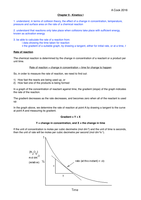
In a graph of the concentration of reactant against time, the gradient (slope) of the graph indicates
the rate of the reaction.
The gradient decreases as the rate decreases, and becomes zero when all of the reactant is used
up.
In the graph above, we determine the rate of reaction at point A by drawing a tangent to the curve
at point A and measuring its gradient.
Gradient = Y ÷ X
Y = change in concentration, and X = the change in time
If the unit of concentration is moles per cubic decimetre (mol dm-3) and the unit of time is seconds,
then the unit of rate will be moles per cubic decimetre per second (mol dm-3s-1).
, A Cook 2016
Rate of reaction can also be calculated from the amount of product formed:
Rate = Volume of gas collected ÷ Time taken
Collusion Theory
Consider this reaction: A + B —> C + D
In order for molecule A to react with molecule B, the two molecules must first of all collide with each
other. If they collide they may react.
Why is there a possibility that the molecules may not react? This is because not all collisions
between reactant molecules will result in a reaction. There are two requirements for a reaction to
occur.
• There two molecules must collide with each other with a sufficient enough energy to cause a
reaction (activation energy)
• The two molecules must collide in the correct orientation
Activation Energy:
If the particles collide with less energy than the activation energy, they simply bounce apart and no
reaction occurs. Think of the activation energy as a barrier to the reaction. Only those collision that
have energies equal to or greater than the activation energy result in a reaction taking place.
Any chemical reaction results in bonds breaking (requiring energy) and bond making (releasing
energy). Some collisions which are relatively gentle may not lead to enough energy being supplied
and so there will be no reaction occurring.
Orientation:
Consider the reaction between ethene and hydrogen bromide.
The reaction can only happen if the hydrogen end of the H—Br molecule approaches the C=C of
the ethene molecule. An other collision between the two molecules will result in the molecules
simply bouncing off each other.
Steric Hinderance
When the shoe of the molecules influence the reactions, we say that there is a ‘steric factor’
involved in the reaction. In some cases, the atoms or groups of atoms can hinder a reaction taking
place.
, A Cook 2016
Making the reactions going faster - Part 1
According to the collision theory, reactant particles have to collide with sufficient energy before they
can react.
You can INCREASE RATE OF REACTIONS by increasing the frequency at which the PARTICLES
COLLIDE with sufficient energy.
We will call collisions that result in a reaction, successful collisions.
The effect of concentration
For reactions in solution, the increase of concentration results in an increased rate of reaction.
This is due to the fact that the reactant particles are closer together, and so the frequency of
collisions occurring increases. As a result the number of successful collisions occurring is at a
higher ratio and so there is a grater rate of reaction.
At A, the reaction has a greater concentration of the reactant and so has the fastest ROR
At B, the reaction has a lesser concentration of reactant compared to A so has a slower ROR
At C, the reaction has the lowest concentration of reactant, as a result has the slowest ROR
You will also notice that apart from the greater gradient there is a plateau earlier from the start of
the reaction in the higher concentrations.
Both these factors give evidence for the concentration leading to a change in the rate of
reaction.
The effect of Pressure:
For a reaction in which molecules collide and react in the gas phase, an increase in the pressure
will bring about an increase in the rate of reaction
Chapter 9 - Kinetics I
1. understand, in terms of collision theory, the effect of a change in concentration, temperature,
pressure and surface area on the rate of a chemical reaction
2. understand that reactions only take place when collisions take place with sufficient energy,
known as activation energy
3. be able to calculate the rate of a reaction from:
i data showing the time taken for reaction
ii the gradient of a suitable graph, by drawing a tangent, either for initial rate, or at a time, t
Rate of reaction
The chemical reaction is determined by the change in concentration of a reactant or a product per
unit time.
Rate of reaction = change in concentration ÷ time for change to happen
So, in order to measure the rate of reaction, we need to find out:
1) How fast the reacts are being used up, or
2) How fast one of the products is being formed
In a graph of the concentration of reactant against time, the gradient (slope) of the graph indicates
the rate of the reaction.
The gradient decreases as the rate decreases, and becomes zero when all of the reactant is used
up.
In the graph above, we determine the rate of reaction at point A by drawing a tangent to the curve
at point A and measuring its gradient.
Gradient = Y ÷ X
Y = change in concentration, and X = the change in time
If the unit of concentration is moles per cubic decimetre (mol dm-3) and the unit of time is seconds,
then the unit of rate will be moles per cubic decimetre per second (mol dm-3s-1).
, A Cook 2016
Rate of reaction can also be calculated from the amount of product formed:
Rate = Volume of gas collected ÷ Time taken
Collusion Theory
Consider this reaction: A + B —> C + D
In order for molecule A to react with molecule B, the two molecules must first of all collide with each
other. If they collide they may react.
Why is there a possibility that the molecules may not react? This is because not all collisions
between reactant molecules will result in a reaction. There are two requirements for a reaction to
occur.
• There two molecules must collide with each other with a sufficient enough energy to cause a
reaction (activation energy)
• The two molecules must collide in the correct orientation
Activation Energy:
If the particles collide with less energy than the activation energy, they simply bounce apart and no
reaction occurs. Think of the activation energy as a barrier to the reaction. Only those collision that
have energies equal to or greater than the activation energy result in a reaction taking place.
Any chemical reaction results in bonds breaking (requiring energy) and bond making (releasing
energy). Some collisions which are relatively gentle may not lead to enough energy being supplied
and so there will be no reaction occurring.
Orientation:
Consider the reaction between ethene and hydrogen bromide.
The reaction can only happen if the hydrogen end of the H—Br molecule approaches the C=C of
the ethene molecule. An other collision between the two molecules will result in the molecules
simply bouncing off each other.
Steric Hinderance
When the shoe of the molecules influence the reactions, we say that there is a ‘steric factor’
involved in the reaction. In some cases, the atoms or groups of atoms can hinder a reaction taking
place.
, A Cook 2016
Making the reactions going faster - Part 1
According to the collision theory, reactant particles have to collide with sufficient energy before they
can react.
You can INCREASE RATE OF REACTIONS by increasing the frequency at which the PARTICLES
COLLIDE with sufficient energy.
We will call collisions that result in a reaction, successful collisions.
The effect of concentration
For reactions in solution, the increase of concentration results in an increased rate of reaction.
This is due to the fact that the reactant particles are closer together, and so the frequency of
collisions occurring increases. As a result the number of successful collisions occurring is at a
higher ratio and so there is a grater rate of reaction.
At A, the reaction has a greater concentration of the reactant and so has the fastest ROR
At B, the reaction has a lesser concentration of reactant compared to A so has a slower ROR
At C, the reaction has the lowest concentration of reactant, as a result has the slowest ROR
You will also notice that apart from the greater gradient there is a plateau earlier from the start of
the reaction in the higher concentrations.
Both these factors give evidence for the concentration leading to a change in the rate of
reaction.
The effect of Pressure:
For a reaction in which molecules collide and react in the gas phase, an increase in the pressure
will bring about an increase in the rate of reaction