
• ¿Documento equivocado? Cámbialo gratis
  • Escrito por estudiantes que aprobaron
  • Inmediatamente disponible después del pago
  • Leer en línea o como PDF
Vender
¿Dónde estudias?
Tu idioma
Document preview thumbnail
Vista previa 1 fuera de 2 páginas
Examen

Belmont Report

Document preview thumbnail
Vista previa 1 fuera de 2 páginas

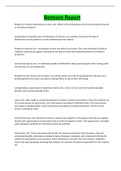
Belmont Report Respect for Persons, Beneficence, Justice. Ans- Which of the following are the three principles discussed in the Belmont Report? maximization of benefits and a minimization of risks Ans- an example of how the Principle of Beneficence can be applied to a study employing human subjects Respect for persons Ans- incorporates at least two ethical convictions: first, that individuals should be treated as autonomous agents, and second, that persons with diminished autonomy are entitled to protection. autonomous person Ans- an individual capable of deliberation about personal goals and of acting under the direction of such deliberation. Beneficence Ans- Persons are treated in an ethical manner not only by respecting their decisions and protecting them from harm, but also by making efforts to secure their well-being. complementary expressions of beneficent actions Ans- (1) do not harm and (2) maximize possible benefits and minimize possible harms. Justice Ans- Who ought to receive the benefits of research and bear its burdens? These formulations are (1) to each person an equal share, (2) to each person according to individual need, (3) to each person according to individual effort, (4) to each person according to societal contribution, and (5) to each person according to merit. Informed Consent. Ans- Respect for persons requires that subjects, to the degree that they are capable, be given the opportunity to choose what shall or shall not happen to them. This opportunity is provided when adequate standards for informed consent are satisfied. Information. Ans- These items generally include: the research procedure, their purposes, risks and anticipated benefits, alternative procedures (where therapy is involved), and a statement offering the subject the opportunity to ask questions and to withdraw at any time from the research. Additional items have been proposed, including how subjects are selected, the person responsible for the research, etc. Examples of Justified incomplete information. Ans- (1) incomplete disclosure is truly necessary to accomplish the goals of the research, (2) there are no undisclosed risks to subjects that are more than minimal, and (3) there is an adequate plan for debriefing subjects, when appropriate, and for dissemination of research results to them. Comprehension. Ans- Making sure the the manner and context in which information is presented is easily understandable to the research subjects. Voluntariness. Ans- An agreement to participate in research constitutes a valid consent only if voluntarily given. This element of informed consent requires conditions free of coercion and undue influence. Assessment of Risks and Benefits. Ans- requires a careful arrayal of relevant data, including, in some cases, alternative ways of obtaining the benefits sought in the research. Thus, the assessment presents both an opportunity and a responsibility to gather systematic and comprehensive information about proposed research. The Nature and Scope of Risks and Benefits. Ans- Accordingly, so-called risk/benefit assessments are concerned with the probabilities and magnitudes of possible harm and anticipated benefits. The Systematic Assessment of Risks and Benefits. Ans- It is commonly said that benefits and risks must be "balanced" and shown to be "in a favorable ratio." (i) Brutal or inhumane treatment of human subjects is never morally justified. (ii) Risks should be reduced to those necessary to achieve the research objective. (iii) When research involves significant risk of serious impairment, review committees should be extraordinarily insistent on the justification of the risk (looking usually to the likelihood of benefit to the subject -- or, in some rare cases, to the manifest voluntariness of the participation).(iv) When vulnerable populations are involved in research, the appropriateness of involving them should itself be demonstrated.v) Relevant risks and benefits must be thoroughly arrayed in documents and procedures used in the informed consent process. 3. Selection of Subjects. Ans- it can be considered a matter of social justi

Vista previa del contenido

Belmont Report
Respect for Persons, Beneficence, Justice. Ans- Which of the following are the three principles discussed
in the Belmont Report?


maximization of benefits and a minimization of risks Ans- an example of how the Principle of
Beneficence can be applied to a study employing human subjects


Respect for persons Ans- incorporates at least two ethical convictions: first, that individuals should be
treated as autonomous agents, and second, that persons with diminished autonomy are entitled to
protection.


autonomous person Ans- an individual capable of deliberation about personal goals and of acting under
the direction of such deliberation.


Beneficence Ans- Persons are treated in an ethical manner not only by respecting their decisions and
protecting them from harm, but also by making efforts to secure their well-being.


complementary expressions of beneficent actions Ans- (1) do not harm and (2) maximize possible
benefits and minimize possible harms.


Justice Ans- Who ought to receive the benefits of research and bear its burdens? These formulations are
(1) to each person an equal share, (2) to each person according to individual need, (3) to each person
according to individual effort, (4) to each person according to societal contribution, and (5) to each
person according to merit.


Informed Consent. Ans- Respect for persons requires that subjects, to the degree that they are capable,
be given the opportunity to choose what shall or shall not happen to them. This opportunity is provided
when adequate standards for informed consent are satisfied.


Information. Ans- These items generally include: the research procedure, their purposes, risks and
anticipated benefits, alternative procedures (where therapy is involved), and a statement offering the
subject the opportunity to ask questions and to withdraw at any time from the research. Additional
items have been proposed, including how subjects are selected, the person responsible for the research,
etc.


Información del documento

Subido en
21 de marzo de 2023
Número de páginas
2
Escrito en
2022/2023
Tipo
Examen
Contiene
Preguntas y respuestas
$10.09

¿Documento equivocado? Cámbialo gratis Dentro de los 14 días posteriores a la compra y antes de descargarlo, puedes elegir otro documento. Puedes gastar el importe de nuevo.
Escrito por estudiantes que aprobaron
Inmediatamente disponible después del pago
Leer en línea o como PDF

Seller avatar
Los indicadores de reputación están sujetos a la cantidad de artículos vendidos por una tarifa y las reseñas que ha recibido por esos documentos. Hay tres niveles: Bronce, Plata y Oro. Cuanto mayor reputación, más podrás confiar en la calidad del trabajo del vendedor.
CertifiedGrades
3.9
(38)
Vendido
149
Seguidores
61
Artículos
8729
Última venta
1 mes hace


Por qué los estudiantes eligen Stuvia

Creado por compañeros estudiantes, verificado por reseñas

Calidad en la que puedes confiar: escrito por estudiantes que aprobaron y evaluado por otros que han usado estos resúmenes.

¿No estás satisfecho? Elige otro documento

¡No te preocupes! Puedes elegir directamente otro documento que se ajuste mejor a lo que buscas.

Paga como quieras, empieza a estudiar al instante

Sin suscripción, sin compromisos. Paga como estés acostumbrado con tarjeta de crédito y descarga tu documento PDF inmediatamente.

Student with book image

“Comprado, descargado y aprobado. Así de fácil puede ser.”

Alisha Student

Preguntas frecuentes