
• ¿Documento equivocado? Cámbialo gratis
  • Escrito por estudiantes que aprobaron
  • Inmediatamente disponible después del pago
  • Leer en línea o como PDF
Vender
¿Dónde estudias?
Tu idioma
Document preview thumbnail
Vista previa 1 fuera de 3 páginas
Notas de lectura

Quality Management

Document preview thumbnail
Vista previa 1 fuera de 3 páginas

A look at what is quality, how quality is measured and the various standards including: EFQM, ISO 9000 and benchmarking.

Vista previa del contenido

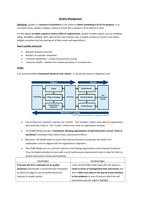
Quality Management

Definition: Quality is a measure of excellence or the extent to which something is fit for its purpose. In its
narrowest sense, quality is simply a measure of how free a product is from defects or fault.

It is the degree to which a good or service fulfils its requirements. Quality includes aspects such as reliability,
safety, durability, usability, after sales service and customer care. A quality product or service is one which
delights customers by fully meeting all of their needs and expectations.

How is quality measured:

 Quantity of goods returned.
 Number of customer complaints.
 Customer satisfaction – usually measured by a survey.
 Customer loyalty – evident from repeat purchases, or renewal rates.

EFQM:

Is an non-prescriptive framework based on nine criteria. It can also be used as a diagnostic tool.


 Five of these are "enablers" and four are "results". The "enabler" criteria cover what an organisation
does and how it does it. The "results" criteria cover what an organisation achieves.

 The EFQM Model provides a framework allowing organisations to determine their current “level of
excellence” and where they need to focus improvement efforts.

 Moreover, the Model helps to ensure that business decisions incorporate the needs of all
stakeholders and are aligned with the organisation’s objectives.

 The EFQM Model acts as a common reference tool helping organisations move towards Excellence .
Thus, the Model provides its users with a set of performance improvement tools in order for them to
achieve and sustain results and Excellence .

Advantages Disadvantages
It focuses the firm's attention on its quality Critics of the EFQM model argue that the system is
processes and provides a comprehensive framework costly in terms of management time and money and
on which to judge its current performance and that it offers very little in the way of actual solutions
improve its quality system. to the problems or area of concern which the self-
assessment exercise might h highlight.


Información del documento

Nivel de Estudio
Tema
Subido en
30 de junio de 2016
Número de páginas
3
Escrito en
2014/2015
Tipo
Notas de lectura
Profesor(es)
Desconocido
Contiene
Todas las clases
$7.38

¿Documento equivocado? Cámbialo gratis Dentro de los 14 días posteriores a la compra y antes de descargarlo, puedes elegir otro documento. Puedes gastar el importe de nuevo.
Escrito por estudiantes que aprobaron
Inmediatamente disponible después del pago
Leer en línea o como PDF

Seller avatar
Los indicadores de reputación están sujetos a la cantidad de artículos vendidos por una tarifa y las reseñas que ha recibido por esos documentos. Hay tres niveles: Bronce, Plata y Oro. Cuanto mayor reputación, más podrás confiar en la calidad del trabajo del vendedor.
MarkC57
4.3
(102)
Vendido
66
Seguidores
49
Artículos
231
Última venta
1 año hace


Por qué los estudiantes eligen Stuvia

Creado por compañeros estudiantes, verificado por reseñas

Calidad en la que puedes confiar: escrito por estudiantes que aprobaron y evaluado por otros que han usado estos resúmenes.

¿No estás satisfecho? Elige otro documento

¡No te preocupes! Puedes elegir directamente otro documento que se ajuste mejor a lo que buscas.

Paga como quieras, empieza a estudiar al instante

Sin suscripción, sin compromisos. Paga como estés acostumbrado con tarjeta de crédito y descarga tu documento PDF inmediatamente.

Student with book image

“Comprado, descargado y aprobado. Así de fácil puede ser.”

Alisha Student

Preguntas frecuentes