
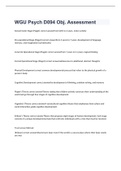
WGU Psych D094 Obj. Assessment exam 2023 with 100% correct answers
Sensorimotor Stage (Piaget) from birth to 2 years, motor activity Pre-operational Stage (Piaget) from 2 years to 7 years, development of language, memory, and imagination (symbolically) Concrete Operational Stage (Piaget) from 7 years to 11 years, logical thinking Formal Operational Stage (Piaget) adolescence to adulthood, abstract thoughts Physical Development a developmental process that refers to the physical growth of a person's body Cognitive Development the development of thinking, problem solving, and memory Piaget's Theory Theory stating that children actively construct their understanding of the world and go through four stages of cognitive development. Vygotsky's Theory A sociocultural cognitive theory that emphasizes how culture and social interaction guide cognitive development. Erikson's Theory Theory that proposes eight stages of human development. Each stage consists of a unique developmental task that confronts individuals with a crisis that must be resolved. Trust versus Mistrust (Erikson) Infants learn basic trust if the world is a secure place where their basic needs are met Autonomy versus Shame and Doubt (Erikson) Erikson's second crisis of psychosocial development. Toddlers either succeed or fail in gaining a sense of self-rule over their actions and their bodies. Initiative versus Guilt (Erikson) Pre-school children initiating activities and asserting control. Industry versus Inferiority (Erikson) The fourth of Erikson's eight psychosocial crises, during which children attempt to master many skills, developing a sense of themselves as either industrious or inferior, competent or incompetent. Identity versus Role Confusion (Erikson) Erikson's term for the fifth stage of development, in which the person tries to figure out "who am I?" but is confused as to which of many possible roles to adopt Intimacy versus Isolation (Erikson) Erikson's sixth stage of development. Adults see someone with whom to share their lives in an enduring and self-sacrificing commitment. Without such commitment, they risk profound aloneness and isolation. Bandura's Social Cognitive Theory Holds that behavior, environment, and person/cognitive factors are the key factors in development Kohlberg's Theory of Moral Development Developing children progress through a predictable sequence of stages of moral reasoning (preconventional, conventional, postconventional). Preconventional Kohlberg's stage of moral development in which rewards and punishments dominate moral thinking
Información del documento
- Subido en
- 17 de febrero de 2023
- Número de páginas
- 4
- Escrito en
- 2022/2023
- Tipo
- Examen
- Contiene
- Preguntas y respuestas

