
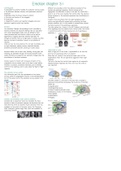
Emotion chapter 31
Learning goals: Different nerve bundles control the volitional movement of the
• Understand how emotion modifies the autonomic nervous system muscles and emotional expression. Partial overlap, partial
• The difference between voluntary and spontaneous emotional segregation. The difference is mostly in the eyes. You could have a
expression lesion in one of the nerve bundles that control either the voluntary
• Reproduce brain structures involved in emotion muscle movement or the emotional expression (see the difference in
• Structure and function of the amygdala the figure).
• Frontal lobes A lesion in the nerve fibres from the right hemisphere motor
• Integration of emotion and cognition: Amygdala and social cortex could give difficulty symmetrically contracting the facial
behaviour, cognitive control over emotion muscles voluntarily, but it is still possible to symmetrically contract
the facial muscles of the spontaneous expression.
Emotions The other person has a tumour in the left thalamus which disrupts
Your behaviour, feelings, and physiology are all controlled by nerve signalling from non-classical moror cortical areas. This results
emotions. Emotions are subjective feelings that are associated in symmetrical control of facial muscles, but not of spontaneous
with certain physiological states, that are defined by their expression.
valence (pleasantness) and intensity. Valance can be positive
(appetitive) or negative (aversive). Intensity describes the
strength of emotion from low to high levels. In animals, we often
describe the level of emotional ‘arousal’ as an indication of
intensity.
When we have too many emotions, this can lead to problems, such
as major depression, phobias, anxiety, compulsive disorder,
borderline personality disorder, and drug or alcohol abuse.
Lesion study in a cat:
Emotional states, such as heart rate, blushing, turning pale, and When a huge part of the cortex + hypothalamus is cut from the
sweating, are expressed through the visceral autonomic motor brain the cat experiences little to no emotion.
system. Emotions are subjective, but autonomic changes allow the When they cut a piece of the cortex but leave a part of the
quantification of emotional responses. hypothalamus intact, the cat experiences aggressive “sham rage”
behaviour.
Animals respond to threats with increased activation of the This led to the idea that cortical brain regions do not necessarily
sympathetic nervous system, what can be seen is pupil dilation, mediate emotional responses. But this is not true, the cortex is
inhibition in salivation, accelerated heartbeat, and an inhibited very important.
activity of the intestines, which is also called the “fight or flight”
response.
The autonomic nervous system
The information goes from the hypothalamus to the central
nervous system via preganglionic neurons in the brainstem/lateral
horn of the spinal cord, to the autonomic nervous system in the Emotional processing
ganglia. The limbic system is a structure in the brain that is involved in
behavioural and emotional processing, the structures of the limbic
system are:
• Cingulate gyrus
• Parahippocampal gyrus
• Orbital & medial prefrontal cortex
• Mediodorsal nucleus of the thalamus
• Basal ganglia
• Hypothalamus
• Amygdala
Voluntary and involuntary motor control in emotions
Duchenne did an experiment where he stimulated the facial
muscles to induce an emotional response. He discovered that the
fake smile was driven by voluntary muscle contraction that was
mediated via the control of the motor cortex. The “Duchenne
smile” conveyed a genuine happy face, which was mediated via
spontaneous emotion.
Learning goals: Different nerve bundles control the volitional movement of the
• Understand how emotion modifies the autonomic nervous system muscles and emotional expression. Partial overlap, partial
• The difference between voluntary and spontaneous emotional segregation. The difference is mostly in the eyes. You could have a
expression lesion in one of the nerve bundles that control either the voluntary
• Reproduce brain structures involved in emotion muscle movement or the emotional expression (see the difference in
• Structure and function of the amygdala the figure).
• Frontal lobes A lesion in the nerve fibres from the right hemisphere motor
• Integration of emotion and cognition: Amygdala and social cortex could give difficulty symmetrically contracting the facial
behaviour, cognitive control over emotion muscles voluntarily, but it is still possible to symmetrically contract
the facial muscles of the spontaneous expression.
Emotions The other person has a tumour in the left thalamus which disrupts
Your behaviour, feelings, and physiology are all controlled by nerve signalling from non-classical moror cortical areas. This results
emotions. Emotions are subjective feelings that are associated in symmetrical control of facial muscles, but not of spontaneous
with certain physiological states, that are defined by their expression.
valence (pleasantness) and intensity. Valance can be positive
(appetitive) or negative (aversive). Intensity describes the
strength of emotion from low to high levels. In animals, we often
describe the level of emotional ‘arousal’ as an indication of
intensity.
When we have too many emotions, this can lead to problems, such
as major depression, phobias, anxiety, compulsive disorder,
borderline personality disorder, and drug or alcohol abuse.
Lesion study in a cat:
Emotional states, such as heart rate, blushing, turning pale, and When a huge part of the cortex + hypothalamus is cut from the
sweating, are expressed through the visceral autonomic motor brain the cat experiences little to no emotion.
system. Emotions are subjective, but autonomic changes allow the When they cut a piece of the cortex but leave a part of the
quantification of emotional responses. hypothalamus intact, the cat experiences aggressive “sham rage”
behaviour.
Animals respond to threats with increased activation of the This led to the idea that cortical brain regions do not necessarily
sympathetic nervous system, what can be seen is pupil dilation, mediate emotional responses. But this is not true, the cortex is
inhibition in salivation, accelerated heartbeat, and an inhibited very important.
activity of the intestines, which is also called the “fight or flight”
response.
The autonomic nervous system
The information goes from the hypothalamus to the central
nervous system via preganglionic neurons in the brainstem/lateral
horn of the spinal cord, to the autonomic nervous system in the Emotional processing
ganglia. The limbic system is a structure in the brain that is involved in
behavioural and emotional processing, the structures of the limbic
system are:
• Cingulate gyrus
• Parahippocampal gyrus
• Orbital & medial prefrontal cortex
• Mediodorsal nucleus of the thalamus
• Basal ganglia
• Hypothalamus
• Amygdala
Voluntary and involuntary motor control in emotions
Duchenne did an experiment where he stimulated the facial
muscles to induce an emotional response. He discovered that the
fake smile was driven by voluntary muscle contraction that was
mediated via the control of the motor cortex. The “Duchenne
smile” conveyed a genuine happy face, which was mediated via
spontaneous emotion.


