
College 1 – Definition and main theories of prosocial
behaviour
Why examine prosocial behaviour?
Important theme in religion (bible), philosophy, folktales. We can state that acting prosocial
is
- A universal rule or guideline
- An adaptive function (evolutionary psychology)
1900: scientists (Mc Dougall, social psychologist) show interest in prosocial behaviour, but
interest readily declines. Behaviourism (based on observable and experimental behaviour)
became more influential, while Mc Dougall relied on reasoning.
- Turning point in the ‘60’s: murder on Kitty Genovese
What is prosocial behaviour?
Prosocial behaviour: behaviour that is defined by society as generally beneficial to other
people and/or to the ongoing political or cultural system
Important features:
- Prosocial behaviour is always an interpersonal act
- The behaviours that are seen as prosocial are context depended
Specific forms of prosocial behaviour are:
- Cooperation: acting together (in a coordinated way at work, leisure or within social
relationships) in the pursuit of shared goals, the enjoyment of the joint activity, or
simply furthering the relationship
- Example: 3FM serious request
- Altruism: helping purely out of the desire to benefit someone
else, with no benefit (and often cost) to oneself
- Helping: any action that has the consequence of providing
some benefit to or improving the well-being of another person
Four types of helping (McGuire, 1994):
- Casual helping: Small favour
- Substantial personal helping: Considerable effort
- Emotional helping: Emotional support
- Emergency helping: Helping with an acute problem (doesn’t
require a personal relationship with the
recipient)
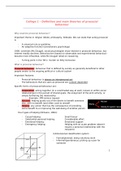
3-dimensional classification system
- Formal/planned: doing voluntary work
- Informal/spontaneous: picking up a pen for
someone
1
, - Serious: helping someone who has a heart attack
- Not serious: picking up a pen for someone
- Direct: giving an euro to a homeless guy
- Indirect: donation to a charity
When are people prosocial?
Latané and Darley Model: Whether a person will act prosocial (or not) is the result of a logical
decision-making process that includes five steps:
1. Notice the event: the clarity and context of the event as well
as the mood of the helper determines whether someone
notices something is wrong
- Clarity: hen someone falls down the stairs it is more
likely you will interpret it as an emergency
- Context: people who live in urban environments are
less likely to notice an event due to stimulus overload
- People in good mood are more sensitive to others
needs and often more attentive to their environment
2. Interpret event as emergency: obvious signs of distress increase the chance of
bystanders interpreting the situation as an emergency
- Example: screaming is a clear sign someone needs help
3. Taking personal: a number of actions could hinder actions to help: bystander effect:
when you are the only person witnessing an emergency, you are more likely to help
than when there are more witnesses
- The bystander effect is an inverse relationship: the greater the number of
bystanders, the less likely will help
Due to:
- Pluralistic ignorance: looking to one another to (re)interpret situation
- Diffusion of responsibility: believing that someone else will take responsibility
4. Know what to do
- Research: are people with first aid training more able to decide what to do and
do they take action?
- They don’t help more often but
provide better quality of help
5. Implement decision
People are only prosocial when all these steps are
fulfilled, in al other cases: no help is given
Model does not explain all helping situations and
does not (completely) explain why people are
prosocial
Why are people prosocial?
Five potential explanations - we help people because:
- The benefits outweigh the costs
2
, - Cost-benefit analysis: the decision to help depends on the consideration of
costs benefits: people want to minimalize their costs and maximize their
benefits
Benefits for helping Costs for helping
- Social recognition - Time and effort
- Positive self-view - Loss of goods Model explains the
- Positive emotions - Risk getting individual differences
injured when peoples are
- Emotional toll witnessing the same
emergency
Costs for not helping
- Social disapproval The model does not
- Physical/mental explain that in certain
problems situations all people are
likely to help
- It is the norm. This can be based on religion, philosophy, law, culture or even
storybooks. We can differentiate two types of norms:
- Social norms: rules for acceptable and non-acceptable behaviour in certain
situations (Schwartz theory of norm activation)
- Reciprocity norm: we feel inclined to help other who have helped us
- Social responsibility norm: we feel inclined to help others who are
dependent on us
- Personal norms: one’s individual feelings of moral obligation on how to behave
in a certain situation
- Predict helping behaviour better than social norms
Explanations presented mostly focused on cognition: think + weight + decide = help
Do people only help from cognition, or is there more to it? – Explanations prosocial
behaviour from a more emotional perspective:
- We feel empathy and we want to reduce stress
- Aversive arousal reduction: we want to reduce our arousal when witnessing an
event or emergency either by helping or by
walking away this leads to the question
whether helping it the result of altruism or
egoism. This is explained in:
- Negative state relief model: people have an
innate drive to reduce negative moods
(motivation stems from egocentric reasons:
helping to make yourself feel better)
- Empathy-altruism model (motivation stems
form altruistic reasons: helping to make the
other feel better
- We learned this from others
- It is an inherited characteristic (evolutionary
psychology)
3
, College 2 – Definition and main theories of antisocial
behaviour
Why are people aggressive? - Introduction
- Release internal energy/conflict?
- In genes and evolutionary adaptive?
- Physical disposition (hormones)?
- Frustration?
- Cognitive interpretation of arousal?
- Learned from others?
- Aggressive scripts?
- Many factors?
Personal and situational factors including influencing affect, cognition, physiological
responses leading to aggressive behaviour
What is aggression?
Working definition: aggression is any form of behaviour directed toward the goal of harming
or injuring another living being who is motivated to avoid such treatment
Aggression is behavioural
- ‘Any form of behaviour’
- Aggression is no emotion, motivation, or attitude
- Emotion is not necessary for aggression
- Aggression is behaviour hurting another person
Aggression is intentional
- ‘Direct toward the goal of harming or injuring’
- Aggression is not accidental
- Aggression is ‘voluntarily’ chosen and intended to hurt someone else
Aggression involves harming
- ‘Harming or injuring’ Physical vs. verbal
- Aggression does not have to be physical damage Active vs passive
perse
Direct vs. indirect
- Negative consequences for another person
Aggression involves living beings
- ‘Direct toward another living being’
- Not acted directly towards living being perse
- Act aimed at hurting a living being
Aggression involves avoidance motivation in the recipient
- ‘Who is motivated to avoid such treatment’
- Those who undergo the aggressive treatment want to avoid this aggressive
treatment
- Suicide and auto mutilation are not aggression
- BDSM is not aggression
4
behaviour
Why examine prosocial behaviour?
Important theme in religion (bible), philosophy, folktales. We can state that acting prosocial
is
- A universal rule or guideline
- An adaptive function (evolutionary psychology)
1900: scientists (Mc Dougall, social psychologist) show interest in prosocial behaviour, but
interest readily declines. Behaviourism (based on observable and experimental behaviour)
became more influential, while Mc Dougall relied on reasoning.
- Turning point in the ‘60’s: murder on Kitty Genovese
What is prosocial behaviour?
Prosocial behaviour: behaviour that is defined by society as generally beneficial to other
people and/or to the ongoing political or cultural system
Important features:
- Prosocial behaviour is always an interpersonal act
- The behaviours that are seen as prosocial are context depended
Specific forms of prosocial behaviour are:
- Cooperation: acting together (in a coordinated way at work, leisure or within social
relationships) in the pursuit of shared goals, the enjoyment of the joint activity, or
simply furthering the relationship
- Example: 3FM serious request
- Altruism: helping purely out of the desire to benefit someone
else, with no benefit (and often cost) to oneself
- Helping: any action that has the consequence of providing
some benefit to or improving the well-being of another person
Four types of helping (McGuire, 1994):
- Casual helping: Small favour
- Substantial personal helping: Considerable effort
- Emotional helping: Emotional support
- Emergency helping: Helping with an acute problem (doesn’t
require a personal relationship with the
recipient)
3-dimensional classification system
- Formal/planned: doing voluntary work
- Informal/spontaneous: picking up a pen for
someone
1
, - Serious: helping someone who has a heart attack
- Not serious: picking up a pen for someone
- Direct: giving an euro to a homeless guy
- Indirect: donation to a charity
When are people prosocial?
Latané and Darley Model: Whether a person will act prosocial (or not) is the result of a logical
decision-making process that includes five steps:
1. Notice the event: the clarity and context of the event as well
as the mood of the helper determines whether someone
notices something is wrong
- Clarity: hen someone falls down the stairs it is more
likely you will interpret it as an emergency
- Context: people who live in urban environments are
less likely to notice an event due to stimulus overload
- People in good mood are more sensitive to others
needs and often more attentive to their environment
2. Interpret event as emergency: obvious signs of distress increase the chance of
bystanders interpreting the situation as an emergency
- Example: screaming is a clear sign someone needs help
3. Taking personal: a number of actions could hinder actions to help: bystander effect:
when you are the only person witnessing an emergency, you are more likely to help
than when there are more witnesses
- The bystander effect is an inverse relationship: the greater the number of
bystanders, the less likely will help
Due to:
- Pluralistic ignorance: looking to one another to (re)interpret situation
- Diffusion of responsibility: believing that someone else will take responsibility
4. Know what to do
- Research: are people with first aid training more able to decide what to do and
do they take action?
- They don’t help more often but
provide better quality of help
5. Implement decision
People are only prosocial when all these steps are
fulfilled, in al other cases: no help is given
Model does not explain all helping situations and
does not (completely) explain why people are
prosocial
Why are people prosocial?
Five potential explanations - we help people because:
- The benefits outweigh the costs
2
, - Cost-benefit analysis: the decision to help depends on the consideration of
costs benefits: people want to minimalize their costs and maximize their
benefits
Benefits for helping Costs for helping
- Social recognition - Time and effort
- Positive self-view - Loss of goods Model explains the
- Positive emotions - Risk getting individual differences
injured when peoples are
- Emotional toll witnessing the same
emergency
Costs for not helping
- Social disapproval The model does not
- Physical/mental explain that in certain
problems situations all people are
likely to help
- It is the norm. This can be based on religion, philosophy, law, culture or even
storybooks. We can differentiate two types of norms:
- Social norms: rules for acceptable and non-acceptable behaviour in certain
situations (Schwartz theory of norm activation)
- Reciprocity norm: we feel inclined to help other who have helped us
- Social responsibility norm: we feel inclined to help others who are
dependent on us
- Personal norms: one’s individual feelings of moral obligation on how to behave
in a certain situation
- Predict helping behaviour better than social norms
Explanations presented mostly focused on cognition: think + weight + decide = help
Do people only help from cognition, or is there more to it? – Explanations prosocial
behaviour from a more emotional perspective:
- We feel empathy and we want to reduce stress
- Aversive arousal reduction: we want to reduce our arousal when witnessing an
event or emergency either by helping or by
walking away this leads to the question
whether helping it the result of altruism or
egoism. This is explained in:
- Negative state relief model: people have an
innate drive to reduce negative moods
(motivation stems from egocentric reasons:
helping to make yourself feel better)
- Empathy-altruism model (motivation stems
form altruistic reasons: helping to make the
other feel better
- We learned this from others
- It is an inherited characteristic (evolutionary
psychology)
3
, College 2 – Definition and main theories of antisocial
behaviour
Why are people aggressive? - Introduction
- Release internal energy/conflict?
- In genes and evolutionary adaptive?
- Physical disposition (hormones)?
- Frustration?
- Cognitive interpretation of arousal?
- Learned from others?
- Aggressive scripts?
- Many factors?
Personal and situational factors including influencing affect, cognition, physiological
responses leading to aggressive behaviour
What is aggression?
Working definition: aggression is any form of behaviour directed toward the goal of harming
or injuring another living being who is motivated to avoid such treatment
Aggression is behavioural
- ‘Any form of behaviour’
- Aggression is no emotion, motivation, or attitude
- Emotion is not necessary for aggression
- Aggression is behaviour hurting another person
Aggression is intentional
- ‘Direct toward the goal of harming or injuring’
- Aggression is not accidental
- Aggression is ‘voluntarily’ chosen and intended to hurt someone else
Aggression involves harming
- ‘Harming or injuring’ Physical vs. verbal
- Aggression does not have to be physical damage Active vs passive
perse
Direct vs. indirect
- Negative consequences for another person
Aggression involves living beings
- ‘Direct toward another living being’
- Not acted directly towards living being perse
- Act aimed at hurting a living being
Aggression involves avoidance motivation in the recipient
- ‘Who is motivated to avoid such treatment’
- Those who undergo the aggressive treatment want to avoid this aggressive
treatment
- Suicide and auto mutilation are not aggression
- BDSM is not aggression
4

