lOMoARcPSD|440 687 0
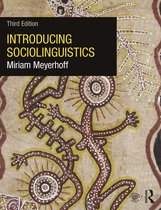
Introducing Sociolinguistics chapters 1-4
summary
Utrecht University
, Chapter 1: Introduction
What is sociolinguistics?
Sociolinguistics pays attention to differences in how individuals say things, and the differences
in how people from different places say things, and they try to relate what they have noticed to
Big Picture problems like the fact that people think that speakers who say things one way are
smarter or more attractive or more trustworthy than speakers who say the same thing in a
different way.
Interlocutor: the people who are talking together are each other’s interlocutors.
Everyone can modify the way they speak depending on who they are with or what the situation
is. When they do this, they are drawing on their sociolinguistic knowledge
How do sociolinguists study sociolinguistics
Sociolinguists use a range or methods, for example recorded speech, but also library and
archive materials.
A major challenge that sociolinguists face is that a lot of the time speakers are completely
unaware of the ways in which language is used differently in different contexts
● Researchers use a range of semi-conscious and subconscious methods for this
Social meaning: inferences about speakers or the variety they use and the interpretations we
draw about how those speakers are positioned in social space because of this.
Weighting: an adjustment that can be made to raw frequencies of a variant so as to take into
account any biases or skewing of its overall distribution. Expresses the probability or likelihood
with which a variant will occur in a given linguistic environment or with a given non-linguistic
factor.
Weighting for the frequency: restates how often a form occurs in the speech of a particular
group of speakers, or in a particular style or in a particular linguistic environment, given how
common that group, or style or environment is in the entire corpus. So it is a further adjustment,
over and above the kind of frequency adjustment a percentage makes. So weightings can be
glossed as adjusted percentages.
Chapter 2: Variation and language
Variables and variants
Variable: The general or abstract feature that you are investigating. An abstract representation
of the source of variation. Realised by two or more variants
● The feature that varies
, Variant: the actual realisation of a variable. Analogous to the phonetic realisations of a
phoneme.
● The actual instantiations of the variable in speech
You can write a variable in parentheses ()
To refer to vowel variables: use the system of keywords in Wells (1982)
● See Book XVII - XVIII for a full overview on this
Regular vs probabilistic alternations between variants
There are phonemes, and their abstract realizations: allophones. With the phoneme /p/, which
allophone is used depends on where it is in a word. It is constrained by where it occurs in a
syllable.
● Constrain/constraints: if the distribution of variants is neither random nor free, and
instead shows systematic correlations with independent factors, those factors can be
said to constrain the variation, or to be the constraints on the variable.
On the other hand, speakers can pronounce certain phonemes differently just depending on the
situation, or randomly.
● Free variation: the idea that some variants alternate with each other without any reliable
constraints on their occurrence in a particular context or by particular speakers.
Since the 1960’s sociolinguists have amassed considerable evidence showing that speaker
variability can be constrained by non-linguistic factors (things external to the linguistic system)
as well as by linguistic factors. The effects of social factors are seldom categorical; that is, all
speakers generally alternate at some time.
No social or contextual constraints determine where you will hear one form rather than another
100% of the time. However, they will tell you how likely you are to hear different forms in
different contexts and with different speakers. The difference is probabilistic. This is why it is so
helpful to take the trouble to quantify forms for different speakers or in different contexts.
● Determinism/deterministic: the idea that there is a strong causal relationship between
two factors (i.e, one determines how the other will be). THe idea that if you know the
value for one factor, you can automatically and reliably predict the value for another)
Sociolinguists have shown that a lot of what appears to be free variation can be accounted for if
linguists take social factors into account as well as linguistic factors.
A sociolinguistic variable can be defined as a linguistic variable that is constrained by social or
non-linguistic factors , and the concept of a variable constrained by non-linguistic factors
emerges straightforwardly from the traditions of dialectology.
Linguistic and non-linguistic factors: sometimes referred to as internal and external factors,
respectively. The distribution of the variants of a variable may be constrained by or depend on
other factors in the linguistic system. (For example; Is the subject a pronoun or a full NP? Is the
Introducing Sociolinguistics chapters 1-4
summary
Utrecht University
, Chapter 1: Introduction
What is sociolinguistics?
Sociolinguistics pays attention to differences in how individuals say things, and the differences
in how people from different places say things, and they try to relate what they have noticed to
Big Picture problems like the fact that people think that speakers who say things one way are
smarter or more attractive or more trustworthy than speakers who say the same thing in a
different way.
Interlocutor: the people who are talking together are each other’s interlocutors.
Everyone can modify the way they speak depending on who they are with or what the situation
is. When they do this, they are drawing on their sociolinguistic knowledge
How do sociolinguists study sociolinguistics
Sociolinguists use a range or methods, for example recorded speech, but also library and
archive materials.
A major challenge that sociolinguists face is that a lot of the time speakers are completely
unaware of the ways in which language is used differently in different contexts
● Researchers use a range of semi-conscious and subconscious methods for this
Social meaning: inferences about speakers or the variety they use and the interpretations we
draw about how those speakers are positioned in social space because of this.
Weighting: an adjustment that can be made to raw frequencies of a variant so as to take into
account any biases or skewing of its overall distribution. Expresses the probability or likelihood
with which a variant will occur in a given linguistic environment or with a given non-linguistic
factor.
Weighting for the frequency: restates how often a form occurs in the speech of a particular
group of speakers, or in a particular style or in a particular linguistic environment, given how
common that group, or style or environment is in the entire corpus. So it is a further adjustment,
over and above the kind of frequency adjustment a percentage makes. So weightings can be
glossed as adjusted percentages.
Chapter 2: Variation and language
Variables and variants
Variable: The general or abstract feature that you are investigating. An abstract representation
of the source of variation. Realised by two or more variants
● The feature that varies
, Variant: the actual realisation of a variable. Analogous to the phonetic realisations of a
phoneme.
● The actual instantiations of the variable in speech
You can write a variable in parentheses ()
To refer to vowel variables: use the system of keywords in Wells (1982)
● See Book XVII - XVIII for a full overview on this
Regular vs probabilistic alternations between variants
There are phonemes, and their abstract realizations: allophones. With the phoneme /p/, which
allophone is used depends on where it is in a word. It is constrained by where it occurs in a
syllable.
● Constrain/constraints: if the distribution of variants is neither random nor free, and
instead shows systematic correlations with independent factors, those factors can be
said to constrain the variation, or to be the constraints on the variable.
On the other hand, speakers can pronounce certain phonemes differently just depending on the
situation, or randomly.
● Free variation: the idea that some variants alternate with each other without any reliable
constraints on their occurrence in a particular context or by particular speakers.
Since the 1960’s sociolinguists have amassed considerable evidence showing that speaker
variability can be constrained by non-linguistic factors (things external to the linguistic system)
as well as by linguistic factors. The effects of social factors are seldom categorical; that is, all
speakers generally alternate at some time.
No social or contextual constraints determine where you will hear one form rather than another
100% of the time. However, they will tell you how likely you are to hear different forms in
different contexts and with different speakers. The difference is probabilistic. This is why it is so
helpful to take the trouble to quantify forms for different speakers or in different contexts.
● Determinism/deterministic: the idea that there is a strong causal relationship between
two factors (i.e, one determines how the other will be). THe idea that if you know the
value for one factor, you can automatically and reliably predict the value for another)
Sociolinguists have shown that a lot of what appears to be free variation can be accounted for if
linguists take social factors into account as well as linguistic factors.
A sociolinguistic variable can be defined as a linguistic variable that is constrained by social or
non-linguistic factors , and the concept of a variable constrained by non-linguistic factors
emerges straightforwardly from the traditions of dialectology.
Linguistic and non-linguistic factors: sometimes referred to as internal and external factors,
respectively. The distribution of the variants of a variable may be constrained by or depend on
other factors in the linguistic system. (For example; Is the subject a pronoun or a full NP? Is the