FSWBM-4220 International Public Management
Week 1
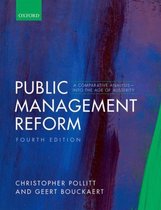
Public Management Reform – Pollitt & Bouckaert (2017)
Chapter 1 – Comparative Public Management Reform
Public Management Reforms are deliberative attempts to change the structures, processes, and
cultures of public sector organizations with the objective of getting them to run better. 3 waves of
reform thinking:
1. Mid-1960s – Late 1970s: rational, hierarchical, cost-benefit analysis, science and expertise
will produce progress.
2. Late 1970s – Late 1990s: New Public Management, business techniques to improve
efficiency.
3. Late 1990s – present: no dominant model, rather layering of models, focusing on
transparency, trust, governance, partnership, and networks.
Efficiency is the ratio between the inputs and the outputs. Effectivity is the degree to which the
desired outcomes result from the outputs.
Different reform models:
- New Public Management (NPM): to make the government more efficient and consumer-
oriented by injecting business-like methods, such as market-type mechanisms, competitive
contracts, performance indicators, and quasi-markets.
- Neo-Weberian State (NWS): to modernize the government so that it becomes more
professional, more efficient, and more responsive to citizens, but the state remains a
distinctive actor with its own rules, methods, and culture, authority via hierarchy.
- Networks: to make the government better informed, flexible, and less exclusive by working
through self-organizing networks instead of hierarchies or markets, networks of
interdependent stakeholders exchanging information and resources.
- New Public Governance (NPG): to make the government more effective and legitimate by
including a wider range of social actors, emphasize horizontality over vertical control,
partnerships bring different skills and resources.
3 approaches to cutbacks:
1. Cheese-slicing: ministers avoid directly choosing, everyone must meet its share, but
specialists might make self-interested choices which hurt the effectiveness.
2. Efficiency gains: doing more with less, sounds less threatening, but it requires considerable
changes that might not yield enough to correct imbalances.
, 3. Centralized priority setting: government is in direct control to protect the most effective
programs, but ministers are visibly responsible for painful choices.
A Public Management for All Seasons? – Hood (1991)
7 doctrines of NPM:
1. Hands-on professional management, clear assignment of responsibility, no diffusion of
power.
2. Explicit standards and measures of performance, clear definition of goals.
3. Greater emphasis on output controls, results rather than procedures.
4. Disaggregation of units in the public sector, operating in manageable decentralized units.
5. Competition in the public sector, rivalry to lower costs and better standards.
6. Private sector styles of management practice, greater flexibility in hiring and rewards.
7. Greater discipline and parsimony in resource use, do more with less.
There is no single explanation on why NPM found favor. NPM is an all-purpose solution, as it is
generally applicable to public management because 1) different applications led to uniformity, and 2)
it was claimed to be a-political with a wide range of values.
3 types of administrative values:
1. Sigma-type values try to match resources to tasks in an efficient manner, measurement in time
and money, goals must be fixed and checkable, such as just-in-time principle, payment by
result, and administrative cost-engineering.
2. Theta-type values focus on honesty, fairness, and mutuality by preventing distortion, bias, and
inequality, focus on process rather than in- and outputs, such as election for public officials,
anti-corruption bodies, and ‘hard lock’ requirements.
3. Lambda-type values focus on reliability, robustness, and adaptivity to ensure system survival,
focus on input and process, such as redundancy and diversity.
3 implications of NPM:
1. NPM expresses sigma-type values but focuses less on honesty and security.
2. NPM assumes public service honesty but tries to undermine it by removing measures that
secure that.
3. NPM focuses on cost-cutting and contracting-out but what effect does this have on safety and
survival of public service organizations.
, Lecture 1
Traditional Public Administration (TPA) focuses on the professionalization of how to conduct the
affairs of state. 3 testators:
1. Bureaucracy (Weber): clear hierarchy, standardization, rules dominate work, written
documents, impersonal, fulltime, and lifelong employment.
2. Politico-Administrative Dichotomy (Wilson): separation between politics and administration,
thus politicians and civil servants.
3. Scientific Management (Frederick): optimizing every work process, efficiency,
rationalization, standardization, and no mention of human relations.
The rise of NPM due to:
- Economic downturn in the 1970s.
- Market-oriented thinking became dominant due to Thatcher, World Bank, and IMF.
- TPA is seen as inefficient and ineffective in the allocation of resources.
- Critique on public officials as primarily self-serving.
NPM is a mix of 2 streams of ideas:
1. New Institutional Economics
o Public Choice Theory: maximizing public officials as budget builders
o Reduction of transaction costs
o Principal-Agent: delegating tasks
2. Business-type Managerialism
o Expertise
o Professional discretion
o Output management
Week 1
Public Management Reform – Pollitt & Bouckaert (2017)
Chapter 1 – Comparative Public Management Reform
Public Management Reforms are deliberative attempts to change the structures, processes, and
cultures of public sector organizations with the objective of getting them to run better. 3 waves of
reform thinking:
1. Mid-1960s – Late 1970s: rational, hierarchical, cost-benefit analysis, science and expertise
will produce progress.
2. Late 1970s – Late 1990s: New Public Management, business techniques to improve
efficiency.
3. Late 1990s – present: no dominant model, rather layering of models, focusing on
transparency, trust, governance, partnership, and networks.
Efficiency is the ratio between the inputs and the outputs. Effectivity is the degree to which the
desired outcomes result from the outputs.
Different reform models:
- New Public Management (NPM): to make the government more efficient and consumer-
oriented by injecting business-like methods, such as market-type mechanisms, competitive
contracts, performance indicators, and quasi-markets.
- Neo-Weberian State (NWS): to modernize the government so that it becomes more
professional, more efficient, and more responsive to citizens, but the state remains a
distinctive actor with its own rules, methods, and culture, authority via hierarchy.
- Networks: to make the government better informed, flexible, and less exclusive by working
through self-organizing networks instead of hierarchies or markets, networks of
interdependent stakeholders exchanging information and resources.
- New Public Governance (NPG): to make the government more effective and legitimate by
including a wider range of social actors, emphasize horizontality over vertical control,
partnerships bring different skills and resources.
3 approaches to cutbacks:
1. Cheese-slicing: ministers avoid directly choosing, everyone must meet its share, but
specialists might make self-interested choices which hurt the effectiveness.
2. Efficiency gains: doing more with less, sounds less threatening, but it requires considerable
changes that might not yield enough to correct imbalances.
, 3. Centralized priority setting: government is in direct control to protect the most effective
programs, but ministers are visibly responsible for painful choices.
A Public Management for All Seasons? – Hood (1991)
7 doctrines of NPM:
1. Hands-on professional management, clear assignment of responsibility, no diffusion of
power.
2. Explicit standards and measures of performance, clear definition of goals.
3. Greater emphasis on output controls, results rather than procedures.
4. Disaggregation of units in the public sector, operating in manageable decentralized units.
5. Competition in the public sector, rivalry to lower costs and better standards.
6. Private sector styles of management practice, greater flexibility in hiring and rewards.
7. Greater discipline and parsimony in resource use, do more with less.
There is no single explanation on why NPM found favor. NPM is an all-purpose solution, as it is
generally applicable to public management because 1) different applications led to uniformity, and 2)
it was claimed to be a-political with a wide range of values.
3 types of administrative values:
1. Sigma-type values try to match resources to tasks in an efficient manner, measurement in time
and money, goals must be fixed and checkable, such as just-in-time principle, payment by
result, and administrative cost-engineering.
2. Theta-type values focus on honesty, fairness, and mutuality by preventing distortion, bias, and
inequality, focus on process rather than in- and outputs, such as election for public officials,
anti-corruption bodies, and ‘hard lock’ requirements.
3. Lambda-type values focus on reliability, robustness, and adaptivity to ensure system survival,
focus on input and process, such as redundancy and diversity.
3 implications of NPM:
1. NPM expresses sigma-type values but focuses less on honesty and security.
2. NPM assumes public service honesty but tries to undermine it by removing measures that
secure that.
3. NPM focuses on cost-cutting and contracting-out but what effect does this have on safety and
survival of public service organizations.
, Lecture 1
Traditional Public Administration (TPA) focuses on the professionalization of how to conduct the
affairs of state. 3 testators:
1. Bureaucracy (Weber): clear hierarchy, standardization, rules dominate work, written
documents, impersonal, fulltime, and lifelong employment.
2. Politico-Administrative Dichotomy (Wilson): separation between politics and administration,
thus politicians and civil servants.
3. Scientific Management (Frederick): optimizing every work process, efficiency,
rationalization, standardization, and no mention of human relations.
The rise of NPM due to:
- Economic downturn in the 1970s.
- Market-oriented thinking became dominant due to Thatcher, World Bank, and IMF.
- TPA is seen as inefficient and ineffective in the allocation of resources.
- Critique on public officials as primarily self-serving.
NPM is a mix of 2 streams of ideas:
1. New Institutional Economics
o Public Choice Theory: maximizing public officials as budget builders
o Reduction of transaction costs
o Principal-Agent: delegating tasks
2. Business-type Managerialism
o Expertise
o Professional discretion
o Output management