

Topic 1.1 Monomers and Polymers and 1.2 Carbohydrates
Monomer - Smaller units, identical or similar, from which larger molecules are made.
Polymer - Molecules made from a large number of monomers joined together.
Condensation Reaction - Joins two molecules together with the formation of a chemical bond and involves the
elimination/removal of a water molecule.
Hydrolysis Reaction - Breaks a chemical bond between two molecules and involves the addition of a water
molecule.
Polymer Monomer
Carbohydrates Glucose
Proteins Amino Acids
Nucleic Acids Nucleotides
Lipids are NOT polymers - Made up of different monomers. Triglycerides do not chemically join with other
triglycerides as they are all different.
Carbohydrates contain the elements:
- Carbon - Oxygen - Hydrogen
They are split into 3 groups known as:
Monosaccharides (Monomers) - One sugar
Disaccharides (Dimers) - Two sugars
Polysaccharides (Polymers) - Many sugars
Monosaccharides and disaccharides are sweet, small and soluble whereas polysaccharides are large, insoluble
and not sweet.
Monosaccharides
There are 3 types:
Glucose, Fructose and Galactose - They all have the same molecular formula but different structures (isomers).
The most important monosaccharide is glucose.
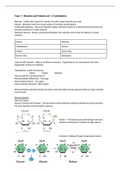
Carbon 1 - The hydroxyl group and hydrogen have been
switched in beta glucose compared to alpha glucose.
Formation of Maltose through condensation reaction:
,Maltose Molecular Formula = C12H22011
3 Main Disaccharides:
Glucose + Glucose = Maltose
Glucose + Fructose = Sucrose
Glucose + Galactose = Lactose
Polysaccharides:
- Starch - Cellulose - Glycogen
Chemical Tests
Test for starch is iodine. If the solution turns blue/black, starch is present.
Test for simple carbohydrates is heating with benedict's reagent. If reducing sugar is present, solution turns green
(least concentrated), yellow, orange or brick red (most concentrated)
Starch
Amylopectin = Branched chains of alpha glucose molecules.
This provides a large SA for rapid hydrolysis by enzymes releasing alpha glucose for respiration. It has 1-6 and 1-4
glycosidic bonds
Amylose = Long and straight chains of alpha glucose which coil into a helix.
This structure is compact so is good for storage - Large amount in a small space.
It has 1-4 glycosidic bonds only.
Starch is insoluble so has no effect on water potential - Osmosis does not occur and cause cell lysis. It is also too
large to pass through the cell membrane.
Glycogen
It has shorter chains, so it is more readily available to be hydrolysed into glucose - Due to higher metabolic rate of
animals and humans compared to plants. It is more highly branched therefore has a larger surface area. It is
stored in muscles and liver.
Glycogen is insoluble so does not affect water potential or diffuse out of cells.
Cellulose
It is made up of beta glucose molecules and has only 1-4 glycosidic bonds.
Beta glucose molecules join together through condensation reactions to form long straight, unbranched chains
that are parallel to one another.
Every other beta glucose molecule rotates 180° to allow OH groups on carbon 1 and 4 to be adjacent to each other
to form a glycosidic bond.
Several chains of cellulose are joined together in layers; these chains are held together by the formation of
hydrogen bonds formed between OH groups. Many chains joined by hydrogen bonds form a microfibril - many
microfibrils joined together form cellulose fibre to provide strength.
Topic 1.3 Lipids
,Lipids made up of elements :
- Carbon - Hydrogen - Oxygen
Triglycerides are made from one molecule of glycerol linked to three fatty acids.
Glycerol Formula = C3H803
Formation of triglyceride through condensation reaction:
Saturated Fatty Acid = Straight chain, only C-C single bonds, maximum amount of hydrogens.
Unsaturated Fatty Acid = Chain is ‘kinked’, C=C double bonds, doesn’t have maximum no. of hydrogens.
Chemical Test For Lipids - Emulsion Test
Crush sample, add ethanol, shake, add water. If lipid is present, milky white emulsion will appear.
Properties of Triglycerides
Energy storage molecule – Hydrocarbon tails of fatty acids contain lots of chemical energy.Carbon-hydrogen
bonds release energy when broken.
Insoluble - Do not affect water potential, conserve water – form droplets in water. Large non-polar molecule.
Source of water - High ratio of hydrogen:oxygen and releases oxygen when oxidised.
Insulation – Slow conductors of heat can help retain body heat and act as electrical insulators in nerve impulses
as myelin sheath.
Protection – Surrounds organs.
, Phospholipids = Similar structure to triglycerides but one of the fatty acids is replaced by a phosphate group, so
the glycerol combines with two fatty acids and one phosphate group.
The phosphate group has a negative charge (polar)
whereas the fatty acid tails do not have a charge
(non-polar). This makes the phospho-glycerol head
hydrophilic (attracts water - soluble) and the fatty
acid tails hydrophobic (repels water- not soluble)
This allows the phospholipids to form a bilayer in
water.
The hydrophobic fatty acid tails are arranged in the
middle away from water and the hydrophilic heads
interact with water so are arranged on the outside in
contact with water. This is a polar molecule as each
component behaves differently.
These phospholipids can join with carbohydrates to form glycolipids which act as receptors and are important in
cell recognition. Phospholipids help to form the cell membrane of a cell.
Topic 1.4.1 Proteins
Chemical Test For Proteins - Biuret Test
Add sodium hydroxide to the sample, add copper sulphate. If the sample turns lilac/purple, protein is present. This
test detects the presence of peptide bonds. Some amino acids will also give a positive test as peptide bonds are
found in the R-group.
All proteins and amino acids contain the elements Nitrogen (N), Carbon (C), and Hydrogen (H) and oxygen (O).
Some also contain sulphur (S).
Proteins are made of monomers called amino acids. There are about 20 different types of amino acids, all with the
same general structure.
Two amino acids join together to form a dipeptide by a
condensation reaction.
Dipeptide Formation:
The hydroxyl group (OH) from one amino acid reacts
with hydrogen (H) from the amine group in the second
amino acid to form water. The water is removed in the
formation of a peptide bond. Many amino acids join
together to form a polypeptide chain.
Protein Primary Structure
The primary structure is the number and sequence of
amino acids in a polypeptide chain. Proteins differ
Monomer - Smaller units, identical or similar, from which larger molecules are made.
Polymer - Molecules made from a large number of monomers joined together.
Condensation Reaction - Joins two molecules together with the formation of a chemical bond and involves the
elimination/removal of a water molecule.
Hydrolysis Reaction - Breaks a chemical bond between two molecules and involves the addition of a water
molecule.
Polymer Monomer
Carbohydrates Glucose
Proteins Amino Acids
Nucleic Acids Nucleotides
Lipids are NOT polymers - Made up of different monomers. Triglycerides do not chemically join with other
triglycerides as they are all different.
Carbohydrates contain the elements:
- Carbon - Oxygen - Hydrogen
They are split into 3 groups known as:
Monosaccharides (Monomers) - One sugar
Disaccharides (Dimers) - Two sugars
Polysaccharides (Polymers) - Many sugars
Monosaccharides and disaccharides are sweet, small and soluble whereas polysaccharides are large, insoluble
and not sweet.
Monosaccharides
There are 3 types:
Glucose, Fructose and Galactose - They all have the same molecular formula but different structures (isomers).
The most important monosaccharide is glucose.
Carbon 1 - The hydroxyl group and hydrogen have been
switched in beta glucose compared to alpha glucose.
Formation of Maltose through condensation reaction:
,Maltose Molecular Formula = C12H22011
3 Main Disaccharides:
Glucose + Glucose = Maltose
Glucose + Fructose = Sucrose
Glucose + Galactose = Lactose
Polysaccharides:
- Starch - Cellulose - Glycogen
Chemical Tests
Test for starch is iodine. If the solution turns blue/black, starch is present.
Test for simple carbohydrates is heating with benedict's reagent. If reducing sugar is present, solution turns green
(least concentrated), yellow, orange or brick red (most concentrated)
Starch
Amylopectin = Branched chains of alpha glucose molecules.
This provides a large SA for rapid hydrolysis by enzymes releasing alpha glucose for respiration. It has 1-6 and 1-4
glycosidic bonds
Amylose = Long and straight chains of alpha glucose which coil into a helix.
This structure is compact so is good for storage - Large amount in a small space.
It has 1-4 glycosidic bonds only.
Starch is insoluble so has no effect on water potential - Osmosis does not occur and cause cell lysis. It is also too
large to pass through the cell membrane.
Glycogen
It has shorter chains, so it is more readily available to be hydrolysed into glucose - Due to higher metabolic rate of
animals and humans compared to plants. It is more highly branched therefore has a larger surface area. It is
stored in muscles and liver.
Glycogen is insoluble so does not affect water potential or diffuse out of cells.
Cellulose
It is made up of beta glucose molecules and has only 1-4 glycosidic bonds.
Beta glucose molecules join together through condensation reactions to form long straight, unbranched chains
that are parallel to one another.
Every other beta glucose molecule rotates 180° to allow OH groups on carbon 1 and 4 to be adjacent to each other
to form a glycosidic bond.
Several chains of cellulose are joined together in layers; these chains are held together by the formation of
hydrogen bonds formed between OH groups. Many chains joined by hydrogen bonds form a microfibril - many
microfibrils joined together form cellulose fibre to provide strength.
Topic 1.3 Lipids
,Lipids made up of elements :
- Carbon - Hydrogen - Oxygen
Triglycerides are made from one molecule of glycerol linked to three fatty acids.
Glycerol Formula = C3H803
Formation of triglyceride through condensation reaction:
Saturated Fatty Acid = Straight chain, only C-C single bonds, maximum amount of hydrogens.
Unsaturated Fatty Acid = Chain is ‘kinked’, C=C double bonds, doesn’t have maximum no. of hydrogens.
Chemical Test For Lipids - Emulsion Test
Crush sample, add ethanol, shake, add water. If lipid is present, milky white emulsion will appear.
Properties of Triglycerides
Energy storage molecule – Hydrocarbon tails of fatty acids contain lots of chemical energy.Carbon-hydrogen
bonds release energy when broken.
Insoluble - Do not affect water potential, conserve water – form droplets in water. Large non-polar molecule.
Source of water - High ratio of hydrogen:oxygen and releases oxygen when oxidised.
Insulation – Slow conductors of heat can help retain body heat and act as electrical insulators in nerve impulses
as myelin sheath.
Protection – Surrounds organs.
, Phospholipids = Similar structure to triglycerides but one of the fatty acids is replaced by a phosphate group, so
the glycerol combines with two fatty acids and one phosphate group.
The phosphate group has a negative charge (polar)
whereas the fatty acid tails do not have a charge
(non-polar). This makes the phospho-glycerol head
hydrophilic (attracts water - soluble) and the fatty
acid tails hydrophobic (repels water- not soluble)
This allows the phospholipids to form a bilayer in
water.
The hydrophobic fatty acid tails are arranged in the
middle away from water and the hydrophilic heads
interact with water so are arranged on the outside in
contact with water. This is a polar molecule as each
component behaves differently.
These phospholipids can join with carbohydrates to form glycolipids which act as receptors and are important in
cell recognition. Phospholipids help to form the cell membrane of a cell.
Topic 1.4.1 Proteins
Chemical Test For Proteins - Biuret Test
Add sodium hydroxide to the sample, add copper sulphate. If the sample turns lilac/purple, protein is present. This
test detects the presence of peptide bonds. Some amino acids will also give a positive test as peptide bonds are
found in the R-group.
All proteins and amino acids contain the elements Nitrogen (N), Carbon (C), and Hydrogen (H) and oxygen (O).
Some also contain sulphur (S).
Proteins are made of monomers called amino acids. There are about 20 different types of amino acids, all with the
same general structure.
Two amino acids join together to form a dipeptide by a
condensation reaction.
Dipeptide Formation:
The hydroxyl group (OH) from one amino acid reacts
with hydrogen (H) from the amine group in the second
amino acid to form water. The water is removed in the
formation of a peptide bond. Many amino acids join
together to form a polypeptide chain.
Protein Primary Structure
The primary structure is the number and sequence of
amino acids in a polypeptide chain. Proteins differ

