
1a.Coastal landscapes viewed as systems
● System is a set of interrelated objects comprising components (stores) and processes (links) that
are connected together to form a working unit.
Components including inputs, processes and outputs:
● Inputs- lead to processes
- Marine: tides, waves, salt spray
- Atmosphere: sun, precipitation, air pressure, wind speed and direction
- Humans: pollution, recreation, settlement, defences
- Terrestrial: weathering, erosion, deposition, rock type/ structure
● Processes- lead to outputs
- Erosion
- Transport
- Deposition
● Outputs- landforms/ features
- Beaches
- Sand dunes
- Spits
- Bars and tombolos
- Headlands and bays
- Cliffs
- Wave Cut notches
- Wave Cut platforms
- Caves
- Arches
- Stacks
- stumps
Flows of energy and material through coastal systems:
● Store and transfer energy and material on time scales that can vary from a few days to a millennia
● Energy- may be kinetic, thermal or potential (gravitational)
- Kinetic energy from wind and waves
- Thermal energy from heat of the sun
- Potential from position of material on slopes
● Provided by waves, winds, tides and currents
● This energy enables natural geomorphic processes that shape
● Varies spatially and temporarily
● Material-
- System- sourcing, transfer and deposition of sediment along stretch of coastline called a
sediment cell (-not on advanced but discussed below)
● Coastal systems known as open systems- energy and matter can be transferred from neighbouring
systems as an input. It can also be transferred to neighbouring systems as an output
● When systems input=output, equilibrium exists
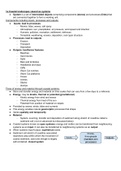
● Sediment cell stretch of coastline associated
nearshore area within which the movement of
coarse sediment, sand and shingle is largely
self-contained- closed system
, 1b.Coastal landscape systems are influenced by a range of physical factors
Winds, including speed, direction and frequency:
● Source of energy for coastal erosion & sediment transport
● Through aeolian processes or through this energy being transferred to wave energy
● Aeolian transport and deposition is responsible for the formation of sand dunes
Waves:
● Waves created by frictional drag of wind blowing over the surface of the
sea, wave energy depends on-
- Wind strength
- Wind duration
- Water depth
- The fetch of the wave
● Wave dominated coasts- sandy and rocky coastlines
● Dynamic and sensitive systems, often in equilibrium in natural
state, but susceptible from interference of human activity
● Global scale coastal environments reflect large degree the climatic
conditions experienced in a region such as wind speed and duration, as well as size of the ocean
concerned
● Deep ocean-sea/force waves
● As they propagate out of area of generation they become swell waves (oscillatory waves)
● They have an oscillatory motion, water particles do no more, just energy
● ¼ wavelength in terms of depth of water= wave base
● When the wave base intersects the seafloor, the wave shoals/ breaks and becomes a translatory
wave
● Translatory wave transfer both energy and water
● Wave formation, development & breaking
- Spilling breakers (constructive)- gentle beach gradients, high steepness waves, bubbles
and foam
- Plunging breakers (destructive)-
- Surging breakers-
● Wave refraction- waves encounter vertical face of sea wall, may approach 100% (L3)
● Wave refraction during shoaling
● Wave approaches irregular coastline, part of wave that is in shallower water travels more slowly
than the part of the wave in deeper water causing wave to bend
● Refraction can create longshore currents such as longshore drift


