

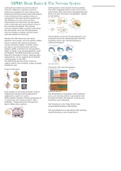
MPBD: Brain Basics & The Nervous System
Information travels via nervous cells or Development of the central nervous system
neurons. Afferent or sensory neurons The brain originates from a tube. The neural
detect the changes from the internal and tube bends, folds, and forms enlargements and
external environment and send information forms a 3 part structure “encephalon” (greek
to the central nervous system which is for the brain).
composed of the brain and the spinal cord.
The efferent or motor neurons send
information from the brain via the spinal
cord to the body and can therefore control
the muscles and glands. The central
nervous system (CNS) consists of the brain
and the spinal cord, and the peripheral
nervous system consists of all the other
neurons present in the body.
The forebrain forms the prosencephalon, the
Besides the CNS there are two other midbrain forms the mesencephalon and the
systems, the somatic nervous system (SNS) hindbrain forms the rhombencephalon
which contains the cranial and spinal (diamond-shaped).
nerves (sensory organs, muscles, joints,
and skin), and the autonomic nervous
system (ANS) is divided into sympathetic
(fight or flight), and parasympathetic (rest
and digest). The SNS transmits incoming
sensory information (vision, hearing, pain,
temperature, touch, position & movement
of body parts) to the CNS.
The ANS balances the body’s internal
organs (heart, blood vessels, lungs, airways,
intestines, etc).
Divisions of the nervous system
Views of the brain
Grey matter in the brain consists of blood
vessels and neuronal cell bodies and is The Brainstem is composed of the midbrain,
organized in layers or nuclei. pons, and medulla which is associated with
While matter consists of axons projection to arousal and basic life support, such as your
or away from the nucleus (layer = fibre heartbeat and breathing.
pathway). These axons are covered in a
layer of glial cells (myelin). The Thalamus is the relay centre that
preprocesses sensory information
The hypothalamus is associated with feeding,
sexual behaviour, and temperature.
, The Cerebellum is associated with fine motor The two cerebral hemispheres are connected
control and balance. via the corpus callosum, which is a bundle of
axons.
Diencephalon = in between brain
Metenchephalon = across brain Telencephalon: Lateral ventricles
Telencephalon = endbrain
Myelencephalon = medulla
The Cortex
Ventricle system The cortex is a wrinkled surface that is about
The brain begins as a tube. After the tube 1.5 - 3 mm thick. It has ridges/folds, called
folds and matures the interior remains Gyrus, and clefts/grooves. The sulcus is a
hollow and internal systems of chambers shallow groove that surrounds the gyrus, and
form, called ventricles. The ventricles are Fissures are large grooves that divide the brain
filled with liquid, cerebrospinal fluid (CSF). into lobes/hemispheres. The cortex is wrinkled
CSF is constantly circulating and is involved so it has a larger cortical surface area, and fits
in absorbing or reducing the impact of into the skull. The cortex is divided into four
knocks, nourishing brain tissue, and areas/lobes:
removal of toxins. • Frontal lobe
• Parietal lobe
• Occipital lobe
• Temporal lobe
The Telencephalon cortex
The telencephalon cortex consists of two
cerebral hemispheres and two lateral
ventricles.
The Cerebral Cortex is a thin layer of
wrinkled tissue with clefts and ridges that
creates and responds to perceptions of the
world.
The Basal Ganglia is a collection of nuclei
that play a role in the control, and
coordination of movement.
Limbic structures play a role in emotion,
memory, motivation, and reward.
Information travels via nervous cells or Development of the central nervous system
neurons. Afferent or sensory neurons The brain originates from a tube. The neural
detect the changes from the internal and tube bends, folds, and forms enlargements and
external environment and send information forms a 3 part structure “encephalon” (greek
to the central nervous system which is for the brain).
composed of the brain and the spinal cord.
The efferent or motor neurons send
information from the brain via the spinal
cord to the body and can therefore control
the muscles and glands. The central
nervous system (CNS) consists of the brain
and the spinal cord, and the peripheral
nervous system consists of all the other
neurons present in the body.
The forebrain forms the prosencephalon, the
Besides the CNS there are two other midbrain forms the mesencephalon and the
systems, the somatic nervous system (SNS) hindbrain forms the rhombencephalon
which contains the cranial and spinal (diamond-shaped).
nerves (sensory organs, muscles, joints,
and skin), and the autonomic nervous
system (ANS) is divided into sympathetic
(fight or flight), and parasympathetic (rest
and digest). The SNS transmits incoming
sensory information (vision, hearing, pain,
temperature, touch, position & movement
of body parts) to the CNS.
The ANS balances the body’s internal
organs (heart, blood vessels, lungs, airways,
intestines, etc).
Divisions of the nervous system
Views of the brain
Grey matter in the brain consists of blood
vessels and neuronal cell bodies and is The Brainstem is composed of the midbrain,
organized in layers or nuclei. pons, and medulla which is associated with
While matter consists of axons projection to arousal and basic life support, such as your
or away from the nucleus (layer = fibre heartbeat and breathing.
pathway). These axons are covered in a
layer of glial cells (myelin). The Thalamus is the relay centre that
preprocesses sensory information
The hypothalamus is associated with feeding,
sexual behaviour, and temperature.
, The Cerebellum is associated with fine motor The two cerebral hemispheres are connected
control and balance. via the corpus callosum, which is a bundle of
axons.
Diencephalon = in between brain
Metenchephalon = across brain Telencephalon: Lateral ventricles
Telencephalon = endbrain
Myelencephalon = medulla
The Cortex
Ventricle system The cortex is a wrinkled surface that is about
The brain begins as a tube. After the tube 1.5 - 3 mm thick. It has ridges/folds, called
folds and matures the interior remains Gyrus, and clefts/grooves. The sulcus is a
hollow and internal systems of chambers shallow groove that surrounds the gyrus, and
form, called ventricles. The ventricles are Fissures are large grooves that divide the brain
filled with liquid, cerebrospinal fluid (CSF). into lobes/hemispheres. The cortex is wrinkled
CSF is constantly circulating and is involved so it has a larger cortical surface area, and fits
in absorbing or reducing the impact of into the skull. The cortex is divided into four
knocks, nourishing brain tissue, and areas/lobes:
removal of toxins. • Frontal lobe
• Parietal lobe
• Occipital lobe
• Temporal lobe
The Telencephalon cortex
The telencephalon cortex consists of two
cerebral hemispheres and two lateral
ventricles.
The Cerebral Cortex is a thin layer of
wrinkled tissue with clefts and ridges that
creates and responds to perceptions of the
world.
The Basal Ganglia is a collection of nuclei
that play a role in the control, and
coordination of movement.
Limbic structures play a role in emotion,
memory, motivation, and reward.

