PORTAGE LEARNING CHEM 210 - MODULE 3 PROBLEM SET.
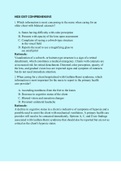
PORTAGE LEARNING CHEM 210 - MODULE 3 PROBLEM SET. Name three different functions of proteins. Transport, hormones, catalysis, structure, and protection What function does a protease have? catalysis. It degrades proteins. What is the function of hormones? These proteins communicate from one cell to another What are the functional groups common to all amino acids? amine and carboxylic acid Briefly describe the five major groupings of amino acids. The amino acids are grouped into 1) nonpolar, aliphatic 2) nonpolar and aromatic 3) polar but neutral, 4) acidic, and 5) basic. What is the name, one-letter abbreviation, and three-letter abbreviation of the following amino acid? Arginine, R, Arg What amino acid can form a disulfide bond? cysteine Which amino acid is the only one to have its side chain connected to the amine group? Proline Consider the following protein structure. Fill the blanks with the appropriate term below. The major type of secondary structure present in this protein is A . The protein’s overall tertiary structure is a B conformation. (select one: globular or fibrous). This protein has two polypeptide chains, which indicates it has C structure. (A) alpha helices (B) globular (C) quaternary Consider the following pentapeptide: ETYLVD. Which amino acid is at the N terminal? Which is at the C terminal? E is at the N-terminal, and D is at the C-terminal. Consider the following tetrapeptide. A) Use the three-letter abbreviations to write the representation of the following tetrapeptide. B) How many peptide bonds are in this peptide? A) Lys-Asp-Ile-Thr B) 3 peptide bonds connect four amino acids. Differentiate between protein tertiary structure and protein quaternary structure. Tertiary structure is the conformation or shape of a single polypeptide chain. Quaternary structure is the orientation of multiple subunits. Proteins typically adopt either a conformation that is fibrous or . globular What is the function of an enzyme? to accelerate the rate of a biological reaction How does a competitive inhibitor differ from a uncompetitive inhibitor? A competitive inhibitor binds at the active site of the enzyme. An uncompetitive inhibitor binds at a site distinct from the active site, but it still inhibits the enzyme. What three factors influence enzyme catalyzed reactions? pH, temperature, and concentration of enzyme and substrate
Escuela, estudio y materia
- Institución
- Portage Learning
- Grado
- Portage Learning Chem 210 -
Información del documento
- Subido en
- 9 de noviembre de 2022
- Número de páginas
- 8
- Escrito en
- 2022/2023
- Tipo
- Examen
- Contiene
- Preguntas y respuestas
Temas
-
hormones
-
catalysis
-
structure
-
and pr
-
portage learning chem 210 module 3 problem set
-
portage learning chem 210 module 3 problem set name three different functions of proteins transport

Documento también disponible en un lote