Baumol (1990): Entrepreneurship: Productive, Unproductive, and
Destructive
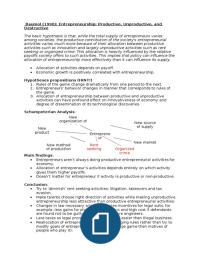
The basic hypothesis is that, while the total supply of entrepreneurs varies
among societies, the productive contribution of the society's entrepreneurial
activities varies much more because of their allocation between productive
activities such as innovation and largely unproductive activities such as rent
seeking or organized crime. This allocation is heavily influenced by the relative
payoffs society offers to such activities. This implies that policy can influence the
allocation of entrepreneurship more effectively than it can influence its supply.
Allocation of activities depends on payoff.
Economic growth is positively correlated with entrepreneurship.
Hypotheses propositions (HINT!)
1. Rules of the game change dramatically from one period to the next.
2. Entrepreneurs’ behavior changes in manner that corresponds to rules of
the game.
3. Allocation of entrepreneurship between productive and unproductive
activities can have profound effect on innovativeness of economy and
degree of dissemination of its technological discoveries.
Schumpeterian Analysis:
New
organization of New source
industry of supply
New
product Entreprene
ur
New market
New method Rent
of production seeking Organized
crime
Main findings:
Entrepreneurs aren’t always doing productive entrepreneurial activities for
economy.
Allocation of entrepreneur’s activities depends entirely on which activity
gives them higher payoffs.
Doesn’t matter for entrepreneur if activity is productive or non-productive.
Conclusion:
Try to ‘diminish’ rent seeking activities: litigation, takeovers and tax
evasion.
Make talents choose right direction of activities while making unproductive
entrepreneurship less attractive than productive entrepreneurial activities:
Changes in law necessary which eliminates incentives for legal suits, for
example: less gains for plaintiff firm if it wins and high cost if defendants
are found not to be guilty less lawyers more engineers.
Less taxes so legal productive work becomes easier then illegal business.
Reallocation of entrepreneurial effort by changing rules rather than try to
modify goals of entrepreneurs (easier to change game then motives of
people who play it).
, Apply restrictions on monopolies to eliminate chances for rent seeking
activities.
HINT
Schumpeter: Austrian economist, became famous in Chicago.
Sobel (2008): Testing Baumol: Institutional quality and the productivity
of entrepreneurship
Hypothesis: productive entrepreneur (creating wealth) versus unproductive
entrepreneur (destroying wealth).
Main findings: to become wealthier, states and nations need to promote more
productive entrepreneurship and less unproductive entrepreneurship:
1. Increase rate of return on productive market entrepreneurship.
2. Decrease rate of return on unproductive entrepreneurship.
Hence, confirming both parts of Baumol’s theory of productive and unproductive
entrepreneurship.
Conclusion:
Shift towards institutional reform as way to promote entrepreneurship is
large change in thinking given conventional wisdom.
Baumol’s theory and its policy implications could potentially form
foundation of 21st century economic development policy. Which in turn
leads to more wealth as product innovation is promoted.
HINT
Contribution of Baumol’s theory: shift towards institutional reform as
way to promote entrepreneurship is large change in thinking given
conventional wisdom.
Economists’ definitions of entrepreneurship.
o 1730: Cantillon: willingness to bear personal financial risk of
business venture.
o 1800: Say: creating value by moving resources out of less
productive areas and into more productive ones.
o 1921: Knight: entrepreneurs deal with uncertainty about future, not
risk.
o 1942: Schumpeter: entrepreneurs find new combinations of
resources.
o 1997: Kirzner: entrepreneurship is equilibrating force in which
entrepreneurs discover unnoticed profit opportunities.
o 1998: Holcombe: innovation creates multitude of new profit
opportunities that are exploited by Kirzenian entrepreneurs.
o 2002: Baumol: theory of productive and unproductive
entrepreneurship.
Delaware no. 1 state: lot of companies switched to Delaware. Tax in
destructive, crime and war, and subsidiaries are bad. Government isn’t
entrepreneur; should only make rules.
Bowman Ambrosini (2000): Value Creation versus Value Capture
Resource-based theory has tended to focus on the development and protection of
valuable resources. What determines a valuable resource has received less
attention. This paper addresses three related issues concerning value and valuable
Destructive
The basic hypothesis is that, while the total supply of entrepreneurs varies
among societies, the productive contribution of the society's entrepreneurial
activities varies much more because of their allocation between productive
activities such as innovation and largely unproductive activities such as rent
seeking or organized crime. This allocation is heavily influenced by the relative
payoffs society offers to such activities. This implies that policy can influence the
allocation of entrepreneurship more effectively than it can influence its supply.
Allocation of activities depends on payoff.
Economic growth is positively correlated with entrepreneurship.
Hypotheses propositions (HINT!)
1. Rules of the game change dramatically from one period to the next.
2. Entrepreneurs’ behavior changes in manner that corresponds to rules of
the game.
3. Allocation of entrepreneurship between productive and unproductive
activities can have profound effect on innovativeness of economy and
degree of dissemination of its technological discoveries.
Schumpeterian Analysis:
New
organization of New source
industry of supply
New
product Entreprene
ur
New market
New method Rent
of production seeking Organized
crime
Main findings:
Entrepreneurs aren’t always doing productive entrepreneurial activities for
economy.
Allocation of entrepreneur’s activities depends entirely on which activity
gives them higher payoffs.
Doesn’t matter for entrepreneur if activity is productive or non-productive.
Conclusion:
Try to ‘diminish’ rent seeking activities: litigation, takeovers and tax
evasion.
Make talents choose right direction of activities while making unproductive
entrepreneurship less attractive than productive entrepreneurial activities:
Changes in law necessary which eliminates incentives for legal suits, for
example: less gains for plaintiff firm if it wins and high cost if defendants
are found not to be guilty less lawyers more engineers.
Less taxes so legal productive work becomes easier then illegal business.
Reallocation of entrepreneurial effort by changing rules rather than try to
modify goals of entrepreneurs (easier to change game then motives of
people who play it).
, Apply restrictions on monopolies to eliminate chances for rent seeking
activities.
HINT
Schumpeter: Austrian economist, became famous in Chicago.
Sobel (2008): Testing Baumol: Institutional quality and the productivity
of entrepreneurship
Hypothesis: productive entrepreneur (creating wealth) versus unproductive
entrepreneur (destroying wealth).
Main findings: to become wealthier, states and nations need to promote more
productive entrepreneurship and less unproductive entrepreneurship:
1. Increase rate of return on productive market entrepreneurship.
2. Decrease rate of return on unproductive entrepreneurship.
Hence, confirming both parts of Baumol’s theory of productive and unproductive
entrepreneurship.
Conclusion:
Shift towards institutional reform as way to promote entrepreneurship is
large change in thinking given conventional wisdom.
Baumol’s theory and its policy implications could potentially form
foundation of 21st century economic development policy. Which in turn
leads to more wealth as product innovation is promoted.
HINT
Contribution of Baumol’s theory: shift towards institutional reform as
way to promote entrepreneurship is large change in thinking given
conventional wisdom.
Economists’ definitions of entrepreneurship.
o 1730: Cantillon: willingness to bear personal financial risk of
business venture.
o 1800: Say: creating value by moving resources out of less
productive areas and into more productive ones.
o 1921: Knight: entrepreneurs deal with uncertainty about future, not
risk.
o 1942: Schumpeter: entrepreneurs find new combinations of
resources.
o 1997: Kirzner: entrepreneurship is equilibrating force in which
entrepreneurs discover unnoticed profit opportunities.
o 1998: Holcombe: innovation creates multitude of new profit
opportunities that are exploited by Kirzenian entrepreneurs.
o 2002: Baumol: theory of productive and unproductive
entrepreneurship.
Delaware no. 1 state: lot of companies switched to Delaware. Tax in
destructive, crime and war, and subsidiaries are bad. Government isn’t
entrepreneur; should only make rules.
Bowman Ambrosini (2000): Value Creation versus Value Capture
Resource-based theory has tended to focus on the development and protection of
valuable resources. What determines a valuable resource has received less
attention. This paper addresses three related issues concerning value and valuable