
An introduction to Spatial Planning in the Netherlands
Going Dutch
Spatial planning – an exploration of the discipline
Three elements that are crucial for an understanding of planning:
Public activity
Future
Space
Projective scenarios are forecasting and is short-term.
Prospective scenarios are backcasting and long-term.
The object of reference in (spatial) planning is space, or a territory (neighbourhood, municipality,
region, state), while in sectoral planning it is a topic or sector (agriculture, tourism, transport).
The trias politica is a separation of powers in liberal democracies in order to prevent abuse of power
Legislative branch: elected politicians making laws
Executive branch: implementing and enforcing laws
Judicial branch: courts and organs
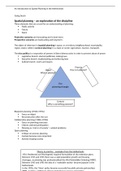
Process
Object How is it planned?
What is planned?
The
planning triangle
Context
Why is something planned?
Blueprint planning (1940s-1970s)
Focus on object
Reconstruction after the war
Collaborative planning (1980s-1990s)
Focus on planning processes
Citizens claimed participation
Planning as ‘mirror of society’ > wicked problems
Open planning
Critique on process planning
Context became more important
Actively shaping society
Theory in practice – examples from the Netherlands
1901: Residental act (Woningwet) required formulation of city extension plans.
Between 1945 and 1965 there was a rapid population growth and housing
shortages, so planning was professionalised the Wet Ruimtelijke Ordening (WRO).
Between 1965 and 1985 the idea of a ‘makeable society’ became popular in the
Netherlands.
In the 1990s, the ‘Vinex’ policy became successful by public-private partnerships
, An introduction to Spatial Planning in the Netherlands
The object of planning
Object of planning: five key characteristics
Physical connection (Immovability and place attachment)
Inert nature (Irreversible, immovable and inert nature of land)
Heterogeneity (Every location is different from another)
Functions (Functional uses are spatially bounded)
Price (Difference in price and value)
Land-use planning Spatial planning
Regulations on how land may be used More strategic and ambitious
Regulate the rights of others Strategic planning for entire cities/regions
Using numerical standards Integral
Contraction: used to stop deterioration of neighbourhoods
Conservation: protecting the qualities in planning
Land-use planning at different scales
National level: steer the development of main structure
Regional level: develops spatial visions & specifying national planning concepts
Local level: legally binding land-use plans
Multi-level dynamics: abstract to concrete ideas
Investments in infrastructure
Cause economic development
Development in transport infrastructures and growth of the regional economy stimulate
each other. > However, there is a lack of proof in this claim.
Economic costs of external effects like noise, congestion and emissions
Transport infrastructure is dependent on economic development and vice versa.
Investments in infrastructure are important for the development of spatial structures and mobility.
Traffic effects attainability of houses and the other way around.
The question which development is caused by infrastructure is hard to determine.


