
Package Title: Testbank
Course Title: Berg 3e
Chapter Number: 01
Question type: Multiple Choice
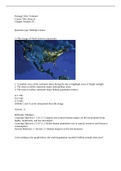
1) This image of North America represents:
1. A satellite view of the continent taken during the day to highlight areas of bright sunlight.
2. The areas in yellow represent major metropolitan areas.
3. The areas in yellow represent major human population centers.
a) 1 only
b) 2 only
c) 3 only
d) Both 2 and 3 can be interpreted from the image.
Answer: d
Difficulty: Medium
Learning Objective 1: LO 1.1 Compare and contrast human impact on the environment from
highly, moderately, and less developed
Learning Objective 2: LO 1.1.2 Relate human population size to natural resources and resource
consumption.
Section Reference 1: Section 1.1 Human Impacts on the Environment
2) According to the graph below, the world population reached 6 billion around what year?
,a) 1900 CE
b) 2000 BCE
c) 2000 CE
d) Around the time of the Black Death
Answer: c
Difficulty: Easy
Learning Objective 1: LO 1.1 Compare and contrast human impact on the environment from
highly, moderately, and less developed
Learning Objective 2: LO 1.1.2 Relate human population size to natural resources and resource
consumption.
Section Reference 1: Section 1.1 Human Impacts on the Environment
3) Which of the following statements associated with poverty is CORRECT?
1. Poverty is defined as having a per person income of less than $2 per day, expressed in U.S.
dollars adjusted for purchasing power.
2. The number of people living in poverty has been steadily declining and today less than one
billion people live in poverty worldwide.
3. Poverty is a condition in which people are unable to meet their basic needs for food, clothing,
shelter, education, or health.
a) 1 only
b) 2 only
,c) 3 only
d) Both 1 and 3 apply as descriptions of poverty.
Answer: d
Difficulty: Medium
Learning Objective 1: LO 1.1 Compare and contrast human impact on the environment from
highly, moderately, and less developed
Learning Objective 2: LO 1.1.3 Distinguish between people overpopulation and consumption
overpopulation.
Section Reference 1: Section 1.1 Human Impacts on the Environment
4) Poverty is associated with all of the following EXCEPT:
a) low life expectancy
b) balanced nutrition
c) inadequate access to health services
d) illiteracy
Answer: b
Difficulty: Easy
Learning Objective 1: LO 1.1 Compare and contrast human impact on the environment from
highly, moderately, and less developed
Learning Objective 2: LO 1.1.3 Distinguish between people overpopulation and consumption
overpopulation.
Section Reference 1: Section 1.1 Human Impacts on the Environment
5) Which of the following describes a highly developed country?
a) Countries with low rates of population growth and high per person incomes.
b) Countries with complex industrialized bases such as Mexico and Thailand.
c) Countries with low levels of industrialization, very high rates of population growth, very high
infant mortality rates, and very low per person incomes.
d) Countries with abundant unskilled labor but with limited capital for investment.
Answer: a
Difficulty: Medium
Learning Objective 1: LO 1.1 Compare and contrast human impact on the environment from
highly, moderately, and less developed
Learning Objective 2: LO 1.1.1 Distinguish among highly developed countries, moderately
developed countries, and less developed countries
Section Reference 1: Section 1.1 Human Impacts on the Environment
, 6) Which of the following images represents consumption overpopulation?
a) Family from Mexico
b) Family from Mali
c) Family from Japan
Answer: c
Difficulty: Easy
Learning Objective 1: LO 1.1 Compare and contrast human impact on the environment from
highly, moderately, and less developed
Learning Objective 2: LO 1.1.3 Distinguish between people overpopulation and consumption
overpopulation.
Section Reference 1: Section 1.1 Human Impacts on the Environment
7) The photograph below represents the average family living in Mali. Based on the photo, what
do you think is Mali’s most likely contribution to environmental problems?

