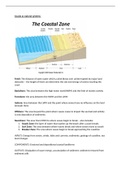
Coasts as natural systems
Fetch: The distance of open water which a wind blows over uninterrupted by major land
obstacles – the length of fetch can determine the size and energy of waves reaching the
coast
Backshore: The area between the high-water mark(HWM) and the limit of marine activity
Foreshore: the area between the HWM and the LWM
Inshore: Area between the LWM and the point where waves have no influence on the land
beneath them
Offshore: The area beyond the point where waves cease to impact the sea bed and activity
is only deposition of sediments
Nearshore: The area from HWM to where waves begin to break – also includes:
1. Swash Zone: the layer of water that washes up the beach after a wave breaks
2. Surf Zone: The area between where waves break and where waves move as swash
3. Breaker Zone: The area where waves begin to break approaching the coastline
INPUTS: Energy from waves, winds, tides and currents, sediments, geology of coastline, sea
level changes
COMPONENTS: Erosional and depositional coastal landforms
OUTPUTS: Dissipation of wave energy, accumulation of sediment, sediment removed from
sediment cells
,Sources of Energy
Wind
- Where wind speeds are persistently high and uninterrupted wave energy is higher,
local weather patterns can have a short term impact on wind speed – but most
coasts have a prevailing wind direction
- Fetch
- Wave Formation: waves are created by the transfer of energy from the wind over
the sea surface – called frictional drag – the energy acquired by waves depends on
the strength, fetch and time frame of the wind
- Wind also can act in erosion – pick and remove sediment – abrasion the most
common form as wind carries sediment and that sediment wears away landscape
features – therefore also important in moving sediment along the coast, inland and
beyond the tidal zone
Waves
Waves are the primary agent of shaping the coast
Wave Height: Height between the
crest A and trough B
Amplitude/Wave Length: Distance
between successive crests
Wave Frequency: The time for one
wave to travel the distance of a wave
length
As waves approach, shallow water friction with the sea bed slows the wave down – this
increase the height of the wave until the water breaks onto the shore
- Water going up the beach = swash – going down the beach = backwash
- Waves are either constructive or destructive
, Constructive Waves
- As they approach the wave front steepens slowly and spills gently onto surface
- Swash loses volume and energy as water percolates through beach material – weak
backwash and therefore insufficient force to pull sediment out
Destructive Waves
- Steep and high wave height + high frequency
- As they approach the wave front steepens rapidly and plunges down when breaking
- Creates a powerful backwash – weak swash so more sediment is removed than built
on the beach
Dynamic Equilibrium
- Over time destructive waves move material back towards the sea reducing the beach
angle and therefore encouraging constructive waves – constructive waves increase
the beach angle and therefore encourage destructive waves – NEGATIVE FEEDBACK
- Therefore dynamic equilibrium should be maintained but it is almost impossible
because wind strength and direction are not constant
Wave Refraction
- The topography of the coast effects waves
- When waves approach a coastline that is not regular in shape they are refracted as
they become parallel to the coastline