
EVOLUTION OF SEX!
WHAT IS SEX?
Sex is inextricably linked conceptually to the process of
recombination, but they are not necessarily the same thing –
recombination is the consequence of sex
Sex (‘amphimixis”) = the process by which an individual is
produced from the fusion of gametes produced by 2 separate
individuals
Recombination = the process through which parts of the pair of
homologous chromosomes are exchanged (the 2 copies of the
genome are “shuffled” together)
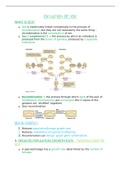
Sex/ recombination:
SEX IS ‘COSTLY’:
1. Reduces population/lineage growth rate
2. Reduces relatedness of parents to offspring
3. Recombination can disrupt ‘good’ gene combinations
1. REDUCES POPULATION GROWTH RATE – TWOFOLD COST OF
SEX
A species/lineage has a growth rate determined by the number of
females
, - In sexual species/ lineages only half the population contributes to
growth rate
- But for an asexual species all individuals are females and contribute
Therefore, males are ‘costly’ since their only role is assumed to be
as a source of fertilisation
COST OF SEX ARISES FROM ANISOGAMY: the union of
morphologically unlike motile gametes
Males are costly because they do not contribute to population
growth – isogamy (the fusion of morphologically similar gametes)
would not suffer the twofold cost
Sex arose before anisogamy, so ancestral state must have been
isogamy
First sexual species presumably cast gametes into environment
(water):
- Individuals that produced tiny gametes (and therefore many) would
gain most fertilisations => proto-sperm
- Indivuduals that make larger (and hence fewer) gametes do best if
they allow them to be fertilised by these tiny gametes (since the
tiny ones are common and mobile) => proto-egg
Once anisogamy evolves it constrains future evolution – cannot
revert to isogamy, so separate sexes are retained
EVOLUTION OF ASEXUAL REPRODUCTION:
Arises repeatedly through evolutionary time
Production of offspring from ‘unfertilised’ gametes as opposed to
vegetative ‘growth’
Removes twofold cost of sex (cost of males)
Two basic mechanisms:

