1
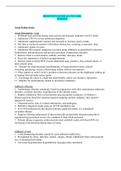
Business Exams Notes
Chapter one: Business activity
Business: combine factors of production to make products satisfying customer wants.
Need: good/service essential to living.
Want: good/service people would like to have but is not essential.
Economic problem: unlimited wants, limited sources; causes scarcity.
Scarcity is lack of sufficient products to fulfil total wants for population.
Factors of production: resources needed to produce goods.
- land, labour, capital, enterprise (businessman putting the 3 factors together).
Opportunity cost: next best alternative given up by choosing another item.
Specialisation: when people/businesses focus on what they’re best at.
Division of labour: production process is split into tasks. Form of specialisation.
Added value: difference is selling price and cost of bought-in materials. Increase by:
- Increase selling price but keep costs the same.
- Reduce costs of material but keep price the same.
Chapter two: Classification of businesses
Stages of economic activity: Compared by % of people working and value of output of goods.
(1) Primary: extracts/uses natural resources to produce raw materials; fishing, farming, etc.
Poor countries employee most people in this sector.
(2) Secondary: manufactures goods using raw materials; baking, construction, etc. Developing
countries (China) are industrialising to employ most people in this sector.
(3) Tertiary: services to consumers; retailer, hairdresser, etc. Highly developed countries
(Norway) have extra income for services so many people work in this sector.
Industrialisation: Decline in primary sector. Poor countries turning to developing countries.
De-industrialisation: Decline in secondary sector. From developing to highly developed.
Mixed economy: both private and public sector. Done by selling public business to individuals. This
is called privatisation.
- Done because: private businesses are more efficient, or to raise money for government.
- Private business increase employment rates to cut costs.
Chapter three: Enterprise, business growth, and size
Entrepreneur: person organising, operating, risking for a business venture.
- Independent, and may be profitable.
- Risky; many fail.
Characteristics include; hardworking, risk-taker, confident, innovative, etc.
Enterprise is person who brings three factors of production together to form business.
Business plan: document about objectives, operation details, finance, and owners. Without plan
bank won’t lend money since owners haven’t showed planning/preparation. It includes:
, 2
- Description
- Products/Services
- Market
- Location and distribution channel
- Management
- Financial information; projected future finance, income statements, financial position.
- Strategy
Governments support start-ups to: Governments support start-ups by:
- Decrease unemployment rates. - Premises: low cost
- Increase competition. - Finance: loans and grants
- More output - Research facilities
- Can grow further.
Interested in business size are banks, workers, government (tax rate), and investors (bigger is
businesses are less risky).
Businesses are measured by:
- People employed: most important but automatic companies are at a disadvantage.
- value of output: businesses in same industry. Some produce few but expensive products.
- Value of sales: important but inaccurate when businesses sell different products.
- Value of capital employed: total capital invested; equity and LT loans.
Owners expand because: possibility of higher profit, status, low average costs (manufacturing).
Internal growth: existing operations expand (organic)
External growth: Integration; mergers and takeovers
Takeover: business buys out another business.
Merger: owners agree to join businesses as one.
Integration:
- Horizontal: merger/takeover in the same industry at same stage of production.
(1) less competitors, and economy growth.
- Vertical: merger/takeover in same industry but different stage. Backward or forward.
(2) Forward: assured outlet and profit margin is absorbed.
(3) Backword: assured supply of components.
- Conglomerate: merger/takeover in different industry – diversification.
(4) Spread risk out.
Problems with growth include:
- difficult controlling: operate in small units.
- Expansion costs: ensure long-term finance is available.
Why remain small?
- Type of industry: hairdresser, car repairs
Business Exams Notes
Chapter one: Business activity
Business: combine factors of production to make products satisfying customer wants.
Need: good/service essential to living.
Want: good/service people would like to have but is not essential.
Economic problem: unlimited wants, limited sources; causes scarcity.
Scarcity is lack of sufficient products to fulfil total wants for population.
Factors of production: resources needed to produce goods.
- land, labour, capital, enterprise (businessman putting the 3 factors together).
Opportunity cost: next best alternative given up by choosing another item.
Specialisation: when people/businesses focus on what they’re best at.
Division of labour: production process is split into tasks. Form of specialisation.
Added value: difference is selling price and cost of bought-in materials. Increase by:
- Increase selling price but keep costs the same.
- Reduce costs of material but keep price the same.
Chapter two: Classification of businesses
Stages of economic activity: Compared by % of people working and value of output of goods.
(1) Primary: extracts/uses natural resources to produce raw materials; fishing, farming, etc.
Poor countries employee most people in this sector.
(2) Secondary: manufactures goods using raw materials; baking, construction, etc. Developing
countries (China) are industrialising to employ most people in this sector.
(3) Tertiary: services to consumers; retailer, hairdresser, etc. Highly developed countries
(Norway) have extra income for services so many people work in this sector.
Industrialisation: Decline in primary sector. Poor countries turning to developing countries.
De-industrialisation: Decline in secondary sector. From developing to highly developed.
Mixed economy: both private and public sector. Done by selling public business to individuals. This
is called privatisation.
- Done because: private businesses are more efficient, or to raise money for government.
- Private business increase employment rates to cut costs.
Chapter three: Enterprise, business growth, and size
Entrepreneur: person organising, operating, risking for a business venture.
- Independent, and may be profitable.
- Risky; many fail.
Characteristics include; hardworking, risk-taker, confident, innovative, etc.
Enterprise is person who brings three factors of production together to form business.
Business plan: document about objectives, operation details, finance, and owners. Without plan
bank won’t lend money since owners haven’t showed planning/preparation. It includes:
, 2
- Description
- Products/Services
- Market
- Location and distribution channel
- Management
- Financial information; projected future finance, income statements, financial position.
- Strategy
Governments support start-ups to: Governments support start-ups by:
- Decrease unemployment rates. - Premises: low cost
- Increase competition. - Finance: loans and grants
- More output - Research facilities
- Can grow further.
Interested in business size are banks, workers, government (tax rate), and investors (bigger is
businesses are less risky).
Businesses are measured by:
- People employed: most important but automatic companies are at a disadvantage.
- value of output: businesses in same industry. Some produce few but expensive products.
- Value of sales: important but inaccurate when businesses sell different products.
- Value of capital employed: total capital invested; equity and LT loans.
Owners expand because: possibility of higher profit, status, low average costs (manufacturing).
Internal growth: existing operations expand (organic)
External growth: Integration; mergers and takeovers
Takeover: business buys out another business.
Merger: owners agree to join businesses as one.
Integration:
- Horizontal: merger/takeover in the same industry at same stage of production.
(1) less competitors, and economy growth.
- Vertical: merger/takeover in same industry but different stage. Backward or forward.
(2) Forward: assured outlet and profit margin is absorbed.
(3) Backword: assured supply of components.
- Conglomerate: merger/takeover in different industry – diversification.
(4) Spread risk out.
Problems with growth include:
- difficult controlling: operate in small units.
- Expansion costs: ensure long-term finance is available.
Why remain small?
- Type of industry: hairdresser, car repairs