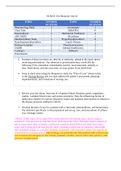
NUR265 Test Blueprint Unit #2
NUR265 Test Blueprint Unit #2 TOPIC NUMBER OF ITEMS TOPIC NUMBER OF ITEMS Pharmacology Math 1 Acromegaly 1 Chest Tube 2 HHS/DKA 8 Pneumothorax 2 Mechanical Ventilation 4 ARF/ARDS 5 Myxedema 1 Interdisciplinary Team 1 Hyper/hypothyroidism 8 Hypo/hyperparathyroidism 1 Graves Disease 1 Diabetes Insipidus 5 Pheochromocytoma 2 SAIDH 2 Adrenal Insufficiency 1 Cushing’s 2 Addison’s 1 Prioritization 2 Fourteen of these test items are, directly or indirectly, related to the topics above involving prioritization. Pay attention to prioritization buzz words like the following: First, immediate, immediately, priority, most important, initially, or next. Read slowly and take your time, no extra points if you finish first! Keep in mind when using the blueprint to study, the “Plan of Care” always refers to the Nursing Process and you must address the patient’s assessment, planning, implementation, and evaluation of nursing care. 1. Review your lab values, from unit #1 of general blood chemistry panel, coagulation studies, complete blood count, and serum osmolarity. Note the influencing factors of medication regimes for various laboratory results and potential interventions in relation to the disease processes studied in Unit #2. 2. Develop the plan of care for a patient with a chest tube, pneumothorax, and thoracotomy. Pay attention specifically to the preparation and set-up, care, and precautions of a Pleurevac drainage system. CHEST TUBE (chart 30-12 page 592): a drain placed in the pleural space, allows lung reexpansion. Also prevents air and fluid from returning to the chest. Drainage system consists of one or more chest tubes or drains, a collection container placed below the chest level, and a water seal to keep air from entering the chest. Drainage system may be stationary, disposable, self-contained system; or a smaller, portable, disposable, self-contained system that requires no connection to a vacuum source. The nursing care priorities for this patient with a chest tube are to ensure the integrity of the system, promote comfort, ensure chest tube patency, and prevent complications. Tip of the tube used to drain air is placed near the front lung apex. The tube that drains liquid is placed on the side near the base of the lung. After lung surgery, two tubes, anterior and posterior, are used. The wounds are covered with airtight dressings. Stationary chest tube drainage systems use a water-seal mechanism that acts as a one-way valve to prevent air or liquid from moving back into the chest cavity. The Pleur-evac system is a common devise using a one-piece disposable plastic unit with three chambers. The three chambers are connected to one another. The tube(s) from the patient are connected to the first chamber in the series of three. This is the drainage collection container. The second chamber is the water seal to prevent air from moving back up the tubing system and into the chest. The third chamber, when suction is applied, is the suction regulator. Chamber one collects the fluid draining from the patient and does not have fluid in it at first. This fluid is measured hourly during the first 24 hours. The fluid in chamber one must never fill to the point that it comes into contact with any tubes! If the tubing from the patient enters the fluid, drainage stops and can led to a tension pneumothorax. Chamber two is the water seal that prevents air from reentering the patient’s pleural space. As the trapped air leaves the pleural space, it will pass through chamber one before entering chamber two, which should always contain at least 2cm of water to prevent air from returning to the patient. As trapped air from the patient’s pleural space passes through the water seal, which serves as a one-way valve, the water will bubble. Once all the air has been evacuated from the pleural space, bubbling of the water seal stops. QSEN NURSING SAFETY PRIORITY: Action Alert For a water-seal chest tube drainage system, 2cm of wate
Información del documento
- Subido en
- 20 de agosto de 2022
- Número de páginas
- 18
- Escrito en
- 2022/2023
- Tipo
- Examen
- Contiene
- Preguntas y respuestas