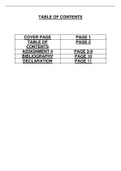
TABLE OF CONTENTS
COVER PAGE PAGE 1
TABLE OF PAGE 2
CONTENTS
ASSIGNMENT 4 PAGE 3-9
BIBLIOGRAPHY PAGE 10
DECLARATION PAGE 11
, Question 1 (20)
1.1. State and explain five ways in which you could use technology to
enhance the teaching and learning of Mathematics in the Intermediate
Phase. (5)
Audio-visual and visual
The amount of cognitive effort required to solve the problem decreases as pupils
become more competent at employing visuals. In other words, their ability to
answer mathematical problems improves. When the teacher assigns pictures,
students respond more positively than when they choose their own.
Graphics
A visual organizer can also be used to illustrate how multiplication and division
relate to one another.
Animation
Using animation technologies, we may construct scenarios for effective
mathematics professional development by combining student thought and
classroom artefacts.
Online Reality
Students can manipulate geometric forms through space and change their point
of view on an object using immersive virtual reality (VR). Students may be abler
to relate to mathematical ideas on a deeper level with the aid of this type of
virtual hands-on experience.
Internet
Students can research new mathematical ideas or conduct independent research
using the Internet. To respond to inquiries from their teachers, they can access
online resources. They can use the Internet to research new ideas or confirm any
confusing new mathematical ideas.
1.2. List three technological software products (excluding GeoGebra) and
explain how you could use them in your Mathematics classroom to
enhance the understanding of difficult topics. (6)
Microsoft Math Add-In
Users can answer math problems using the software, which was created as a
learning aid. It includes a graphing calculator, a unit converter, a triangle solver,
and an equation solver that guides the user step-by-step through the issue to the
resolution. It can solve inequalities like >, and can plot graphs in both two and
three dimensions.
Excel
A very effective approach of visually reviewing and analysing data is to use a
spreadsheet system with user-friendly graphic tools. A primary level example
would be to use a spreadsheet to make a graph showing how many various
colours there are in tubes of "Smarties"!
Desmos
Advanced graphing calculator Desmos is available as an online application and a
mobile device. Using this software, students can make graphs and other
visualizations to analyse mathematical relationships.
COVER PAGE PAGE 1
TABLE OF PAGE 2
CONTENTS
ASSIGNMENT 4 PAGE 3-9
BIBLIOGRAPHY PAGE 10
DECLARATION PAGE 11
, Question 1 (20)
1.1. State and explain five ways in which you could use technology to
enhance the teaching and learning of Mathematics in the Intermediate
Phase. (5)
Audio-visual and visual
The amount of cognitive effort required to solve the problem decreases as pupils
become more competent at employing visuals. In other words, their ability to
answer mathematical problems improves. When the teacher assigns pictures,
students respond more positively than when they choose their own.
Graphics
A visual organizer can also be used to illustrate how multiplication and division
relate to one another.
Animation
Using animation technologies, we may construct scenarios for effective
mathematics professional development by combining student thought and
classroom artefacts.
Online Reality
Students can manipulate geometric forms through space and change their point
of view on an object using immersive virtual reality (VR). Students may be abler
to relate to mathematical ideas on a deeper level with the aid of this type of
virtual hands-on experience.
Internet
Students can research new mathematical ideas or conduct independent research
using the Internet. To respond to inquiries from their teachers, they can access
online resources. They can use the Internet to research new ideas or confirm any
confusing new mathematical ideas.
1.2. List three technological software products (excluding GeoGebra) and
explain how you could use them in your Mathematics classroom to
enhance the understanding of difficult topics. (6)
Microsoft Math Add-In
Users can answer math problems using the software, which was created as a
learning aid. It includes a graphing calculator, a unit converter, a triangle solver,
and an equation solver that guides the user step-by-step through the issue to the
resolution. It can solve inequalities like >, and can plot graphs in both two and
three dimensions.
Excel
A very effective approach of visually reviewing and analysing data is to use a
spreadsheet system with user-friendly graphic tools. A primary level example
would be to use a spreadsheet to make a graph showing how many various
colours there are in tubes of "Smarties"!
Desmos
Advanced graphing calculator Desmos is available as an online application and a
mobile device. Using this software, students can make graphs and other
visualizations to analyse mathematical relationships.