Bio Notes:
Viruses:
- Not placed under and of the 5 kingdoms into which living organisms are classified.
- Have properties of non-living particles as well as living organisms.
- Only characteristic of life is reproduction.
- Only reproduce inside cells of living organisms.
- Do not consist of cells (acellular) and are therefore not classified as prokaryotes or
eukaryotes.
Basic structure of viruses:
- Very small (20nm – 450nm).
- Simple in composition.
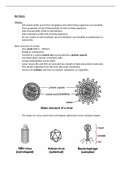
- Consists of a central nucleic acid surrounded by a protein capsule.
- Can infect plant, animal, or bacteria cells.
- Contain DNA or RNA (never both).
- Some viruses (flu and HIV) are enclosed by a sheath of lipid and protein molecules.
This sheath originates from the host cells outer membrane.
- Viruses are acellular and have no nucleus, cytoplasm, or organelles.
- The shape of a virus varies from rod-shaped, spherical to more complex shapes.
, General Characteristics of viruses:
- Parasites known as obligate intracellular parasites (only reproduce within living cells)
- Host specific and some are tissue-specific (poliovirus is tissue-specific – nerve tissue)
- Pathogens
- Cause disease
- Plants: TMV
- Humans: AIDS
- Reproduce by converting genetic material (DNA or RNA) of the host cell into viral
nuclei acids so that new viruses can be reproduced.
Bacteria:
- Smallest and simplest living organism.
- Classified under the kingdom ‘Monera’.
- Occur in almost any habitat on earth.
- Some need oxygen: aerobic bacteria.
- Some can live without oxygen: anaerobic bacteria.
- Some are pathogenic - cause diseases (cholera, TB).
Basic structure of bacteria:
- Unicellular (occur as single cells, filaments, or colonies).
- Bacterium cell is surrounded by a cell wall that consists of polysaccharides
(carbohydrates), proteins and lipids.
- In some bacteria (especially those that cause disease), the cell wall is surrounded by
a slime layer or capsule, which protects the bacterial cell from desiccation and
enemies (i.e. immune cells).
- A plasma membrane (cell membrane), which encloses the cytoplasm, occurs directly
below the cell wall.
- The cytoplasm has no membrane-bound organelles, such as vacuoles, plastids,
mitochondria, or ER, but ribosomes do occur.
- A true nucleus (membrane-bound) is absent.
- Genetic material (DNS) is concentrated in a chromatin body known as the nucleoid.
- Some bacteria move in liquid by means of long, thread-like structures, called flagella
(singular: flagellum).