

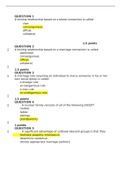
QUESTION 1
A kinship relationship based on a blood connection is called
clan.
consanguineal.
affinal.
collateral.
1.5 points
QUESTION 2
A kinship relationship based on a marriage connection is called
patrilineal.
consanguineal.
affinal.
collateral.
1.5 points
QUESTION 3
A marriage rule requiring an individual to marry someone in his or her
own social group is called
a lineage rule.
an exogamous rule.
a clan rule.
an endogamous rule.
1.5 points
QUESTION 4
A nuclear family consists of all of the following EXCEPT
mother
father
siblings
grandparents
1 points
QUESTION 5
A significant advantage of unilineal descent groups is that they
facilitate property inheritance.
determine residence.
dictate appropriate marriage partners.
, control the choice of a chief.
1.5 points
QUESTION 6
According to "When Brothers Share a Wife," polyandry in Tibet:
is considered detrimental to social structure.
is based on the need for population growth.
consists of brothers marrying the same woman.
causes early death for many women.
1 points
QUESTION 7
All of the following are goals or aims that kinship systems achieve
for their group members EXCEPT
identify political leaders.
organize people into groups.
direct people’s behavior.
provides security for the group.
1.5 points
QUESTION 8
An alternate term for matrilocal residence is
uxorilocal
virilocal
bilocal
matrifocal
1.5 points
QUESTION 9
As described in "When Brothers Share a Wife," unmarried women
were found to do all of the following EXCEPT:
set up their own household.
have more children on average than married women.
become Buddhist nuns.
work as servants for other families.
, 1 points
QUESTION 10
As mentioned in “Rising Number of Dowry Deaths in India,”
demands for dowry can go on for years after the marriage, especially
on the occasion of religious ceremonies or:
the birth of children.
death of one of the bride’s parents.
the purchase of a home by the groom.
when the wife gains a promotion at work.
1 points
QUESTION 11
As reported in “Rising Number of Dowry Deaths in India,” many of
the victims of dowry murder are killed, and the murder explained as
accident or suicide, by:
poison.
being doused in kerosene and set alight.
drowning.
gunshots.
1 points
QUESTION 12
As seen in Saheri’s Choice, child marriage is still practiced in rural
areas in India
True
False
1.5 points
QUESTION 13
Bridewealth refers to
gifts from the groom’s family to the bride’s family.
wealth brought with the bride when she marries.
wealth already owned by the bride.
wealth accumulated prior to marriage.
1.5 points
QUESTION 14
Family that include persons that are not kin are called
blended families
A kinship relationship based on a blood connection is called
clan.
consanguineal.
affinal.
collateral.
1.5 points
QUESTION 2
A kinship relationship based on a marriage connection is called
patrilineal.
consanguineal.
affinal.
collateral.
1.5 points
QUESTION 3
A marriage rule requiring an individual to marry someone in his or her
own social group is called
a lineage rule.
an exogamous rule.
a clan rule.
an endogamous rule.
1.5 points
QUESTION 4
A nuclear family consists of all of the following EXCEPT
mother
father
siblings
grandparents
1 points
QUESTION 5
A significant advantage of unilineal descent groups is that they
facilitate property inheritance.
determine residence.
dictate appropriate marriage partners.
, control the choice of a chief.
1.5 points
QUESTION 6
According to "When Brothers Share a Wife," polyandry in Tibet:
is considered detrimental to social structure.
is based on the need for population growth.
consists of brothers marrying the same woman.
causes early death for many women.
1 points
QUESTION 7
All of the following are goals or aims that kinship systems achieve
for their group members EXCEPT
identify political leaders.
organize people into groups.
direct people’s behavior.
provides security for the group.
1.5 points
QUESTION 8
An alternate term for matrilocal residence is
uxorilocal
virilocal
bilocal
matrifocal
1.5 points
QUESTION 9
As described in "When Brothers Share a Wife," unmarried women
were found to do all of the following EXCEPT:
set up their own household.
have more children on average than married women.
become Buddhist nuns.
work as servants for other families.
, 1 points
QUESTION 10
As mentioned in “Rising Number of Dowry Deaths in India,”
demands for dowry can go on for years after the marriage, especially
on the occasion of religious ceremonies or:
the birth of children.
death of one of the bride’s parents.
the purchase of a home by the groom.
when the wife gains a promotion at work.
1 points
QUESTION 11
As reported in “Rising Number of Dowry Deaths in India,” many of
the victims of dowry murder are killed, and the murder explained as
accident or suicide, by:
poison.
being doused in kerosene and set alight.
drowning.
gunshots.
1 points
QUESTION 12
As seen in Saheri’s Choice, child marriage is still practiced in rural
areas in India
True
False
1.5 points
QUESTION 13
Bridewealth refers to
gifts from the groom’s family to the bride’s family.
wealth brought with the bride when she marries.
wealth already owned by the bride.
wealth accumulated prior to marriage.
1.5 points
QUESTION 14
Family that include persons that are not kin are called
blended families

