Taylor Notes Energetics
Enthalpy Change (ΔH)
Enthalpy is a measure of the energy stored within a substance; it is defined as the heat change at a
constant pressure
Most types of chemical reaction involve a change in enthalpy It is represented by the symbol ΔH
When bonds break energy has to be supplied but when bonds form energy is given out
Why are Reactions Exothermic in terms of Bonds?
Some reactions are exothermic as more energy is given out to the surrounding when forming bonds than
when energy is taken in when breaking bonds
Why are Reactions Endothermic in terms of Bonds?
Some reactions are endothermic as more energy is taken in from the surroundings when breaking bonds
than when energy is released when forming bonds
Energy Profile Diagrams
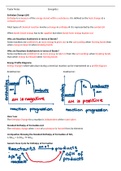
Energy changes which take place during a chemical reaction can be represented on a profile diagram
Endothermic: Exothermic:
Hess’ Law
The Enthalpy Change for a reaction is independent of the route taken
Standard Enthalpy of Formation ΔfH
The enthalpy change when 1 mol of a substance is formed from its elements
An Equation Showing the Standard Enthalpy of Formation of NH3
1/2N2(g) + 3/2H2(g) NH3(g)
Generic Hess Cycle for Enthalpy of Formation
Enthalpy Change (ΔH)
Enthalpy is a measure of the energy stored within a substance; it is defined as the heat change at a
constant pressure
Most types of chemical reaction involve a change in enthalpy It is represented by the symbol ΔH
When bonds break energy has to be supplied but when bonds form energy is given out
Why are Reactions Exothermic in terms of Bonds?
Some reactions are exothermic as more energy is given out to the surrounding when forming bonds than
when energy is taken in when breaking bonds
Why are Reactions Endothermic in terms of Bonds?
Some reactions are endothermic as more energy is taken in from the surroundings when breaking bonds
than when energy is released when forming bonds
Energy Profile Diagrams
Energy changes which take place during a chemical reaction can be represented on a profile diagram
Endothermic: Exothermic:
Hess’ Law
The Enthalpy Change for a reaction is independent of the route taken
Standard Enthalpy of Formation ΔfH
The enthalpy change when 1 mol of a substance is formed from its elements
An Equation Showing the Standard Enthalpy of Formation of NH3
1/2N2(g) + 3/2H2(g) NH3(g)
Generic Hess Cycle for Enthalpy of Formation