
MEMORY
Types of Memory
Sensory Register;
- Temporarily stores information from our senses, constantly receiving information from around us.
- Disappears quickly through spontaneous decay.
- Limited capacity and duration.
- Coded depending on the sense (e.g. visual, auditory or tactile).
Short-term Memory;
- Limited capacity and limited duration.
- Coding is usually acoustic (sound).
Long-term Memory;
- Pretty much unlimited capacity and theoretically permanent, the coding is usually semantic.
- Three different types of long-term memory;
- Episodic memory stores information of events that you’ve experienced. It can contain
information about time and place, emotions you felt and the details. These are declarative - can be
consciously recalled.
- Semantic memory stores facts and knowledge we have learnt and can consciously recall, e.g.
capital cities and word meanings. Simply just knowledge.
- Procedural memory stores the knowledge of how to do things, e.g. walking / swimming /
playing the piano, cannot be consciously recalled.
Coding
“The way information is stored in memory”. In the short-term we try to keep information active by
repeating it. In the long-term, coding is usually semantic - code words in terms of meaning.
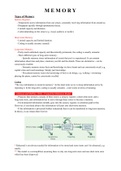
Atkinson and Shiffrin (1968) - Created the Multistore Model ..
- Proposes that memory consists of three stores: a sensory register, a short-term store, and a
long-term store, and information has to move through these stores to become a memory.
- Environmental information initially goes into the sensory register, no attention paid to this.
However, if you think about it the information will pass into short-term memory.
- If the information is processed further (rehearsed) then it can be transferred to long-term memory.
In theory, it can remain there forever.
* Rehearsal is not always needed for information to be stored and some items can’t be rehearsed, e.g.
smells.
** The model is oversimplified, assuming there is only one long-term store and one short-term store
which has been disproved.

