

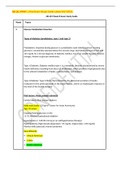
NR 601NR601_Final Exam Study Guide Latest 2021/2022.
NR 601 Week 8 Exam Study Guide
Week Topics
5 Glucose Metabolism Disorders
Types of diabetes (prediabetes, type 1 and type 2)
Prediabetes: Impaired fasting glucose is a prediabetic state where a person’s fasting
glucose is consistently elevated above the normal range, but below the level of 100 and
125 mg/dL for a formal diagnosis of diabetes mellitus. Focus on weight loss and behavior
changes. Known as glucose intolerance.
Type 1 Diabetes: Diabetes mellitus type 1 is a metabolic disorder characterized by severe
insulin deficiency resulting from beta cell destruction, which produces hyperglycemia due
to the altered metabolism of lipids, carbohydrates, and proteins
Type 2 Diabetes: Type 2 DM is characterized by the abnormal secretion of insulin,
resistance to the action of insulin in the target tissues, and/or an inadequate response at
the level of the insulin receptor
Risk factors: Most common ethnicity
Family history (first-degree relative)
Body mass index >25 kg/m2 (lower for Asian Americans)
Age >45 years
Impaired fasting glucose or A1C
>5.7% History of gestational diabetes
Hypertension (> 140/90 mm Hg or on antihypertensive therapy)
Hyperlipidemia (high-density lipoprotein <35 mg/dL, triglycerides >250 mg/dL)
Women with polycystic ovarian syndrome
Race/Ethnicity
• African American
• Latino
• Native American
,NR 601NR601_Final Exam Study Guide Latest 2021/2022.
• Asian American
• Pacific Islander
Diagnostic criteria
There are four laboratory-based criteria to confirm DM:
1. Glycosylated hemoglobin (A1C) level greater than or equal to 6.5%*
2. Random plasma glucose level of 200 mg/dL in the presence of
classic symptoms of hyperglycemia or a hyperglycemic crisis*
3. Fasting plasma glucose level of 126 mg/dL or higher on two occasions; fasting is
defined as no caloric intake for at least 8 hours
4. Two-hour post-load plasma glucose level of 200 mg/dL or higher during an OGTT,
following consumption of a glucose load containing the equivalent of 75 g of
anhydrous glucose dissolved in water (OGTT is also used to screen for diabetes
during pregnancy)
,NR 601NR601_Final Exam Study Guide Latest 2021/2022.
The criterion for the diagnosis of diabetes is either two fasting blood glucose readings with
results greater than or equal to 126 mg/dL or a random blood glucose reading greater than or
equal to 200 mg/dL if symptoms of diabetes are present.
In older adults, the glucose reading after a 2-hour oral glucose tolerance test (OGTT) rises more
rapidly than the fasting glucose. Therefore, diabetes will be diagnosed sooner with the OGTT than
with fasting glucose alone. Hemoglobin A1c (Hb A1c) measurement greater than or equal to 6.5 is
indicative of type 2 diabetes.
In the absence of unequivocal disease, the same test should be repeated at
least once
When hyperglycemia has been established, fasting urine for ketones should be performed to help
differentiate between type 1 and type 2 diabetes and the need for insulin therapy.
Ordering C-peptide levels and antibodies to islet cells and beta cells, as indicated previously, will
help to clarify any uncertainty.
It is also important to screen for nephropathy using the urine albumin to creatinine ratio
Initial treatment recommendations- First line treatment for each type
Nonpharmacological therapy is the recommended first-line therapy for newly diagnosed patients
with mild-to-moderate hyperglycemia
If after 3 to 6 months nonpharmacological treatment fails or the hyperglycemia is severe (fasting
plasma glucose 200 to 300 mg/dL or casual plasma glucose 250 to 350 mg/dL), oral agents may
be added to the treatment regimen. Metformin is also recommended for prevention or delay of
type 2 diabetes in patients with a BMI greater than or equal to 35 kg/m 2 or anyone with a
history of gestational diabetes or patients with a rising Hb A1c in spite of lifestyle modifications
Metformin (Glucophage, Glucophage XR) is a biguanide that acts by decreasing hepatic glucose
production, decreasing glucose intestinal absorption, and increasing insulin sensitivity. It is now
considered first-line therapy in treating type 2 diabetes and may be initiated with lifestyle
changes in many individuals
The AACE recommends that patients with recent-onset type 2 DM or mild hyperglycemia (A1C
<7.5%) start with lifestyle treatment and monotherapy. The ADA and AACE recommend metformin
, NR 601NR601_Final Exam Study Guide Latest 2021/2022.
if there are no contraindications, such as renal disease or abnormal creatinine clearance, acute
myocardial infarction, or septicemia. The AACE recommends adding a second agent to lifestyle
treatment and metformin if the A1C is more than 7.5% at the time of diagnosis or after 3 months
of monotherapy without achievement of the patient’s blood glucose goals.
Common medication side effects
Metformin: Side effects include nausea, vomiting, diarrhea, abdominal pain, anorexia,
and taste disturbances
Sulfonyureas: Side effects of this class of medications include weight gain,
nausea, hypoglycemia, weakness, and photosensitivity
Side effects of DPP-4 inhibitors include upper respiratory tract infection,
nasopharyngitis, and headache.
NR 601 Week 8 Exam Study Guide
Week Topics
5 Glucose Metabolism Disorders
Types of diabetes (prediabetes, type 1 and type 2)
Prediabetes: Impaired fasting glucose is a prediabetic state where a person’s fasting
glucose is consistently elevated above the normal range, but below the level of 100 and
125 mg/dL for a formal diagnosis of diabetes mellitus. Focus on weight loss and behavior
changes. Known as glucose intolerance.
Type 1 Diabetes: Diabetes mellitus type 1 is a metabolic disorder characterized by severe
insulin deficiency resulting from beta cell destruction, which produces hyperglycemia due
to the altered metabolism of lipids, carbohydrates, and proteins
Type 2 Diabetes: Type 2 DM is characterized by the abnormal secretion of insulin,
resistance to the action of insulin in the target tissues, and/or an inadequate response at
the level of the insulin receptor
Risk factors: Most common ethnicity
Family history (first-degree relative)
Body mass index >25 kg/m2 (lower for Asian Americans)
Age >45 years
Impaired fasting glucose or A1C
>5.7% History of gestational diabetes
Hypertension (> 140/90 mm Hg or on antihypertensive therapy)
Hyperlipidemia (high-density lipoprotein <35 mg/dL, triglycerides >250 mg/dL)
Women with polycystic ovarian syndrome
Race/Ethnicity
• African American
• Latino
• Native American
,NR 601NR601_Final Exam Study Guide Latest 2021/2022.
• Asian American
• Pacific Islander
Diagnostic criteria
There are four laboratory-based criteria to confirm DM:
1. Glycosylated hemoglobin (A1C) level greater than or equal to 6.5%*
2. Random plasma glucose level of 200 mg/dL in the presence of
classic symptoms of hyperglycemia or a hyperglycemic crisis*
3. Fasting plasma glucose level of 126 mg/dL or higher on two occasions; fasting is
defined as no caloric intake for at least 8 hours
4. Two-hour post-load plasma glucose level of 200 mg/dL or higher during an OGTT,
following consumption of a glucose load containing the equivalent of 75 g of
anhydrous glucose dissolved in water (OGTT is also used to screen for diabetes
during pregnancy)
,NR 601NR601_Final Exam Study Guide Latest 2021/2022.
The criterion for the diagnosis of diabetes is either two fasting blood glucose readings with
results greater than or equal to 126 mg/dL or a random blood glucose reading greater than or
equal to 200 mg/dL if symptoms of diabetes are present.
In older adults, the glucose reading after a 2-hour oral glucose tolerance test (OGTT) rises more
rapidly than the fasting glucose. Therefore, diabetes will be diagnosed sooner with the OGTT than
with fasting glucose alone. Hemoglobin A1c (Hb A1c) measurement greater than or equal to 6.5 is
indicative of type 2 diabetes.
In the absence of unequivocal disease, the same test should be repeated at
least once
When hyperglycemia has been established, fasting urine for ketones should be performed to help
differentiate between type 1 and type 2 diabetes and the need for insulin therapy.
Ordering C-peptide levels and antibodies to islet cells and beta cells, as indicated previously, will
help to clarify any uncertainty.
It is also important to screen for nephropathy using the urine albumin to creatinine ratio
Initial treatment recommendations- First line treatment for each type
Nonpharmacological therapy is the recommended first-line therapy for newly diagnosed patients
with mild-to-moderate hyperglycemia
If after 3 to 6 months nonpharmacological treatment fails or the hyperglycemia is severe (fasting
plasma glucose 200 to 300 mg/dL or casual plasma glucose 250 to 350 mg/dL), oral agents may
be added to the treatment regimen. Metformin is also recommended for prevention or delay of
type 2 diabetes in patients with a BMI greater than or equal to 35 kg/m 2 or anyone with a
history of gestational diabetes or patients with a rising Hb A1c in spite of lifestyle modifications
Metformin (Glucophage, Glucophage XR) is a biguanide that acts by decreasing hepatic glucose
production, decreasing glucose intestinal absorption, and increasing insulin sensitivity. It is now
considered first-line therapy in treating type 2 diabetes and may be initiated with lifestyle
changes in many individuals
The AACE recommends that patients with recent-onset type 2 DM or mild hyperglycemia (A1C
<7.5%) start with lifestyle treatment and monotherapy. The ADA and AACE recommend metformin
, NR 601NR601_Final Exam Study Guide Latest 2021/2022.
if there are no contraindications, such as renal disease or abnormal creatinine clearance, acute
myocardial infarction, or septicemia. The AACE recommends adding a second agent to lifestyle
treatment and metformin if the A1C is more than 7.5% at the time of diagnosis or after 3 months
of monotherapy without achievement of the patient’s blood glucose goals.
Common medication side effects
Metformin: Side effects include nausea, vomiting, diarrhea, abdominal pain, anorexia,
and taste disturbances
Sulfonyureas: Side effects of this class of medications include weight gain,
nausea, hypoglycemia, weakness, and photosensitivity
Side effects of DPP-4 inhibitors include upper respiratory tract infection,
nasopharyngitis, and headache.

