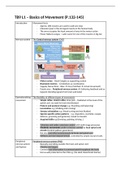
TB9 L1 – Basics of Movement (P.132-145)
Introduction Movement facts
- Approx. 200 muscles are used to walk one step
- Masseter (jaw) is the strongest muscle in the human body
- The arms occupies the least amount of area in the motor cortex
- Flexor Hallucis Longus – Latin name for one of the muscles in big toe
Nervous system The Central nervous system (CNS)
- Motor cortex – Basal Ganglia as supporting system
- Brainstem Centres – Cerebellum as coordination
- Vaguely hierarchical – Blue Grey (Method Actual movement)
- Purple area – Peripheral nervous system Gathering feedback and as
legwork (Sending signals from brain and body)
Operationalising The flexibility of different types of movements
movement - Simple reflex, stretch reflex, knee jerk – Mediated at the level of the
spinal cord, no need for brain involvement
- Posture and postural change e.g. (Standing and balancing)
- Locomotion e.g. (Walking and running)
- Sensory orientation e.g. (Head turning and eye fixation)
- Species specific action patterns – e.g. (Ingestion, courtship, escape,
defence, grooming and gestures), based on Genetic
- Acquired skills e.g.(Dressing, painting, driving…)
- Voluntary and under conscious control with multi-stage processes
- Rhythmic movements under conscious control by local spinal cord
circuits (Central pattern generators)
- But also controlled autonomously by brain and spinal cord
- Reflexes and stereotyped stimuli, controlled by simple neural circuits
Peripheral Peripheral nervous system (PNS)
nervous system - Basically everything outside the brain and spinal cord
and leprosy - Muscles and organs
- Controls how information is communicated throughout the body
- Not as well protected as the CNS e.g. (No skull, blood brain barrier)
Introduction Movement facts
- Approx. 200 muscles are used to walk one step
- Masseter (jaw) is the strongest muscle in the human body
- The arms occupies the least amount of area in the motor cortex
- Flexor Hallucis Longus – Latin name for one of the muscles in big toe
Nervous system The Central nervous system (CNS)
- Motor cortex – Basal Ganglia as supporting system
- Brainstem Centres – Cerebellum as coordination
- Vaguely hierarchical – Blue Grey (Method Actual movement)
- Purple area – Peripheral nervous system Gathering feedback and as
legwork (Sending signals from brain and body)
Operationalising The flexibility of different types of movements
movement - Simple reflex, stretch reflex, knee jerk – Mediated at the level of the
spinal cord, no need for brain involvement
- Posture and postural change e.g. (Standing and balancing)
- Locomotion e.g. (Walking and running)
- Sensory orientation e.g. (Head turning and eye fixation)
- Species specific action patterns – e.g. (Ingestion, courtship, escape,
defence, grooming and gestures), based on Genetic
- Acquired skills e.g.(Dressing, painting, driving…)
- Voluntary and under conscious control with multi-stage processes
- Rhythmic movements under conscious control by local spinal cord
circuits (Central pattern generators)
- But also controlled autonomously by brain and spinal cord
- Reflexes and stereotyped stimuli, controlled by simple neural circuits
Peripheral Peripheral nervous system (PNS)
nervous system - Basically everything outside the brain and spinal cord
and leprosy - Muscles and organs
- Controls how information is communicated throughout the body
- Not as well protected as the CNS e.g. (No skull, blood brain barrier)