Cell Surface Membranes Structure and Function
10 April 2021 19:26
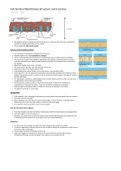
7.5 nm
• The globular proteins and glycoproteins float about in a 'lipid sea' with the polar carbohydrate
portions forming the glycocalyx on the outside
• This is named the fluid mosaic model
Features of the Fluid Mosaic Model
• The membrane is stabilised by hydrophobic interactions
• Globular proteins are either peripheral or integral
• There is relatively free lateral movement of components, but very little transverse mobility
• The structure is fluid and the fluidity is regulated by the numbers of double bonds in the fatty
acids (more double bonds, higher fluidity) and the proportion of cholesterol (more cholesterol,
less fluidity)
• Membrane fluidity needs to be controlled
• The more kinks in the tails, the more fluid the membrane
• Cholesterol reduces the fluidity (above 37°C)
• Cold temperatures reduce fluidity, to the point where it may actually solidify
• Some organisms vary the balance of saturated/unsaturated phospholipids and cholesterol when
ambient temperature varies, in order to keep the membrane fluid enough so the proteins within it
function efficiently
• The lipid bilayer represents a permeability barrier to polar solutes and ions, which can only cross if
transported by a membrane bound protein
• The fluid mosaic model assumes an asymmetrical structure, 2-10% of the membrane is
carbohydrate on the external surface. These are involved in recognition mechanisms
• Different types of membrane differ in thickness, but most are between 5 and 10nm
• The plasma membrane is 7.5nm wide
Cell Signalling
• Cells respond to their changing environment by receiving and processing signals from one another
• They also send out messages
• Most cell signals are in the form of chemical messengers, such as hormones or growth factors
which may have come from cells nearby, or from far away in the body
• An example is neurotransmitters across nerve synapses
How Do Cells Detect These Signals?:
• They have receptors on their cell surface membranes to which certain chemical messengers bind
• This then triggers an internal response
• Receptors are usually trans-membrane proteins which initiate signalling processes within the cell
on binding with the molecule on the outside of the cell surface membrane
Exceptions:
• In a few cases, the receptors are within the cell, sometimes even within the nucleus
• These are triggered by molecules which are able to diffuse through the membrane, usually steroid
hormones, such as oestrogen
• Nitrous oxide also binds to receptors within cells
• Again, this triggers the initiation of a chain of reactions within the cell (cascade reaction)
sometimes involving a second messenger. The response occurs within the cell
10 April 2021 19:26
7.5 nm
• The globular proteins and glycoproteins float about in a 'lipid sea' with the polar carbohydrate
portions forming the glycocalyx on the outside
• This is named the fluid mosaic model
Features of the Fluid Mosaic Model
• The membrane is stabilised by hydrophobic interactions
• Globular proteins are either peripheral or integral
• There is relatively free lateral movement of components, but very little transverse mobility
• The structure is fluid and the fluidity is regulated by the numbers of double bonds in the fatty
acids (more double bonds, higher fluidity) and the proportion of cholesterol (more cholesterol,
less fluidity)
• Membrane fluidity needs to be controlled
• The more kinks in the tails, the more fluid the membrane
• Cholesterol reduces the fluidity (above 37°C)
• Cold temperatures reduce fluidity, to the point where it may actually solidify
• Some organisms vary the balance of saturated/unsaturated phospholipids and cholesterol when
ambient temperature varies, in order to keep the membrane fluid enough so the proteins within it
function efficiently
• The lipid bilayer represents a permeability barrier to polar solutes and ions, which can only cross if
transported by a membrane bound protein
• The fluid mosaic model assumes an asymmetrical structure, 2-10% of the membrane is
carbohydrate on the external surface. These are involved in recognition mechanisms
• Different types of membrane differ in thickness, but most are between 5 and 10nm
• The plasma membrane is 7.5nm wide
Cell Signalling
• Cells respond to their changing environment by receiving and processing signals from one another
• They also send out messages
• Most cell signals are in the form of chemical messengers, such as hormones or growth factors
which may have come from cells nearby, or from far away in the body
• An example is neurotransmitters across nerve synapses
How Do Cells Detect These Signals?:
• They have receptors on their cell surface membranes to which certain chemical messengers bind
• This then triggers an internal response
• Receptors are usually trans-membrane proteins which initiate signalling processes within the cell
on binding with the molecule on the outside of the cell surface membrane
Exceptions:
• In a few cases, the receptors are within the cell, sometimes even within the nucleus
• These are triggered by molecules which are able to diffuse through the membrane, usually steroid
hormones, such as oestrogen
• Nitrous oxide also binds to receptors within cells
• Again, this triggers the initiation of a chain of reactions within the cell (cascade reaction)
sometimes involving a second messenger. The response occurs within the cell