Biochem 10 - TCA Cycle
• Glycolysis is the first stage in the complete oxidation of glucose.
• Rather than being reduced to lactate, ethanol, or some other fermentation product, the pyruvate produced by
glycolysis is further oxidized to H2O and CO2.
• This aerobic phase of catabolism is called cellular respiration.
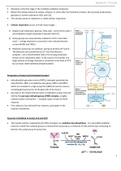
• Cellular respiration occurs in three major stages ;
1) Organic fuel molecules [ glucose, fatty acids , some amino acids ]
are oxidized to acetyl-coenzyme A (acetyl-CoA) (2C).
2) Acetyl groups are enzymatically oxidized to CO2 in the Krebs
cycle — energy released is conserved in the reduced electron
carriers NADH and FADH2.
3) Reduced coenzymes are oxidized , giving up protons (H+) and ẽ .
The electrons are transferred to O2—the final electron
acceptor—via a mitochondrial chain of ẽ-carrying molecules
known as the respiratory chain. In the course of ẽ transfer, the
large amount of energy released is conserved in the form of ATP,
by a process called oxidative phosphorylation.
Production of Acetyl-CoA (Activated Acetate)
• mitochondrial pyruvate carriers (MPCs) transport pyruvate into
mitochondria. MPC is encoded by two genes, MPC1 and MPC2,
which are mutated in a high proportion (80%) of certain cancers,
including gliomas (tumors of the glial cells of the brain).
• pyruvate in the mitochondrial matrix is oxidized to acetyl-CoA and
CO2 by the pyruvate dehydrogenase (PDH) complex, a highly
ordered cluster of enzymes — multiple copies of each of three
enzymes.
• Five cofactors, four derived from vitamins, participate in the
reaction mechanism.
Pyruvate Is Oxidized to Acetyl-CoA and CO2
• The overall reaction catalyzed by the PDH complex is an oxidative decarboxylation , an irreversible oxidation
process in which the carboxyl group is removed from pyruvate as a molecule of CO2 and the two remaining Cs
become the acetyl group of acetyl-CoA
1
, Biochem 10 - TCA Cycle
The Pyruvate Dehydrogenase Complex Requires 5 Coenzymes Coenzyme A has a reactive thiol (—
1) thiamine pyrophosphate (TPP) SH) group that is critical to the role
2) flavin adenine dinucleotide (FAD) of CoA as an acyl carrier in a
number of metabolic reactions.
3) coenzyme A (CoA, or CoA-SH, to emphasize the role of the —SH group)
Acyl groups are covalently linked to
4) nicotinamide adenine dinucleotide (NAD)
the thiol group, forming thioesters.
5) lipoate ( Lipoic acid )
The Pyruvate Dehydrogenase Complex Consists of 3 Distinct Enzymes
1) pyruvate dehydrogenase (E1)
2) dihydrolipoyl transacetylase (E2)
3) dihydrolipoyl dehydrogenase (E3)
• The active site of E1 has bound TPP, and that of E3 has bound FAD.
• In the bovine enzyme, E2 form a pentagonal dodecahedron [the core] (60 identical copies)
• E2 consists of 3 types of domains ;
a) amino-terminal lipoyl domain, containing the lipoyl-Lys residue(s)
b) central E1- and E3-binding domain
c) inner-core acyltransferase domain, which contains the acyltransferase active site.
In Substrate Channeling, Intermediates Never Leave the Enzyme Surface
How the pyruvate dehydrogenase complex carries out the five consecutive reactions in the decarboxylation and
dehydrogenation of pyruvate ;
① Pyruvate reacts with the bound thiamine pyrophosphate (TPP) of pyruvate dehydrogenase (E1) and is
decarboxylated to the hydroxyethyl derivative.
[ C-1 of pyruvate is released as CO2 and C-2, which in pyruvate has the oxidation state of an aldehyde, is
attached to TPP as a hydroxyethyl group. This first step is the slowest and therefore limits the rate of the overall
reaction. It is also the point at which the PDH complex exercises its substrate specificity ]
② Transfer of two electrons and the acetyl group from TPP to the oxidized form of the lipoyllysyl group of the core
enzyme, dihydrolipoyl transacetylase (E2), to form the acetyl thioester of the reduced lipoyl group.
[ the hydroxyethyl group is oxidized to the level of a carboxylic acid (acetate). The 2ẽ removed in this reaction
reduce the —S—S— of a lipoyl group on E2 to two thiol (—SH) groups. ]
③ Transesterification in which the —SH group of CoA replaces the —SH group of E2 to yield acetyl-CoA and the fully
reduced (dithiol) form of the lipoyl group.
[ acetyl moiety produced in this oxidation-reduction reaction is first esterified to one of the lipoyl —SH groups,
then transesterified to CoA to form acetyl-CoA ]
④ Dihydrolipoyl dehydrogenase (E3) promotes transfer of two hydrogen atoms from the reduced lipoyl groups of E2 to
the FAD prosthetic group of E3, restoring the oxidized form of the lipoyllysyl group of E2.
⑤ Reduced FADH2 of E3 transfers a hydride ion to NAD+, forming NADH. The enzyme complex is now ready for another
catalytic cycle.
2
, Biochem 10 - TCA Cycle
* Step 4 and 3 are electron transfers necessary to regenerate the oxidized (disulfide) form of the lipoyl group of E2 to
prepare the enzyme complex for another round of oxidation. The electrons removed from the hydroxyethyl group
derived from pyruvate pass through FAD to NAD+
Pyruvate oxidation defect
✓ Thiamine-deficient animals are unable to oxidize pyruvate normally, especially in brain.
✓ Beriberi - a disease that results from thiamine deficiency, is characterized by loss of neural function.
✓ Occurs in populations that rely on a diet consisting mainly of white rice, which lacks the hulls in which most of
the thiamine of rice is found.
✓ People who habitually consume large amounts of alcohol - because much of their dietary intake consists of the
vitamin-free “empty calories” of distilled spirits
✓ An elevated level of pyruvate in the blood is often an indicator of defects in pyruvate oxidation due to one of
these causes.
Reactions of the Citric Acid Cycle Citric acid cycle has 8 steps
① Formation of Citrate
▪ The first reaction of the cycle is the condensation of acetyl-CoA with oxaloacetate to form citrate, catalyzed by
citrate synthase.
3
• Glycolysis is the first stage in the complete oxidation of glucose.
• Rather than being reduced to lactate, ethanol, or some other fermentation product, the pyruvate produced by
glycolysis is further oxidized to H2O and CO2.
• This aerobic phase of catabolism is called cellular respiration.
• Cellular respiration occurs in three major stages ;
1) Organic fuel molecules [ glucose, fatty acids , some amino acids ]
are oxidized to acetyl-coenzyme A (acetyl-CoA) (2C).
2) Acetyl groups are enzymatically oxidized to CO2 in the Krebs
cycle — energy released is conserved in the reduced electron
carriers NADH and FADH2.
3) Reduced coenzymes are oxidized , giving up protons (H+) and ẽ .
The electrons are transferred to O2—the final electron
acceptor—via a mitochondrial chain of ẽ-carrying molecules
known as the respiratory chain. In the course of ẽ transfer, the
large amount of energy released is conserved in the form of ATP,
by a process called oxidative phosphorylation.
Production of Acetyl-CoA (Activated Acetate)
• mitochondrial pyruvate carriers (MPCs) transport pyruvate into
mitochondria. MPC is encoded by two genes, MPC1 and MPC2,
which are mutated in a high proportion (80%) of certain cancers,
including gliomas (tumors of the glial cells of the brain).
• pyruvate in the mitochondrial matrix is oxidized to acetyl-CoA and
CO2 by the pyruvate dehydrogenase (PDH) complex, a highly
ordered cluster of enzymes — multiple copies of each of three
enzymes.
• Five cofactors, four derived from vitamins, participate in the
reaction mechanism.
Pyruvate Is Oxidized to Acetyl-CoA and CO2
• The overall reaction catalyzed by the PDH complex is an oxidative decarboxylation , an irreversible oxidation
process in which the carboxyl group is removed from pyruvate as a molecule of CO2 and the two remaining Cs
become the acetyl group of acetyl-CoA
1
, Biochem 10 - TCA Cycle
The Pyruvate Dehydrogenase Complex Requires 5 Coenzymes Coenzyme A has a reactive thiol (—
1) thiamine pyrophosphate (TPP) SH) group that is critical to the role
2) flavin adenine dinucleotide (FAD) of CoA as an acyl carrier in a
number of metabolic reactions.
3) coenzyme A (CoA, or CoA-SH, to emphasize the role of the —SH group)
Acyl groups are covalently linked to
4) nicotinamide adenine dinucleotide (NAD)
the thiol group, forming thioesters.
5) lipoate ( Lipoic acid )
The Pyruvate Dehydrogenase Complex Consists of 3 Distinct Enzymes
1) pyruvate dehydrogenase (E1)
2) dihydrolipoyl transacetylase (E2)
3) dihydrolipoyl dehydrogenase (E3)
• The active site of E1 has bound TPP, and that of E3 has bound FAD.
• In the bovine enzyme, E2 form a pentagonal dodecahedron [the core] (60 identical copies)
• E2 consists of 3 types of domains ;
a) amino-terminal lipoyl domain, containing the lipoyl-Lys residue(s)
b) central E1- and E3-binding domain
c) inner-core acyltransferase domain, which contains the acyltransferase active site.
In Substrate Channeling, Intermediates Never Leave the Enzyme Surface
How the pyruvate dehydrogenase complex carries out the five consecutive reactions in the decarboxylation and
dehydrogenation of pyruvate ;
① Pyruvate reacts with the bound thiamine pyrophosphate (TPP) of pyruvate dehydrogenase (E1) and is
decarboxylated to the hydroxyethyl derivative.
[ C-1 of pyruvate is released as CO2 and C-2, which in pyruvate has the oxidation state of an aldehyde, is
attached to TPP as a hydroxyethyl group. This first step is the slowest and therefore limits the rate of the overall
reaction. It is also the point at which the PDH complex exercises its substrate specificity ]
② Transfer of two electrons and the acetyl group from TPP to the oxidized form of the lipoyllysyl group of the core
enzyme, dihydrolipoyl transacetylase (E2), to form the acetyl thioester of the reduced lipoyl group.
[ the hydroxyethyl group is oxidized to the level of a carboxylic acid (acetate). The 2ẽ removed in this reaction
reduce the —S—S— of a lipoyl group on E2 to two thiol (—SH) groups. ]
③ Transesterification in which the —SH group of CoA replaces the —SH group of E2 to yield acetyl-CoA and the fully
reduced (dithiol) form of the lipoyl group.
[ acetyl moiety produced in this oxidation-reduction reaction is first esterified to one of the lipoyl —SH groups,
then transesterified to CoA to form acetyl-CoA ]
④ Dihydrolipoyl dehydrogenase (E3) promotes transfer of two hydrogen atoms from the reduced lipoyl groups of E2 to
the FAD prosthetic group of E3, restoring the oxidized form of the lipoyllysyl group of E2.
⑤ Reduced FADH2 of E3 transfers a hydride ion to NAD+, forming NADH. The enzyme complex is now ready for another
catalytic cycle.
2
, Biochem 10 - TCA Cycle
* Step 4 and 3 are electron transfers necessary to regenerate the oxidized (disulfide) form of the lipoyl group of E2 to
prepare the enzyme complex for another round of oxidation. The electrons removed from the hydroxyethyl group
derived from pyruvate pass through FAD to NAD+
Pyruvate oxidation defect
✓ Thiamine-deficient animals are unable to oxidize pyruvate normally, especially in brain.
✓ Beriberi - a disease that results from thiamine deficiency, is characterized by loss of neural function.
✓ Occurs in populations that rely on a diet consisting mainly of white rice, which lacks the hulls in which most of
the thiamine of rice is found.
✓ People who habitually consume large amounts of alcohol - because much of their dietary intake consists of the
vitamin-free “empty calories” of distilled spirits
✓ An elevated level of pyruvate in the blood is often an indicator of defects in pyruvate oxidation due to one of
these causes.
Reactions of the Citric Acid Cycle Citric acid cycle has 8 steps
① Formation of Citrate
▪ The first reaction of the cycle is the condensation of acetyl-CoA with oxaloacetate to form citrate, catalyzed by
citrate synthase.
3